How to Customize a Wood Pellet Production Line
Kingwood · May 26, 2026
Engineering a Custom Wood Pellet Production Line: Process Logic and Equipment Selection
Customizing a wood pellet production line is not a product catalog exercise — it is an engineering process that begins with raw material characterization and ends with a validated throughput target. Kingwood’s approach sequences every process stage — conveying, size reduction, pelletizing, classification, and cooling — so that each unit’s output spec matches the next unit’s feed requirement. The 12 t/h installation documented below illustrates how that logic translates into physical equipment choices.
Stage 1 — Material Handling: Screw Conveyors to Hammer Mill Feed
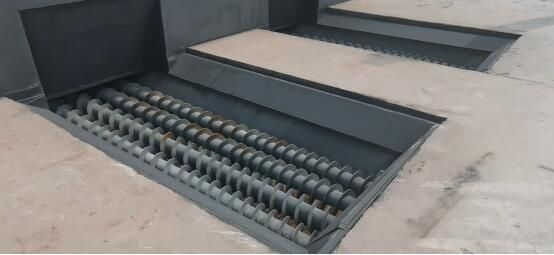
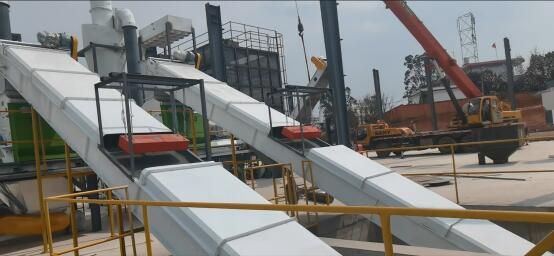
The line begins with two sets of four screw conveyors feeding raw wood chips from the receiving area to the hammer mill inlets. Screw conveyor sizing on this line accounts for wood chip bulk density, target feed rate, and the elevation change between the chip pile and the mill inlet throat.
Critical installation parameters:
- Belt/conveyor alignment: The conveyor must be level and straight. Lateral drift causes uneven feed distribution across the hammer mill width, producing inconsistent particle size downstream.
- Feed regulation: A hopper with adjustable gate controls the volume of chips entering the conveyor at any given time. Surging — bursts of oversized material — causes hammer mill overloads and downstream pellet quality variation.
- Distance and angle: Where elevation gain is required, screw pitch and rotational speed are recalculated to maintain rated capacity without material rollback.
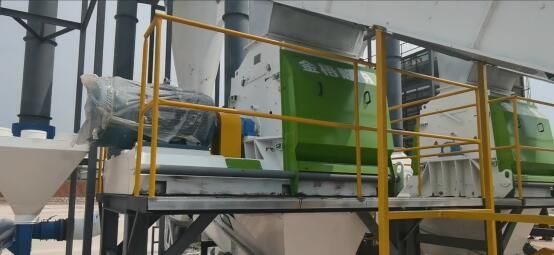
The line uses two 120T-model wood hammer mills operating in parallel. Each hammer mill uses a high-speed rotor fitted with hardened steel hammers to reduce incoming wood chips to a particle size suitable for ring die pelletizing — typically under 6 mm for standard 8 mm pellets. Hammer count, spacing, and screen aperture are selected based on the incoming chip size distribution and target output fineness. For this 12 t/h line, parallel operation ensures that scheduled hammer replacement on one unit does not interrupt production on the other.
For detailed specifications on Kingwood’s hammer mill range, see the FSP-series biomass wood hammer mill product page.
Stage 2 — Pelletizing: Four JWZL-688D Units in Parallel
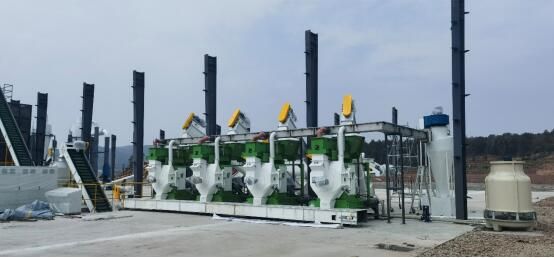
The size-reduced material moves to four JWZL-688D vertical biomass pellet mills, each rated at 3–3.5 t/h, for a combined line capacity of 12–14 t/h. Each unit is driven by a 200 kW servo motor, which provides the torque control precision needed to maintain consistent die pressure as feedstock moisture and particle size vary through a shift.
The JWZL-688D uses a vertical ring die configuration. In this geometry, rollers press material radially outward through the die channels under gravity-assisted feed. This design offers two practical advantages over horizontal ring die arrangements on high-moisture wood feedstocks:
- Reduced bridging risk — material distributes evenly around the die circumference under gravity, reducing the dry-spot channeling that occurs in horizontal dies when feed rate fluctuates.
- Extended die service life — the vertical load distribution reduces localized wear at the 6 o’clock position common in horizontal ring die pellet mills.
The JWZL-688D product page contains full mechanical specifications, die material options, and motor configurations.
Stage 3 — Classification and Cooling: Vibrating Sieve and Counter-Flow Cooler
Vibrating Sieve
Hot pellets exiting the JWZL-688D units pass immediately to a multi-deck vibrating sieve. The sieve operates at high frequency to classify the output stream into three fractions:
- Oversized — pellets exceeding target length, routed back to regrind.
- On-specification — correct diameter and length, passed forward to the cooler.
- Fines — dust and broken pellets, recirculated to the hammer mill inlet to minimize waste.
Screen deck configuration — aperture count and mesh size — is determined by the target pellet diameter (typically 6 mm or 8 mm) and the acceptable fines fraction for the end market.
Counter-Flow Cooler
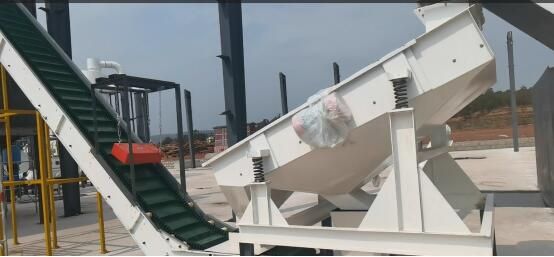
Freshly pelleted biomass exits the die at temperatures that can exceed 80 °C and carries residual moisture that must be reduced to below 15% before bulk storage or packaging — the threshold specified in both EU and ISO pellet quality standards. Without active cooling, pellet surfaces re-absorb atmospheric moisture, mechanical strength degrades, and the risk of exothermic decomposition in bulk storage increases.
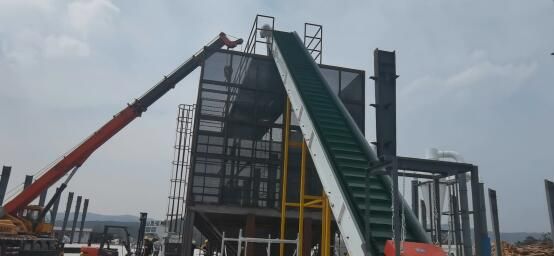
Kingwood’s counter-flow cooler draws ambient air upward through a descending bed of hot pellets. Because the coolest air contacts the coolest pellets at the discharge point, the temperature gradient across the cooler is maximized throughout the bed — more efficient than co-current designs where warm exhaust air contacts the already-cooling discharge fraction. The result is uniform pellet temperature and moisture at the cooler outlet, reducing the variation that causes packaging weight inconsistency.
The super-large finished product warehouse cooling arrangement shown above accommodates the 12 t/h continuous output, providing sufficient residence time for pellets to reach ambient-stable temperature and moisture before moving to the packaging line.
Configuring Capacity: From 12 t/h to 30 t/h and Beyond
The modular logic of a Kingwood production line means capacity is scaled by adding parallel process trains rather than replacing equipment. The same engineering sequence — conveying → hammer milling → pelletizing → sieving → cooling — applies whether the target is the 12 t/h Vietnam installation documented here or the 30 t/h line delivered in Chongqing, China in 2021. Complete lines can be engineered to annual capacities up to 200,000 tonnes per year.
All Kingwood production lines are designed under the Three-Standardization Framework — Integrated, Dust-Free, and Automated — which defines the build standard for every line regardless of scale. Dust-Free enclosed processing is standard on all new installations, as demonstrated in the Guizhou Dust-Free biomass pellet workshop project (2024).
Kingwood has planned and designed over 2,000 production line projects across 30 countries since its founding in 1999. Each custom line is backed by full-lifecycle services: consultation, engineering design, manufacture, logistics, installation, commissioning, operator training, and after-sales support.
For throughput requirements, raw material specifications, or site layout consultation, contact Kingwood’s engineering team directly.
FAQ
What equipment makes up a typical custom wood pellet production line?
A standard Kingwood wet-feed pellet production line integrates screw conveyors, hammer mills for size reduction, ring die or vertical pellet mills (such as the JWZL-688D), vibrating sieves for particle classification, and a counter-flow cooler for post-pelletizing temperature and moisture management. Exact configuration depends on throughput target, raw material moisture, and site constraints.
How is conveyor capacity determined for a custom line?
Conveyor sizing is driven by target throughput (tonnes per hour), feed material bulk density, and the distance between the feed point and the hammer mill inlet. Screw conveyor angle, diameter, and rotational speed are all adjusted to ensure consistent, regulated material flow without bridging or spillage.
Why are hammer mills critical in a biomass pellet line?
Hammer mills reduce incoming wood chips and sawdust to a uniform particle size required for efficient pelletizing. Particle size directly affects pellet density, die wear, and energy consumption. On a 12 t/h line, Kingwood typically deploys two 120T-model hammer mills operating in parallel to maintain throughput without bottlenecking the pellet mills downstream.
What is the JWZL-688D and when is it specified?
The JWZL-688D is Kingwood's vertical biomass pellet mill rated at 3–3.5 t/h per unit. On a 12 t/h line, four JWZL-688D units driven by 200 kW servo motors are deployed in parallel. The vertical ring die design reduces die-to-roller contact stress compared to horizontal configurations, extending die service life on abrasive feedstocks.
Why is pellet cooling essential before storage or packaging?
Freshly pelleted biomass exits the die at elevated temperature and can carry up to 10% residual moisture. Without active cooling, pellets absorb atmospheric moisture, degrade mechanically, and risk spontaneous heating in storage. A counter-flow cooler draws ambient air counter to pellet flow, reducing temperature and moisture simultaneously to meet the <15% moisture threshold required by EU and ISO standards.
What vibrating sieve configuration is used in Kingwood lines?
Kingwood installs multi-deck vibrating sieves downstream of the cooler to remove oversized fines and undersized particles. Only on-spec pellets — meeting target diameter and length — advance to packaging. Reject fractions are typically recirculated to the hammer mill inlet, eliminating waste.
What payback period can a 12 t/h wood pellet line achieve?
A documented Kingwood 12 t/h installation in Vietnam (2024) achieved investment payback in 23 months. Biomass pellets as a fuel source reduce operating energy costs by 40–50% versus fossil fuel alternatives, which is the primary driver of rapid payback at commercial scale.
- A Kingwood 12 t/h wood pellet production line installed in Vietnam in 2024 achieved full investment payback in 23 months. (2024, Kingwood project case record: vietnam-wood-pellet-line-12-tph-kingwood-payback)
- Biomass pellets produced on Kingwood lines deliver a calorific value of 4,800 kcal/kg with moisture content below 15% and sulfur content below 0.3%, meeting EU, ISO, and China GB standards. (2025, Kingwood product specification sheet, Jiangsu Kingwood Industrial Co., Ltd.)