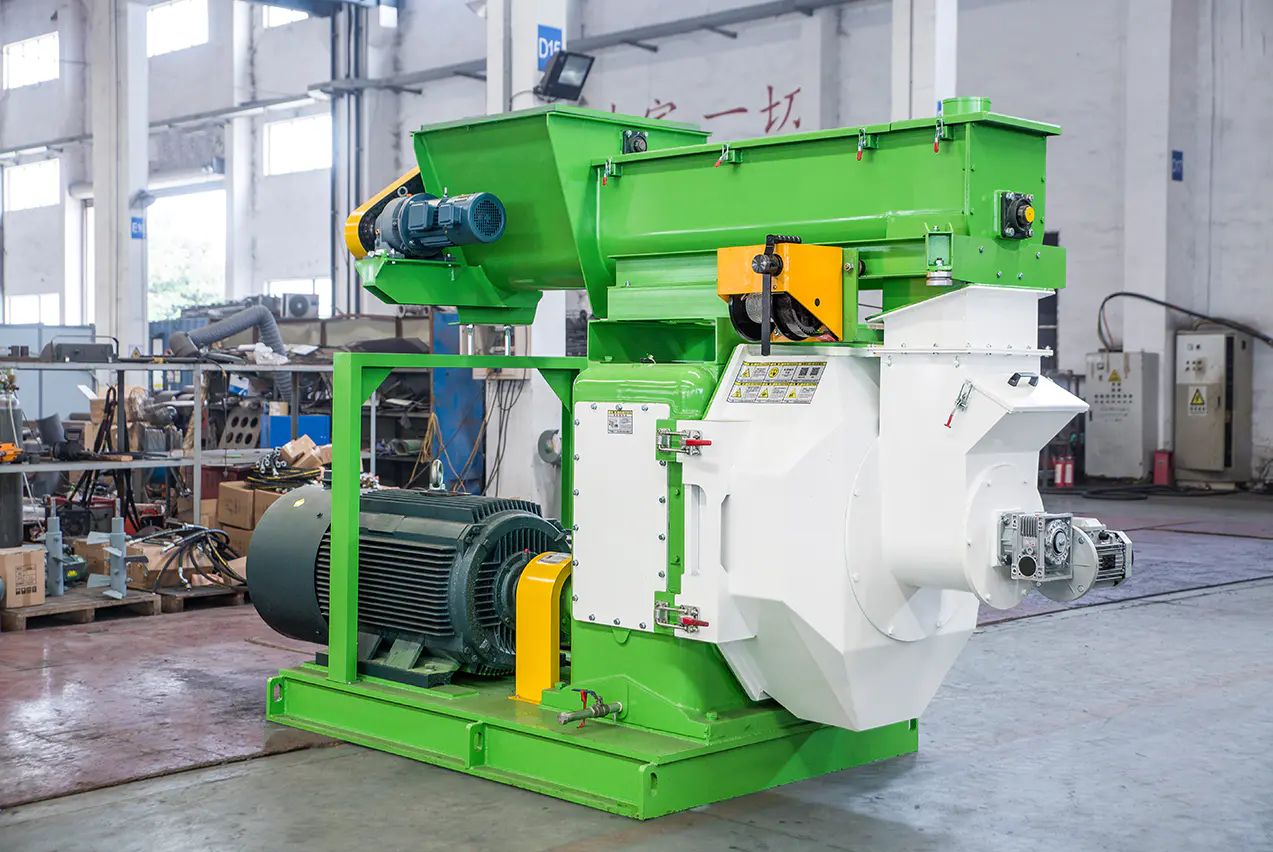
Industrial Ring Die Wood Pellet Mill — JWZL-688
Capacity: 2-2.3 t/h
JWZL-688 Vertical Ring Die Pellet Mill — Technical Overview
The Kingwood JWZL-688 is a vertical biomass pellet mill engineered for continuous industrial wood pellet production at 2–2.3 metric tons per hour. Its core pelletizing mechanism is a rotating annular die manufactured from high-alloy steel, paired with a pressure roller assembly that forces conditioned biomass through precision-machined die apertures to produce dense, cylindrical pellets of uniform geometry and consistent bulk density.
The vertical drive architecture reduces horizontal footprint relative to conventional horizontal ring die layouts, simplifying integration into space-constrained processing buildings without sacrificing throughput. The die-to-roller gap is field-adjustable to accommodate variation in raw material bulk density and fiber structure, maintaining pellet hardness targets across different feedstock batches — a practical requirement when sourcing biomass from multiple suppliers or seasonal wood waste streams.
All structural and load-bearing components are specified for continuous duty cycles. The lubrication system is designed around scheduled maintenance intervals rather than reactive servicing, directly supporting two- and three-shift industrial production schedules where unplanned downtime carries significant commercial cost.
Complete Wet-Feed Production Line Integration
At industrial output scale, pellet quality and throughput consistency depend on upstream and downstream equipment operating within tightly controlled parameters. The JWZL-688 is designed as the pelletizing core of a complete wet-feed biomass pellet production line — a system architecture that processes high-moisture raw biomass from intake through to packaged, shipment-grade pellet output.
Upstream processing sequence:
- Drum chipper — reduces oversized wood logs, branches, or slabs to chip-sized material suitable for hammer mill feed
- Hammer mill (coarse pass) — grinds chips to uniform particle size distribution required for consistent die fill
- Drum dryer — reduces feedstock moisture to below 15%, meeting the threshold required by EU biomass standards and ISO pellet quality specifications
- Hammer mill (fine pass) — conditions dried material to the fiber fineness that produces cohesive, binder-free pellets
Downstream processing sequence:
- Counter-flow cooler — reduces freshly extruded pellet temperature and surface moisture, hardening pellets for mechanical handling and bulk transport
- Screening — removes fines and oversized material to ensure uniform, shipment-grade pellet size distribution
- Pellet packaging machine — automated bagging for bulk bag or retail sack formats
Complete lines built around the JWZL-688 are engineered under Kingwood’s Three-Standardization Framework: fully Integrated (single control architecture spanning all equipment), Dust-Free (enclosed processing with active extraction at every material transfer point), and Automated (continuous operation with minimal manual intervention at steady state). This framework directly addresses the two most prevalent failure modes in biomass pellet operations — fugitive dust accumulation creating fire and health hazards, and inter-equipment throughput mismatch causing bottlenecks and pellet quality variation.
For operations requiring higher capacity, Kingwood’s JWZL-928 and JWZL-1068 pellet mills deliver 4–5 t/h and above. Complete turnkey lines scale to 200,000 metric tons per year of pellet output capacity.
Biomass Pellet Quality and Fuel Performance
Pellets produced on JWZL-688 lines are verified against the following fuel quality parameters:
| Parameter | Kingwood Specification | Reference Standard |
|---|---|---|
| Calorific value | 4,800 kcal/kg | — |
| Moisture content | <15% | EU biomass standard |
| Sulfur content | <0.3% | Japan standard (≤0.5%) |
| Ash content | <18% | ISO standard (<20%) |
| Dioxin content | <0.5 ng-TEQ | China GB (≤1.0 ng-TEQ) |
All emission indicators from boilers burning Kingwood-produced pellets test below GB13271-2001, China’s national Emission Standard of Air Pollutants for Boilers. Industrial operators transitioning from coal or heavy fuel oil to Kingwood biomass pellets consistently report fuel cost reductions of 40–50%, driven by both the pellet’s calorific density and the elimination of fuel handling surcharges associated with liquid fossil fuels.
These specifications are directly relevant for procurement and compliance teams evaluating Japanese import requirements, EU Renewable Energy Directive fuel quality thresholds, or South Korean RPS biomass certification criteria — three of the largest destination markets for internationally traded industrial wood pellets.
Deployment Context and Target Applications
The JWZL-688 is sized for mid-scale industrial operators: dedicated pellet fuel manufacturers supplying regional industrial boilers, biomass co-firing plants requiring supplementary on-site fuel production capacity, and integrated wood processing facilities converting sawmill residues or furniture manufacturing waste into a commercial fuel product.
Primary end-use applications for pellets produced at this throughput level include:
- Industrial thermal energy — boiler fuel for district heating plants, food processing facilities, and textile or paper mills displacing coal
- Power generation co-firing — supplementary biomass fuel for grid-connected power stations operating under renewable portfolio obligations
- Export commodity supply — ENplus or equivalent grade pellets for international bulk fuel markets
Kingwood has commissioned operational pellet production systems across more than 30 countries. Verified reference projects include a 24 t/h wood chip pellet production line in Vietnam (2023) and a 12 t/h line in Vietnam (2024) that achieved full capital payback within 23 months — both demonstrating the commercial return profile of Kingwood-engineered systems at scale.
Jiangsu Kingwood Industrial Co., Ltd. (NEEQ: 871765) operates from a 31,200 m² facility at Liyang Zhongguancun Industrial Park, Jiangsu Province, China. Founded in 1999, the company holds ISO 9001, ISO 14001, and CE certifications and maintains a dedicated R&D team of 20 specialists across 27 years of biomass pellet equipment development.
FAQ
What is the rated output capacity of the JWZL-688 pellet mill?
The JWZL-688 produces 2–2.3 metric tons of biomass pellets per hour under standard operating conditions.
What feedstocks can the JWZL-688 process?
The JWZL-688 handles wood chips, sawdust, agricultural residues, and other lignocellulosic biomass materials conditioned to the correct moisture specification for pelletization.
What moisture content is required for feedstock entering the pellet mill?
Feedstock moisture must be reduced below 15% prior to pelletizing, consistent with EU and ISO biomass fuel standards. Kingwood's integrated drum dryer manages upstream moisture reduction within the complete wet-feed line.
Does the JWZL-688 meet international emission and quality standards?
Pellets produced on Kingwood equipment comply with GB13271-2001 boiler emission standards and meet EU (<15% moisture), ISO (<20% ash), and Japan (≤0.5% sulfur) biomass fuel benchmarks.
What does Kingwood's Three-Standardization Framework mean for a JWZL-688 production line?
The Three-Standardization Framework integrates three operational pillars — Integrated, Dust-Free, and Automated production lines — into a single cohesive system, eliminating fugitive dust, reducing inter-equipment throughput mismatch, and enabling continuous unattended operation.
How does ring die pelletizing differ from flat die pelletizing at industrial scale?
A ring die configuration applies centrifugal roller pressure uniformly across a rotating annular die, producing consistent pellet density and geometry at high throughput. This architecture scales more reliably than flat die systems for continuous industrial production above 1 t/h.
What auxiliary equipment is required upstream and downstream of the JWZL-688?
A complete wet-feed line typically includes a drum chipper, hammer mill, drum dryer, counter-flow cooler, and pellet packaging machine — all available from Kingwood as an integrated turnkey system.