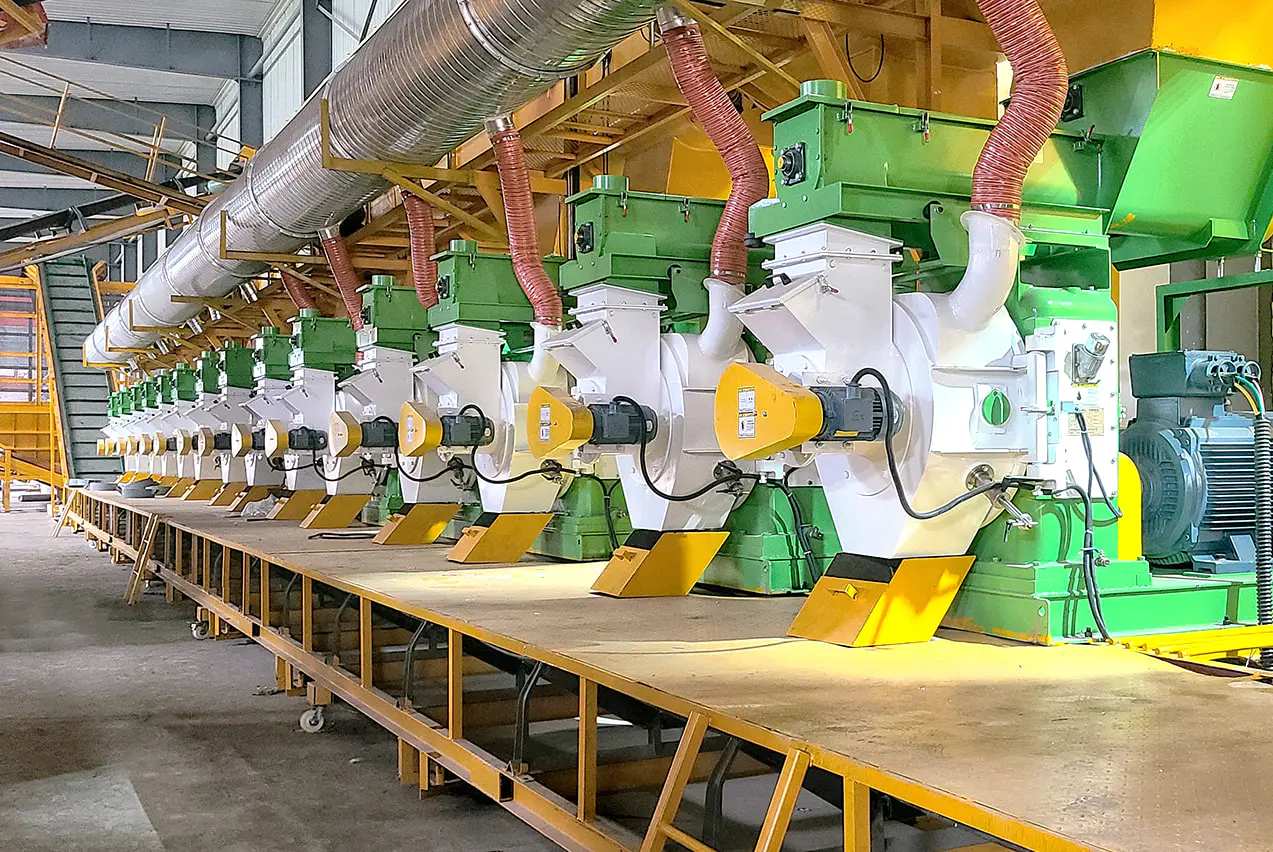
30 TPH Wood Pellet Mill in Chongqing, China — 2021
China · 2021
Background and Project Context
Commissioned in September 2021 — during a period of significant logistical disruption — this Chongqing biomass pellet facility stands as one of the largest wood pellet mill installations in mainland China by single-line throughput. Operating at 30 tonnes per hour, the line converts furniture manufacturing residues into industrial-grade biomass pellets delivered to boiler operators across the Chongqing municipality.
Chongqing is one of China’s four direct-controlled municipalities and a major hub for furniture manufacturing, generating substantial volumes of wood chips and sawdust as process byproducts. Prior to this installation, much of that residue was landfilled or incinerated without energy recovery — a disposal cost that the client was motivated to eliminate. By converting these residues into standardised biomass fuel, the facility generates a revenue stream from what was previously a waste liability.
The project reflects a broader policy direction in China’s industrial energy sector. National guidance under the 14th Five-Year Plan has accelerated the substitution of coal with compliant biomass fuel in industrial boiler applications, particularly in urban municipalities subject to tightened air quality enforcement. Chongqing’s local government has been active in this transition, providing a stable regulatory environment for biomass pellet offtakers operating coal-to-biomass switching programmes.
Kingwood supplied the core pelletizing equipment for this project. The customer’s own engineering team took responsibility for upstream and downstream process design, integrating Kingwood’s machinery into a broader site-specific production layout. This delivery model suits large industrial operators with established engineering departments who require proven, high-capacity pellet mill hardware without a full turnkey scope. For operators seeking a more comprehensive solution, Kingwood’s complete biomass pellet production lines are also available with integrated pre-processing and handling equipment.
Equipment Configuration
The Chongqing line was built around Kingwood’s ring die pellet mill technology, selected for its suitability to high-load, extended-cycle industrial operation. Ring die configurations deliver the compression geometry and die-wear characteristics needed to sustain continuous throughput at the 30 TPH scale — performance that flat-die designs cannot reliably replicate at this capacity level.
Kingwood’s pellet mill product range scales from 1 TPH entry-level units such as the JWZL-420 through to high-capacity configurations including the JWZL-688, JWZL-688D, JWZL-928, and JWZL-1068. The Chongqing project required equipment from the upper end of this range to achieve the target throughput. Multiple ring die pellet mills operating in parallel allow the facility to reach 30 TPH aggregate output while maintaining redundancy — if one unit requires a scheduled die change or roller inspection, remaining units sustain partial production rather than causing a full line stoppage.
Feedstock conditioning ahead of the pellet mills is critical at this scale. Furniture-grade wood chips and sawdust arrive with variable moisture content depending on production schedules at the supplying factories. The customer’s process team integrated a drum dryer upstream of the pelletizing stage to reduce feedstock moisture to the sub-15% range required for stable die operation and compliant pellet quality. A hammer mill stage reduces oversized chip fractions to a particle size compatible with the ring die geometry, ensuring consistent feed bulk density across the pellet mill infeed.
Downstream of the pellet mills, a counter-flow cooler reduces pellet temperature and residual moisture before conveying to storage. Counter-flow cooling is the preferred configuration at industrial throughput rates because it achieves uniform pellet hardness and minimises fines generation during subsequent handling and bulk transport — both factors that affect delivered quality and customer satisfaction among boiler operators.
The integrated process — hammer mill, drum dryer, ring die pellet mills, counter-flow cooler — reflects the standard industrial biomass pellet production architecture that Kingwood has refined across multiple large-scale installations. The customer’s engineering team interfaced with this equipment package at defined boundary points, taking responsibility for site civils, electrical infrastructure, and bulk material handling conveyors.
Commissioning and Performance Results
The facility reached commissioned status in September 2021 and achieved its 30 TPH throughput target within the initial operational period. Commissioning during 2021 presented logistical challenges common to that year — extended lead times for certain components and travel restrictions affecting commissioning personnel — which the project team managed through pre-shipment factory acceptance testing and remote technical support protocols.
Pellet quality at steady-state operation meets the following parameters, consistent with Kingwood’s standard biomass pellet specification:
- Calorific value: ~4,800 kcal/kg
- Moisture content: <15%
- Sulfur content: <0.3%
- Ash content: <18%
- Dioxin content: <0.5 ng TEQ
All emission indicators comply with China’s GB13271-2001 national standard for boiler air pollutants — a prerequisite for supply contracts with industrial boiler operators subject to environmental compliance audits. The ISO 17225-2 standard for graded wood pellets establishes comparable moisture and ash benchmarks at the international level, confirming that the Chongqing pellets meet quality thresholds recognised across export markets should the operator seek to diversify offtake in future.
The pellets are distributed to industrial boilers throughout Chongqing, where they serve as a cost-effective alternative to coal and heavy fuel oil. According to IEA Bioenergy reporting on industrial biomass heat applications, operators switching from fossil fuels to compliant biomass pellets in the Chinese industrial boiler segment typically achieve fuel cost reductions of 40–50%, depending on local energy pricing and the specific fossil fuel being displaced. At 30 TPH and assuming standard operational hours, annual pellet output exceeds 200,000 tonnes — a volume sufficient to supply a significant cluster of mid-scale industrial boiler installations within the municipality.
Lessons and Takeaways
The Chongqing project demonstrates several principles relevant to procurement engineers evaluating large-scale biomass pellet mill investments in China or comparable markets.
Feedstock concentration enables quality control. Drawing exclusively from furniture manufacturing residues — wood chips and sawdust — rather than mixed forestry or agricultural biomass gives the operator predictable feedstock chemistry. Furniture-grade wood residues carry low bark and resin contamination compared to forestry slash or construction demolition waste, which translates to cleaner combustion and lower ash content in the finished pellet. Procurement teams specifying equipment for new facilities should prioritise feedstock supply chain analysis before finalising die specification and dryer sizing.
Equipment scope separation works at scale. The decision to purchase Kingwood’s pellet mill equipment as a defined hardware package — rather than a full turnkey installation — allowed the customer to leverage their own engineering capability and site knowledge while still accessing industrial-grade ring die pellet mill technology. This model is appropriate where the operator has an established engineering department and wishes to retain control over civil and electrical design. Operators without this internal resource should consider Kingwood’s complete line offering, which includes pre-processing, pelletizing, and post-processing equipment under unified technical responsibility.
Redundancy planning protects throughput. At 30 TPH aggregate capacity, distributing load across multiple ring die pellet mill units rather than a single large machine provides meaningful operational resilience. Scheduled maintenance events — die changes, roller replacements — can be absorbed without full production stoppage, protecting offtake commitments to boiler customers who depend on consistent pellet supply.
Regulatory alignment is a commercial prerequisite. Compliance with GB13271-2001 is not optional for operators supplying industrial boiler customers in Chinese municipalities: it is a condition of supply contracts and a requirement for ongoing environmental audit clearance. Specifying equipment and process conditions that reliably deliver compliant pellet emission profiles from the outset avoids costly retrofits and potential supply contract penalties.
Kingwood operates under its Three-Standardization Framework — standardised design, standardised manufacturing, and standardised service — which underpins the repeatability of performance outcomes across installations of this type. The company is listed on China’s National Equities Exchange and Quotations market under stock code 871765 (NEEQ), providing publicly accessible financial transparency relevant to procurement due diligence. For comparable large-scale project references, see the related case study index for industrial biomass pellet installations.
Sources
- IEA Bioenergy — Industrial Biomass Heat Applications and Fuel Switching Economics, Task 32 reporting series
- ISO 17225-2:2021 — Solid biofuels — Fuel specifications and classes — Part 2: Graded wood pellets
- China National Standard GB13271-2001 — Emission Standard of Air Pollutants for Boilers