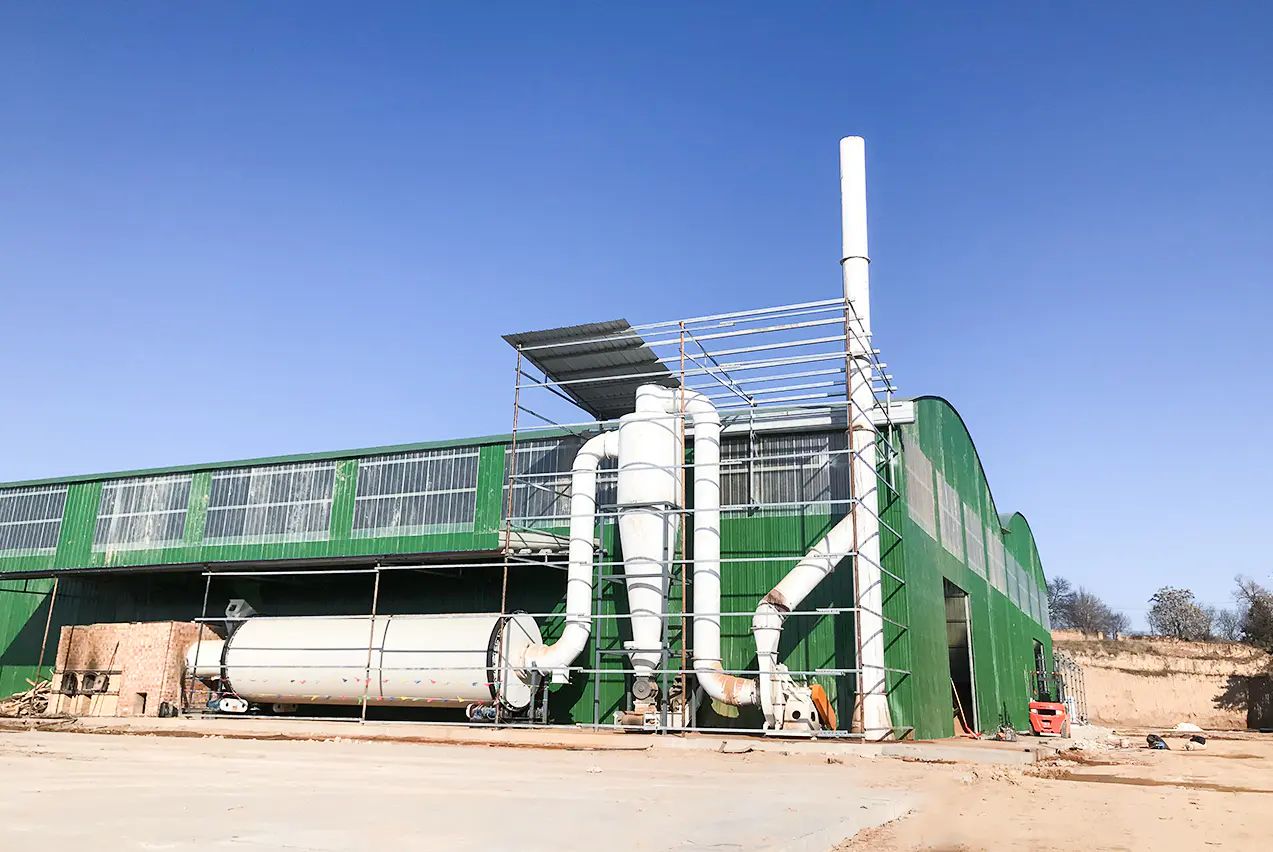
Industrial Drum Dryer for Biomass Pellet Production Lines
Role of the Drum Dryer in Wet-Feed Biomass Pellet Production
Moisture control is the most consequential variable in biomass pellet manufacturing. Feedstocks arriving at a pellet plant—whether fresh wood chips from a forest operation, sawdust from a sawmill, or agricultural residues such as corn stover or bagasse—commonly carry moisture content in the 35–50% range. Ring die pellet mills require feedstock at substantially lower moisture to achieve stable pellet formation and target density.
Kingwood’s drum dryer addresses this gap as a dedicated drying stage within the company’s wet-feed pellet production line architecture. The sequence is: crushing → coarse grinding → drum drying → fine grinding → pelletizing → packaging. Material is conveyed from the coarse grinder into the rotating drum, where continuous contact with the heated drum surface and controlled hot-air circulation progressively reduces moisture to process-ready levels. The drum’s rotation ensures uniform exposure of all particles, preventing the localized overdrying or underdrying that undermines pellet quality downstream.
This continuous-operation design distinguishes drum drying from batch or static-bed alternatives. For industrial-scale lines—particularly those processing wet residues such as bagasse or freshly chipped wood—uninterrupted throughput is essential to production economics. The drum dryer delivers that continuity.
Compatible Feedstocks and Application Range
Kingwood’s drum dryer is validated across a range of biomass feedstocks encountered in commercial pellet production:
Wood chips and sawdust are the primary feedstocks in wood pellet manufacturing. Both materials enter the drying stage at high and variable moisture levels depending on season, origin, and storage conditions. The drum dryer handles this variability reliably, producing consistent outlet moisture regardless of inlet fluctuation within the design range.
Corn stover—leaves and stalks remaining after corn harvest—is an established feedstock for agricultural biomass pellets used in animal bedding, soil amendment, and industrial fuel applications. Drum drying preserves the fibrous structure of corn stover while removing the moisture that would otherwise cause microbial degradation during storage.
Bagasse, the fibrous residue from sugarcane juice extraction, is abundant in tropical sugar-producing regions and carries high initial moisture. The drum dryer’s capacity to process high-moisture, fibrous materials makes it well suited to bagasse drying for biofuel and paper-feedstock applications.
Algae biomass, while a less conventional feedstock, is processed through drum drying for nutraceutical, fertilizer, and emerging biofuel applications. Precise temperature control within the drum is critical here to preserve thermally sensitive compounds, a parameter addressed in Kingwood’s engineering configuration for algae-specific lines.
For detailed feedstock-to-pellet line configurations, see Kingwood’s complete wet-feed biomass pellet production line page.
Engineering Design and Production Line Integration
The drum dryer is engineered to recover and utilize available heat from adjacent process equipment—hot air or flue gas streams that would otherwise be exhausted as waste. This heat-recovery approach reduces the dryer’s direct fuel demand and contributes to the overall energy efficiency of the production line. For operators targeting a 40–50% cost reduction versus fossil fuel inputs—a benchmark achievable with Kingwood’s biomass fuel specifications—minimizing energy consumption at the drying stage is a material factor in the economics.
Kingwood’s Three-Standardization Framework governs equipment design across all product lines: Integrated, Dust-Free, and Automated production. The drum dryer conforms to the Dust-Free pillar through enclosed material handling at both the inlet and outlet transitions, and integration with the line’s centralized dust removal system. This design approach is substantiated by Kingwood’s 2024 Guizhou installation, where a fully Dust-Free biomass pellet workshop was commissioned, and by Beijing’s first biomass pellet demonstration project, also completed in 2024.
Complete line capacity in Kingwood’s engineering portfolio reaches up to 200,000 metric tons per year. Drum dryer specifications—drum diameter, retention time, airflow volume, and heat source configuration—are scaled to the line’s target throughput and adapted to local feedstock moisture profiles and available energy sources.
Kingwood has planned and designed over 2,000 production line projects across 30 countries. Engineering support for drum dryer installations includes process layout, equipment commissioning, operator training, and ongoing spare-parts provision. International references include a 24 t/h wood chip pellet line in Vietnam (2023) and a 30 t/h installation in Chongqing, China (2021), both of which incorporate drum drying as a standard production stage.
For equipment specifications, throughput requirements, or feedstock-specific engineering consultation, contact Kingwood’s technical sales team directly.
FAQ
What moisture range does Kingwood's drum dryer handle at the inlet?
The drum dryer is designed to receive crushed biomass feedstock at approximately 35–50% moisture content, delivered by conveyor from the upstream hammer mill or chipper stage. It reduces that moisture to the level required for fine grinding and pelletizing.
Which biomass feedstocks are compatible with this drum dryer?
The unit is validated for wood chips, sawdust, corn stover, bagasse, and algae biomass. It is routinely deployed in Kingwood's wet-feed pellet production lines handling wood-origin and agricultural-residue feedstocks.
How does the drum dryer integrate into a complete Kingwood pellet production line?
In Kingwood's wet-feed line sequence—crushing, coarse grinding, drying, fine grinding, pelletizing, and packaging—the drum dryer sits between the coarse grinder and the fine grinder. Material enters at high moisture and exits at a moisture level suitable for ring die pellet mill operation.
What is the energy source for the drum dryer?
The drum dryer is engineered to utilize recovered heat sources, including hot air or flue gas from adjacent process equipment. This heat-recovery configuration reduces direct fuel consumption and supports the overall energy efficiency of the production line.
How does drum drying compare to other drying methods for industrial biomass processing?
Drum dryers operate continuously, enabling high-throughput processing without batch interruptions. The rotating drum ensures uniform heat exposure across all particles, preventing localized over-drying or under-drying. For high-moisture materials such as bagasse or fresh sawdust, drum drying outperforms static-bed or flash-drying alternatives in throughput stability and product consistency.
Does the drum dryer comply with Kingwood's Dust-Free production line standard?
Kingwood's Three-Standardization Framework requires all production line components—including the drum dryer—to conform to the Dust-Free pillar. The dryer is integrated with enclosed material transport and the line's centralized dust removal system, minimizing fugitive dust at the drying stage.
What after-sale and engineering support does Kingwood provide for drum dryer installations?
Kingwood provides full engineering support: process layout design, equipment commissioning, operator training, and spare-parts supply. The company has planned and designed over 2,000 production line projects across 30 countries and can adapt drum dryer specifications to site-specific feedstock, throughput, and energy supply conditions.