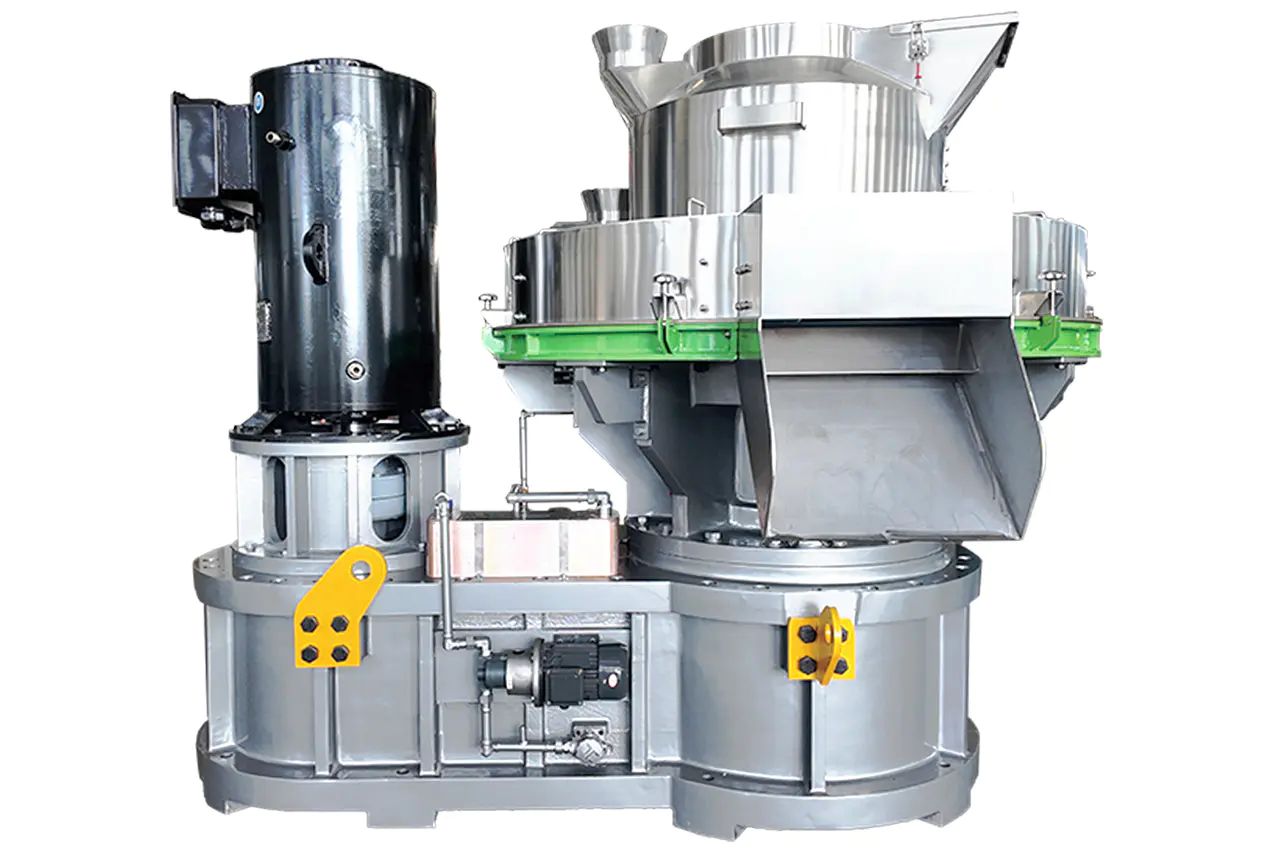
JWZL-1068 Vertical Biomass Pellet Mill — Technical Overview
JWZL-1068 Technical Specifications
The JWZL-1068 is Kingwood’s highest-output vertical biomass pellet mill in the JWZL series. Built for continuous industrial-scale operation, it centers on a 500 kW, 8-pole main drive motor and a dual ring die assembly to sustain throughput of 6–8 metric tons per hour across a wide range of biomass feedstocks.
| Parameter | Specification |
|---|---|
| Main Motor Power | 500 kW — 8P |
| Material Shifting Motor | 3 kW |
| Cooling Oil Pump | 1.5 kW |
| Pneumatic Grease System | YGP-A |
| Reduction Gearbox | JWKJ680-500-8.8 |
| Gear Oil Grade | L-CKC220 |
| Ring Die | 1068 mm × 76 mm × 2 |
| Roller Shell | 428 mm × 81 mm × 3 |
| Rated Capacity | 6–8 t/h |
| Machine Dimensions (operating) | 3,500 × 2,300 × 2,500 mm |
| Machine Dimensions (transport) | 5,080 × 1,965 × 3,460 mm |
| Machine Weight | 18 t |
| Pellet Formation Rate | ≥97% |
| Pellet Pulverization Rate | ≤3% |
| Noise Level | ≤93 dB(A) |
For buyers evaluating options across the JWZL range, the JWZL-1068 sits above the JWZL-928 (4–5 t/h) and is the correct choice for operators requiring maximum single-unit throughput within a vertical ring die configuration.
Drive System and Structural Engineering
The mechanical architecture of the JWZL-1068 is built around long service intervals and minimal unplanned downtime — two operational priorities that directly govern line economics in industrial biomass fuel production.
Gearbox and gear train. The JWKJ680-500-8.8 reduction gearbox is base-mounted to lower the machine’s center of gravity and reduce vibration transfer to the frame. Gear blanks are forged from 20CrMnTi alloy steel and finished with precision-ground hard-tooth surfaces, delivering high contact fatigue resistance and low-noise power transmission under sustained load.
Motor selection. The 8-pole, 500 kW motor runs at lower rotational speed than a comparable 4-pole unit, producing higher torque at the input shaft while generating less heat per operating cycle. Reduced thermal loading extends winding life and decreases the frequency of motor-related interventions. An optional permanent magnet servo motor configuration reduces energy consumption by 10–15% against standard induction motor equivalents — a measurable operational saving on lines running two or three shifts daily.
Power coupling. Motor-to-gearbox power transmission uses a compensating nylon pin coupling that absorbs minor shaft misalignment and torsional shock loads during startup and load transitions, protecting both motor and gearbox bearings from accelerated wear.
Sealing. Imported fluororubber oil seals are specified at all critical lubrication points. Compared to standard nitrile seals, fluororubber provides materially superior resistance to petroleum-based gear oil and the fine biomass dust present in active pellet mill environments.
Feeding, Pelletizing, and Discharge Mechanics
Feeding system. Biomass enters from the top of the machine and passes through an integrated material distributor before reaching the ring die. Top-down gravity feeding combined with active distribution ensures consistent cross-sectional coverage of the die surface — a direct determinant of pellet density uniformity and die wear pattern. The distributor geometry handles feedstocks ranging from fine sawdust to coarser agricultural residues without mechanical changeover.
Ring die configuration. The dual ring die assembly (1068 mm × 76 mm × 2) and three-roller configuration (428 mm × 81 mm × 3) are the primary pelletizing components. Vertical installation of both die and rollers allows maintenance technicians to access, inspect, and replace components without the overhead lift requirements associated with horizontal configurations, reducing maintenance window duration at scale.
Discharge. A lower rotary support discharge mechanism provides stable, continuous pellet exit from the die chamber and is designed for part disassembly during die or roller replacement without requiring full machine teardown.
Thermal Management and Condition Monitoring
Sustained high-throughput operation depends on active thermal control. The JWZL-1068 addresses this through two parallel systems.
Oil cooling circuit. A water-cooled oil heat exchanger combined with a dedicated external oil cooling loop maintains gearbox oil temperature within the operating range of L-CKC220 gear oil across extended production runs. Uncontrolled oil temperature rise is a primary driver of gear surface fatigue; the dual-cooling architecture directly mitigates this failure mode.
Intelligent monitoring. Real-time sensors log temperatures at motor windings, gearbox bearings, and main shaft bearing seats, alongside main shaft lubrication pressure and flow status. Monitoring data feeds into the machine’s control interface, enabling operators to identify developing anomalies — abnormal bearing temperature rise, lubrication dropout — before they escalate to unplanned production stops.
This monitoring architecture is consistent with Kingwood’s Three-Standardization Framework pillar of Automated production lines, in which continuous sensor feedback reduces dependence on scheduled manual inspection intervals.
Integration into Complete Biomass Pellet Production Lines
The JWZL-1068 is engineered for integration into complete wet-feed biomass pellet production lines capable of processing up to 200,000 metric tons per year. In a full line configuration, the pellet mill operates downstream of drum drying and fine grinding stages and upstream of counter-flow cooling and packaging. Kingwood supplies all auxiliary equipment — hammer mill, drum chipper, drum dryer, counter-flow cooler — as integrated components engineered to the same throughput envelope, eliminating interface bottlenecks common in mixed-vendor line assemblies.
For reference on operational economics at comparable throughput levels, the Vietnam 12 t/h wood pellet line case study documents full capital payback within 23 months of commissioning on a Kingwood-supplied line.
Contact Kingwood sales for capacity confirmation, feedstock-specific ring die specification, and complete line engineering documentation for the JWZL-1068.
FAQ
What is the rated output capacity of the JWZL-1068?
The JWZL-1068 delivers 6–8 metric tons per hour under standard operating conditions, making it suitable for large-scale biomass pellet production lines.
What ring die dimensions does the JWZL-1068 use?
The machine is fitted with a dual ring die configuration measuring 1068 mm × 76 mm × 2, paired with three roller shells at 428 mm × 81 mm each.
How does the JWZL-1068 reduce energy consumption?
A permanent magnet servo motor reduces energy consumption by 10–15% compared to conventional induction motors of equivalent power class.
What pellet quality metrics does the JWZL-1068 achieve?
The JWZL-1068 achieves a pellet formation rate of ≥97% and a pulverization rate of ≤3%, meeting industrial biomass fuel quality thresholds.
What gearbox and lubrication system does the JWZL-1068 use?
The unit uses a JWKJ680-500-8.8 reduction gearbox lubricated with L-CKC220 gear oil, with an external water-cooled oil heat exchanger maintaining thermal stability during continuous operation.
How is temperature managed on the JWZL-1068 during operation?
Intelligent monitoring tracks real-time temperatures at bearings, gears, and the main motor, while main shaft lubrication status is continuously logged to prevent thermal failures.
What material feeding mechanism does the JWZL-1068 use?
A top-down gravity feed with an integrated distributor ensures even, consistent biomass flow across the ring die surface, accommodating varying raw material types and moisture profiles.