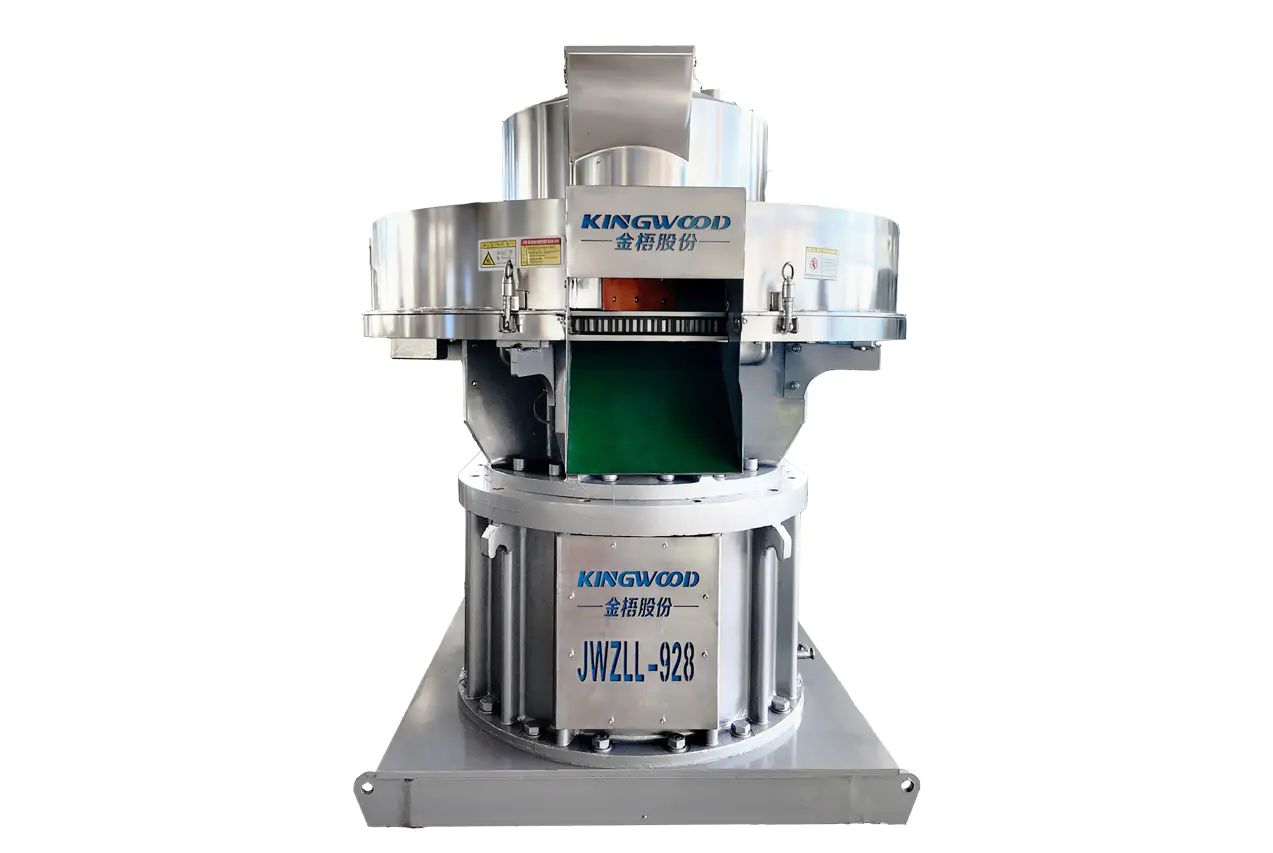
JWZL-928 Vertical Biomass Pellet Mill | Kingwood
JWZL-928 Technical Specifications
The JWZL-928 is the largest vertical ring die pellet mill in Kingwood’s standard JWZL series, rated at 6–8 t/h and engineered for continuous-duty industrial biomass pellet production. Full technical parameters are listed below.
| Parameter | Specification |
|---|---|
| Main Motor Power | 315KW – 8-pole |
| Material Shifting Motor | 3KW |
| Cooling Oil Pump | 1.5KW |
| Pneumatic Grease System | YGP-A |
| Reduction Gearbox | JWKJ600-315-8.8 |
| Gear Oil Grade | L-CKC220 |
| Ring Die | 928mm × 76mm × 2 |
| Roller Shell | 372mm × 81mm × 3 |
| Capacity | 6–8 t/h |
| Machine Dimensions | 3,500mm × 2,300mm × 2,500mm |
| Base Footprint | 3,100mm × 2,080mm × 2,350mm |
| Machine Weight | 18 metric tons |
| Pellet Formation Rate | ≥97% |
| Pellet Pulverization Rate | ≤3% |
| Noise Level | ≤93 dB(A) |
At 18 metric tons, the JWZL-928 is designed for permanent installation within an enclosed, dust-managed facility — consistent with Kingwood’s Three-Standardization Framework, which mandates integrated, dust-free, and automated configurations across all production line designs.
Drive System, Structural Design, and Mechanical Reliability
The JWZL-928 is built for long-interval operation with minimal unplanned downtime. Several interdependent mechanical design decisions support that objective.
Gearbox and gear train. The base-mounted JWKJ600-315-8.8 reduction gearbox positions the drivetrain at a low center of gravity, limiting vibration transmission to the ring die assembly. All gears are forged from 20CrMnTi alloy steel and finished with precision-ground hard-tooth surfaces — a material and process combination suited to high-load, continuous-duty operation while keeping transmission noise within the ≤93 dB(A) ceiling.
Motor configuration. The 315KW 8-pole motor delivers high torque at low rotational speed. Relative to higher-speed motor configurations, this design generates less heat per unit of torque, directly extending winding and bearing service intervals. The motor connects to the gearbox via a compensating nylon pin coupling, which absorbs minor shaft misalignment and mechanical shock loads before they reach the gearbox input shaft.
Sealing. All critical rotating interfaces use imported fluororubber oil seals, selected for resistance to both L-CKC220 petroleum-based lubricants and the elevated interface temperatures common at the ring die.
Thermal management. A water-cooled oil heat exchanger, supported by a dedicated external cooling circuit, keeps gearbox oil temperature within the rated operating range of L-CKC220 regardless of ambient conditions. This is most critical during extended multi-shift production runs where heat accumulation without active cooling would degrade oil viscosity and accelerate gear wear.
Feeding System, Intelligent Monitoring, and Operational Control
Feeding system. The JWZL-928 uses top-down gravity feed with a mechanical distributor that spreads incoming material uniformly across the ring die surface. At 6–8 t/h throughput, uneven distribution creates differential roller shell wear and pellet density inconsistency. The distributor handles mixed-moisture or mixed-species biomass feedstocks without requiring manual reconfiguration between batches — a practical advantage for facilities processing variable raw material supply.
Intelligent monitoring. Real-time sensors continuously track temperature at the main motor windings, gearbox bearings, and ring die bearing housings. Main shaft lubrication status is also monitored in real time. When any parameter approaches a configured threshold, the control system flags the condition before failure occurs — eliminating dependence on scheduled manual inspection as the primary safeguard in multi-shift operations.
Discharge system. The lower rotary support discharge mechanism delivers consistent pellet exit flow and is designed for component-level serviceability. Roller shells and discharge components can be replaced without removing the full lower assembly from the machine frame, reducing labor hours for scheduled wear-part replacement.
Energy efficiency. The optional permanent magnet servo motor reduces energy draw by 10–15% relative to a standard induction motor at equivalent output. Across 6–8 t/h throughput and multi-shift daily operation, this difference compounds into a measurable reduction in per-ton energy cost over the machine’s working life.
Integration into Industrial Biomass Pellet Production Lines
The JWZL-928 is engineered as the pelletizing stage within a complete wet-feed biomass pellet production line. Kingwood’s full-line configurations process feedstock from initial drum chipping and hammer mill crushing through drum drying, fine grinding, pelletizing, counter-flow cooling, and automated packaging — with enclosed processing and integrated dust removal at each stage.
Buyers evaluating the JWZL-928 for wholesale procurement or full-line integration should account for civil and utility requirements upfront: 18 metric tons of structural mass, a 315KW electrical supply, and a 3,500mm × 2,300mm floor footprint each require foundation engineering and dedicated electrical supply design prior to installation. Kingwood’s engineering team provides complete line layout drawings and utility specification packages as part of project design deliverables.
Within the JWZL series, the JWZL-928 is the capacity step above the JWZL-688D (3–3.5 t/h). It is commonly deployed in configurations requiring 6–8 t/h per pellet mill unit, with multiple units running in parallel for production lines exceeding 10 t/h aggregate throughput. For a documented example of a high-throughput multi-unit configuration, see the 24 t/h Vietnam wood chip pellet production line case study.
Kingwood — operating as Jiangsu Kingwood Industrial Co., Ltd., NEEQ-listed under stock code 871765, founded in 1999 — has supplied industrial pellet mill equipment to buyers across 30 countries over more than 27 years of R&D and manufacturing. All equipment is produced at the company’s 25,000 m² manufacturing facility located in Liyang Zhongguancun Industrial Park, Jiangsu Province, China.
FAQ
What is the production capacity of the JWZL-928 vertical biomass pellet mill?
The JWZL-928 delivers 6–8 metric tons per hour under standard operating conditions, making it suitable for mid-to-large-scale industrial biomass pellet production lines.
What motor specification does the JWZL-928 use?
It uses a 315KW 8-pole high-torque motor. The low-speed, high-torque design reduces heat generation, extends service life, and maintains stable output under variable feedstock conditions.
How does the JWZL-928 achieve energy savings?
A permanent magnet servo motor reduces energy consumption by 10–15% compared to conventional motors of the same power class.
What are the key wear components and how are they maintained?
The ring die measures 928mm × 76mm × 2 and roller shells 372mm × 81mm × 3. Vertical installation of both components allows field replacement without full disassembly, reducing planned maintenance downtime.
How does the JWZL-928 protect against thermal and mechanical failure?
Real-time temperature monitoring covers bearings, gears, and the main motor. Main shaft lubrication status is continuously tracked. An external water-cooled oil heat exchange system maintains safe operating temperatures.
What gearbox and gear material does the JWZL-928 use?
The base-mounted reduction gearbox (model JWKJ600-315-8.8) uses gears forged from 20CrMnTi alloy steel with precision-ground hard-tooth surfaces, delivering high load capacity and low-noise power transmission.
What pellet quality metrics does the JWZL-928 meet?
Pellet formation rate is ≥97% and pellet pulverization rate is ≤3%, with operating noise held at ≤93 dB(A). These figures align with commercial biomass fuel quality requirements for industrial boiler applications.