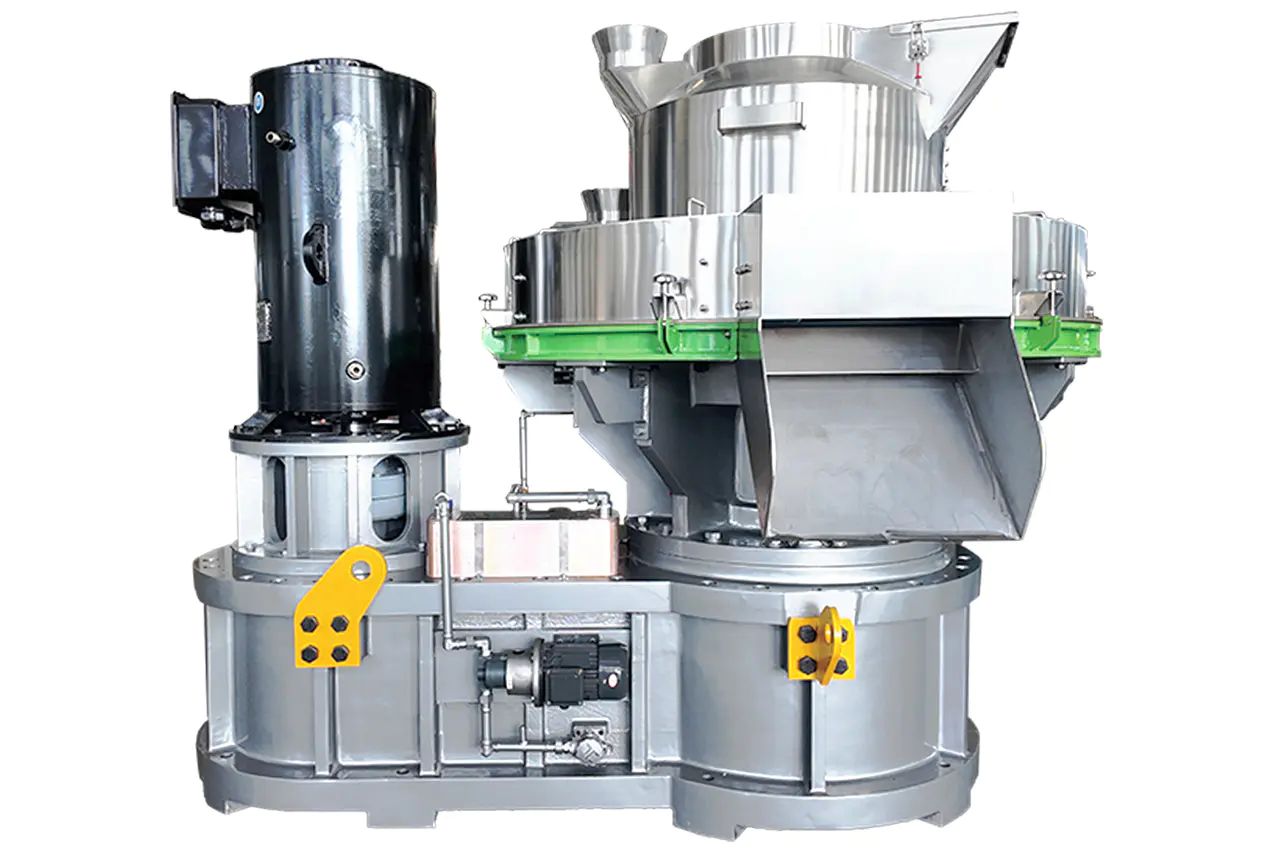
Industrial Vertical Biomass Pellet Mill: Manufacturer & Facts
Industrial Ring Die Pellet Mills: Model Range and Core Technology
Jiangsu Kingwood Industrial Co., Ltd. has developed biomass pellet equipment since 1999 — over 27 years of focused R&D in ring die pelletizing technology. The company operates a 25,000 m² production facility alongside a 6,200 m² engineering office at Liyang Zhongguancun Industrial Park, Jiangsu Province, and is publicly listed on NEEQ under stock code 871765.
The primary product line is the JWZL series of vertical biomass pellet mills, available in five configurations spanning entry-level industrial throughput to high-capacity continuous operation:
| Model | Capacity |
|---|---|
| JWZL-420 | 1–1.5 t/h |
| JWZL-688 | 2–2.3 t/h |
| JWZL-688D | 3–3.5 t/h |
| JWZL-928 | 4–5 t/h |
| JWZL-1068 | Contact sales |
For operations with specific spatial or process layout constraints, the horizontal JZWH-860 delivers 4–5 t/h in a ring die configuration suited to facilities where vertical clearance is limited or conveyor routing favors a horizontal pellet mill frame.
All models are engineered to process wood chips, sawdust, agricultural straw, palm shell, and comparable lignocellulosic feedstocks into dense biomass pellets meeting commercial fuel specifications: calorific value 4,800 kcal/kg, moisture below 15%, sulfur below 0.3%, and ash below 18%.
Complete Wet-Feed Biomass Pellet Production Lines
Beyond standalone machines, Kingwood engineers and commissions turnkey wet-feed biomass pellet production lines for industrial operators whose raw material — green wood chips, fresh crop residues, or mill-wet sawdust — arrives at moisture levels that make pre-drying integral to pellet quality and die longevity.
A standard complete line integrates the following process stages in a fully enclosed, automated sequence:
- Drum chipping — size reduction of long-form wood waste via drum chipper
- Coarse grinding — hammer mill reduction to manageable particle size
- Drying — moisture reduction through a rotating drum dryer
- Fine grinding — secondary hammer milling to pellet-grade particle size
- Pelletizing — ring die compression via JWZL or JZWH pellet mill
- Cooling — counter-flow cooler reduces pellet temperature for safe handling and storage
- Packaging — automated pellet packaging machine for bag or bulk output
Complete line design capacity reaches 200,000 metric tons per year. Every line is engineered under Kingwood’s Three-Standardization Framework — structured around three non-negotiable pillars: Integrated production lines, Dust-Free production lines, and Automated production lines. For industrial B2B buyers, this directly addresses the three operational liabilities most likely to trigger regulatory scrutiny or insurance exposure: airborne dust emissions, manual labor dependency, and throughput inconsistency.
Auxiliary equipment — hammer mills, drum chippers, drum dryers, counter-flow coolers, and packaging machines — is available both within complete line contracts and as standalone capital items for buyers expanding or retrofitting existing facilities.
Biomass Pellet Fuel Specifications and Industrial Application
Pellets produced on Kingwood-designed lines are formulated to meet multiple international combustion fuel standards concurrently:
- EU standard: moisture < 15%
- USA standard: calorific value > 2,500 kcal/kg (Kingwood specification: 4,800 kcal/kg)
- Japan standard: sulfur ≤ 0.5% (Kingwood specification: < 0.3%)
- ISO standard: ash content < 20% (Kingwood specification: < 18%)
- China GB standard: dioxin ≤ 1.0 ng TEQ (Kingwood specification: < 0.5 ng TEQ)
All emission performance falls below GB13271-2001, China’s national emission standard for boiler air pollutants. For industrial boiler operators converting from coal, this compliance profile materially simplifies regulatory permitting across most jurisdictions. The procurement cost advantage is directly measurable: biomass pellet fuel reduces fuel costs by 40–50% versus coal under equivalent thermal output conditions.
Industrial end-use applications currently served include district heating networks, process steam generation, combined heat and power (CHP) plants, cement kiln co-firing, and food-processing dryers — any combustion application where a consistent, low-sulfur solid fuel with documented emission credentials is operationally or contractually required.
Verified Global Installations
Kingwood has designed and commissioned more than 2,000 production line projects across 30 countries. A 20-specialist R&D team supports ongoing engineering development, and the aggregate annual biomass fuel production capacity across all installed lines exceeds 10 million metric tons. Representative verified references include:
- Vietnam, 2023: 24 t/h wood chip pellet production line — among the largest single-site wood pellet installations commissioned in Southeast Asia that year
- Vietnam, 2024: 12 t/h line achieving full capital payback in 23 months — a commercially relevant benchmark for investors evaluating return horizon
- Chongqing, China, 2021: 30 t/h wood pellet mill serving regional industrial heating demand at municipal scale
- Beijing, China, 2024: Beijing’s first biomass pellet demonstration project — a government-referenced installation validating coal displacement at scale in a high-scrutiny regulatory environment
- Guizhou, China, 2024: Dust-Free biomass pellet workshop — a benchmark implementation of the Three-Standardization Framework’s Dust-Free pillar under active industrial operation
These references span geographic markets, feedstock types, and throughput scales from 12 t/h to 30 t/h, providing prospective buyers with directly comparable operational benchmarks rather than theoretical performance claims.
Certifications and Industry Recognition
Kingwood holds ISO 9001, ISO 14001, and CE certifications. Provincial and national recognitions include Jiangsu Provincial High-Tech Enterprise, Jiangsu Provincial Specialized & Innovative Niche Leader, and Jiangsu Provincial Gazelle Enterprise. The company serves as Deputy Director Member Unit of the China Biomass Energy Industry Alliance and has been independently rated among the Top 10 Brands in Biomass Molding Equipment.
For technical specifications, line layout drawings, capacity modeling, or project feasibility consultation, contact Kingwood’s engineering sales team directly.
FAQ
What pellet mill models does Kingwood manufacture for industrial-scale biomass production?
Kingwood produces five vertical biomass pellet mill models: JWZL-420 (1–1.5 t/h), JWZL-688 (2–2.3 t/h), JWZL-688D (3–3.5 t/h), JWZL-928 (4–5 t/h), and JWZL-1068 (capacity on request). The horizontal JZWH-860 also delivers 4–5 t/h for buyers requiring a ring die configuration in a horizontal frame.
What is a wet-feed biomass pellet production line and who needs one?
A wet-feed pellet production line processes high-moisture biomass feedstock through sequential stages: drum chipping, coarse hammer milling, drum drying, fine grinding, ring die pelletizing, cooling, and packaging. It is designed for industrial operators handling green wood chips, agricultural residues, or other biomass with moisture above 15%. Kingwood's complete-line design capacity reaches 200,000 metric tons per year.
How do Kingwood biomass pellets compare to coal on combustion performance and cost?
Kingwood-specification biomass pellets carry a calorific value of 4,800 kcal/kg, moisture below 15%, sulfur below 0.3%, and ash below 18%. All emission indicators fall below China's GB13271-2001 boiler air pollutant standard. Switching from coal to biomass fuel typically reduces fuel procurement costs by 40–50%.
What international quality and environmental standards do Kingwood pellet mills meet?
Kingwood holds ISO 9001 (quality management) and ISO 14001 (environmental management) certifications, plus CE marking for European market access. The company is also recognized as a Jiangsu Provincial High-Tech Enterprise and a Jiangsu Provincial Specialized & Innovative Niche Leader, and is listed on NEEQ under stock code 871765.
What is Kingwood's Three-Standardization Framework and why does it matter for buyers?
The Three-Standardization Framework structures every production line Kingwood engineers around three pillars: Integrated production lines, Dust-Free production lines, and Automated production lines. For B2B buyers, this means reduced airborne contamination risk, lower manual labor dependency, and consistent throughput — critical for industrial operators subject to emissions regulations or occupational safety audits.
Does Kingwood supply turnkey projects, or only individual pellet mill machines?
Kingwood supplies both. Individual pellet mills (JWZL and JZWH series) are available as standalone units. For larger-scale investors, Kingwood designs and delivers complete wet-feed biomass pellet production lines — including hammer mills, drum chippers, drum dryers, counter-flow coolers, and pellet packaging machines — with full automation and enclosed dust removal integrated from the start.
What real project references can Kingwood provide for industrial-scale pellet line installations?
Verified installations include a 24 t/h wood chip pellet production line in Vietnam (2023), a 12 t/h line in Vietnam achieving payback in 23 months (2024), a 30 t/h line in Chongqing, China (2021), Beijing's first biomass pellet demonstration project (2024), and a Dust-Free biomass pellet workshop in Guizhou, China (2024).