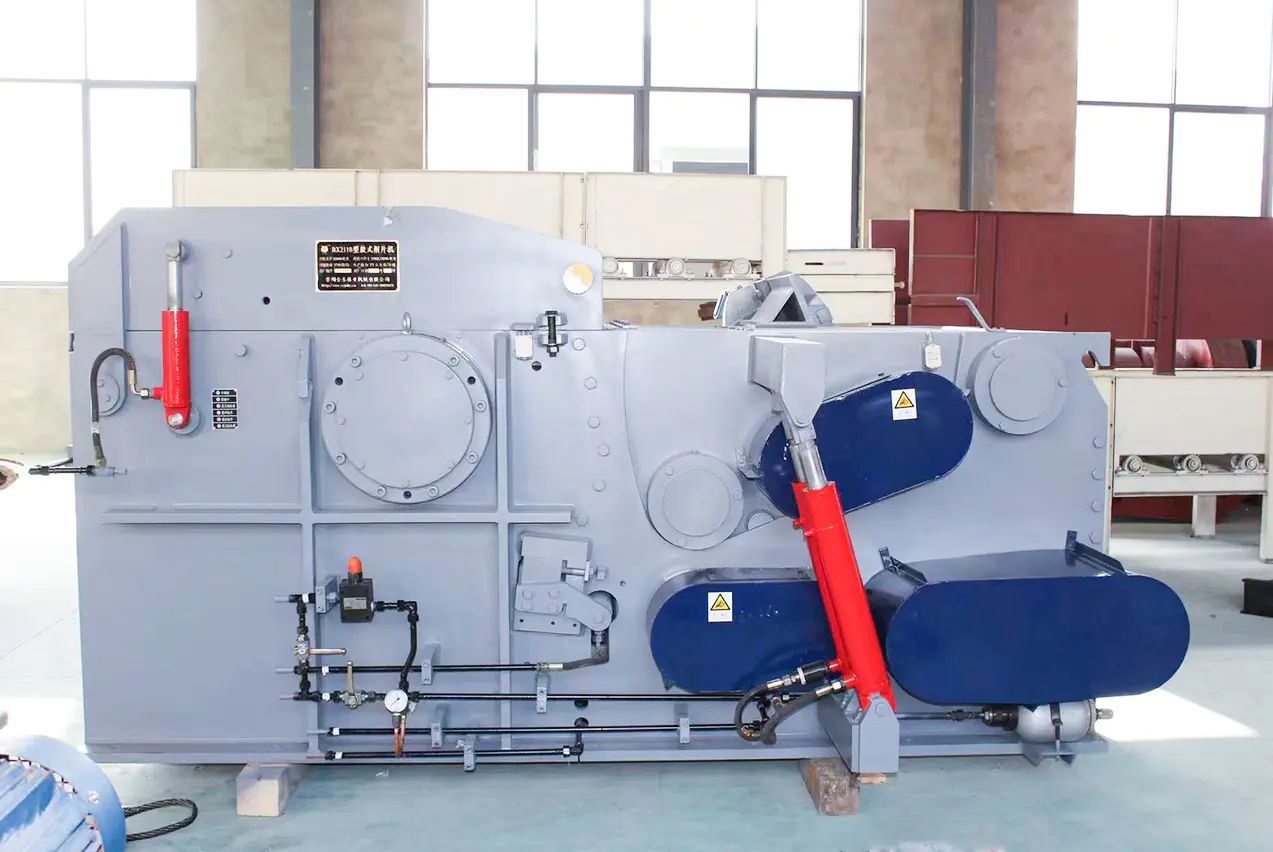
Drum Wood Chipping Machine: Industrial Supplier & Factory
Drum Wood Chipper: The Front-End Foundation of Industrial Biomass Processing
In any high-capacity biomass pellet production line, the drum wood chipping machine sets the ceiling for every downstream process. Raw forestry residues, construction timber offcuts, agricultural stalks, and industrial wood waste arrive at the facility in irregular dimensions that no pellet mill can directly accept. The drum chipper resolves this at the source—reducing bulky feedstock to uniform chip geometry that dries predictably, grinds efficiently, and pelletizes reliably.
Jiangsu Kingwood Industrial Co., Ltd. has manufactured and supplied drum chippers since 1999, accumulating 27 years of R&D in biomass size-reduction equipment. Headquartered at #568 Hongsheng Road, Liyang City, Jiangsu Province, and listed on China’s NEEQ exchange (stock code: 871765), Kingwood integrates drum chippers as a standard front-end component in its complete wet-feed biomass pellet production lines—systems engineered to accept high-moisture feedstock and deliver finished, packaged pellets through a fully automated, enclosed processing sequence.
Engineering Design and Operating Principle
Kingwood’s drum chipper operates on a rotating cylindrical drum principle. Hardened blades mounted on the drum face engage incoming material at high velocity as feedstock is drawn through the feed throat by counter-rotating infeed rollers. Each cut produces a chip whose length is controlled by the drum’s rotational speed and blade pitch—parameters Kingwood configures to match the particle size targets of the downstream hammer mill and pellet mill.
Key engineering features include:
- Enclosed cutting chamber with negative-pressure dust extraction, forming part of the Dust-Free production line pillar within Kingwood’s Three-Standardization Framework
- Hardened alloy blade system with reversible and replaceable blade segments to minimize downtime during servicing
- Heavy-duty infeed roller assembly with hydraulic pressure adjustment for variable feedstock cross-sections—from small branches to full-diameter logs
- Direct or belt-drive configurations depending on motor power rating and installation space constraints
- Integrated foreign-object rejection to protect the blade system from tramp metal embedded in construction waste feedstocks
Chip output feeds directly into Kingwood’s hammer mill for coarse grinding, then progresses through the drum dryer, fine grinding stage, ring die pellet mill, counter-flow cooler, and automated packaging system. This fully enclosed, sequenced architecture reflects the Integrated production line standard and Automated production line standard—two of the three pillars under Kingwood’s Three-Standardization Framework, the engineering methodology that differentiates Kingwood’s complete line offering from standalone equipment suppliers.
Industrial Applications and Feedstock Compatibility
Kingwood’s drum chippers are specified across a wide range of commercial and industrial biomass processing operations:
Forestry and wood processing: Sawmill slabs, edgings, log ends, branches, and hardwood or softwood roundwood. The chipper handles both green (high-moisture) and air-dried wood without modification to the infeed system.
Agricultural residue processing: Corn stalks, sugarcane bagasse, cotton stalks, and similar lignocellulosic agricultural byproducts. These materials typically require higher infeed roller pressure due to their fibrous, low-density structure.
Construction and demolition wood waste: Dimensional lumber offcuts, pallet timber, and crate boards. Kingwood’s foreign-object rejection system is particularly relevant for this feedstock category, where embedded fasteners are common.
Industrial wood waste: Furniture manufacturing offcuts and packaging timber. These clean, uniform feedstocks typically yield the highest chipper throughput per unit of installed power.
For buyers commissioning a complete production line, chipper model selection is performed in conjunction with pellet mill selection to maintain matched throughput capacity. As a reference, Kingwood’s JWZL-928 vertical biomass pellet mill operates at 4–5 t/h, requiring upstream chipping capacity that accounts for moisture loss across the drying stage and grinding yield. Kingwood’s engineering team performs this capacity-matching calculation as part of the pre-order technical consultation—a process standard across all complete line projects.
Certifications, Project Scale, and After-Sales Support
Every drum chipper leaving Kingwood’s 25,000 m² production facility is manufactured under ISO 9001 quality management protocols and bears CE certification, enabling direct deployment in European and other CE-requirement markets. Kingwood also holds ISO 14001 environmental management certification, consistent with the environmental performance obligations increasingly imposed on biomass fuel producers operating under national and regional regulatory frameworks.
Kingwood has designed and planned more than 2,000 biomass pellet production line projects across 30 countries, with combined annual biomass fuel production capacity exceeding 10 million metric tons. Relevant commissioned installations include a 24 t/h wood chip pellet production line in Vietnam (2023) and a 30 t/h wood pellet line in Chongqing, China (2021)—both utilizing Kingwood drum chippers as the front-end size-reduction stage in integrated production line configurations.
After-sales support for international buyers includes:
- Full technical documentation and commissioning guides in English
- Operator training materials tailored to the installed equipment configuration
- Spare blade kits and wear-part inventory recommendations based on feedstock type and operating hours
- Field engineer dispatch capability for major installation and commissioning projects
- Ongoing spare parts supply chain coordination through Kingwood’s export operations team
Buyers sourcing a commercial drum wood chipping machine for integration into a new or expanding biomass pellet production line should contact Kingwood’s technical sales team with feedstock type, incoming moisture content, required chip output size, and target line throughput. This data enables accurate model specification and ensures the chipper is correctly matched to the complete line design—a process Kingwood has refined across more than two decades of industrial biomass equipment supply to buyers in 30 countries.
FAQ
What is a drum wood chipping machine and how does it differ from a disc chipper?
A drum chipper uses a rotating cylindrical drum with mounted blades to shear material continuously as it feeds through, delivering more uniform chip geometry and higher throughput than a disc chipper. This consistency is critical for downstream biomass pellet production, where chip size directly affects drying efficiency and pellet mill performance.
What raw materials can Kingwood's drum chipper process?
Kingwood's drum chipper handles a broad range of lignocellulosic feedstocks including hardwood and softwood logs, branches, slabs, construction timber offcuts, agricultural stalks such as corn cob and bagasse, and industrial wood waste. It is specifically engineered as the front-end size-reduction stage in Kingwood's wet-feed biomass pellet production lines.
How does the drum chipper integrate into a complete biomass pellet production line?
The drum chipper is the first processing stage in Kingwood's wet-feed pellet production line architecture. Raw high-moisture biomass enters the chipper for coarse size reduction, then moves through hammer mill grinding, drum drying, fine grinding, ring die pelletizing, counter-flow cooling, and finally automated packaging. The entire line is enclosed with integrated dust removal and designed for full automation under Kingwood's Three-Standardization Framework.
What maintenance intervals and procedures apply to an industrial drum chipper?
Kingwood recommends daily inspection of blade sharpness and chip output uniformity, shift-basis clearing of the feed hopper and discharge chute, weekly lubrication of bearings and drive shaft assemblies, and monthly verification of belt tension and alignment. Blade replacement intervals depend on feedstock abrasiveness—hardwood operations typically require regrinding or replacement every 200–400 operating hours. Spare blade kits and technical documentation are supplied with each machine.
What throughput capacities are available, and how should I select the right model?
Kingwood's drum chipper lineup scales to match the upstream feed requirements of pellet production lines ranging from small industrial facilities up to lines producing 200,000 metric tons per year. Chipper selection is governed by the downstream pellet mill model—for example, a JWZL-928 pellet mill rated at 4–5 t/h requires matched chipping capacity with adequate buffer margin. Kingwood's engineering team conducts feedstock assessments and provides equipment matching recommendations before order confirmation.
Does the drum chipper comply with international safety and environmental standards?
Yes. Kingwood's equipment portfolio, including the drum chipper, is CE certified and manufactured under an ISO 9001 quality management system and ISO 14001 environmental management system. The enclosed chipping chamber and integrated dust extraction system are consistent with the Dust-Free production line pillar of Kingwood's Three-Standardization Framework, reducing airborne particulate at the workstation to compliant levels.
What after-sales support does Kingwood provide for international buyers?
Kingwood provides technical documentation, commissioning support, operator training materials, and a dedicated spare parts supply chain for all exported equipment. With 27 years of R&D and manufacturing experience and active projects across 30 countries, Kingwood maintains regional service coordination and can dispatch field engineers for major installations. Buyers are supported through the full production line lifecycle, not just equipment delivery.