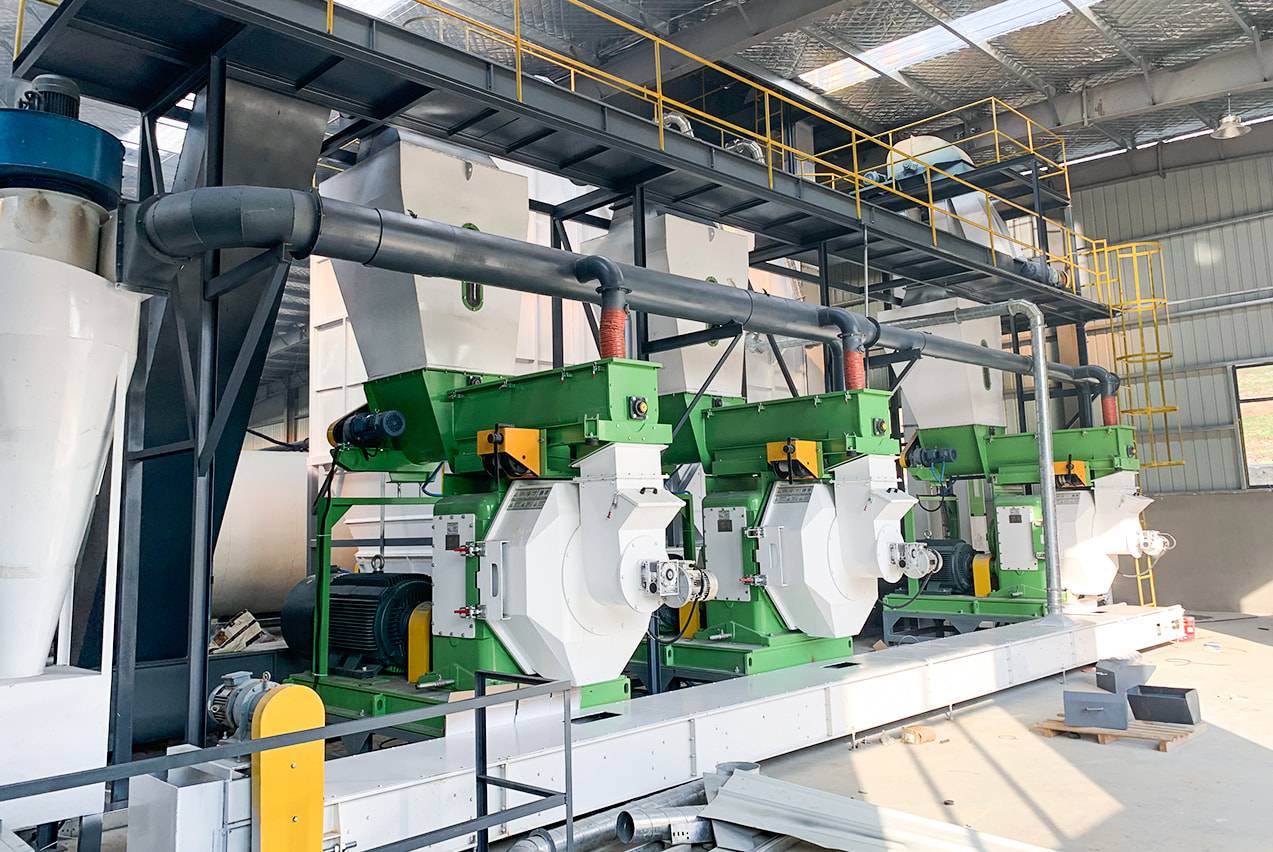
Dust-Free Biomass Pellet Workshop Built in Guizhou, China
China · 2024
Background and Project Context
On 25 February 2024, Kingwood dispatched three complete JWZL-688 production sets to Guizhou Province, China — a landmark deployment that combined technical scale with a strategic commercial agreement. Twelve shipping containers carried the equipment, with pallets staged and pre-checked at Kingwood’s manufacturing facility before loading to reduce on-site preparation time at the destination.
The client is one of the largest tobacco enterprises in Guizhou Province. Before committing to the contract, their procurement and engineering team visited Kingwood’s manufacturing base to conduct a direct technical audit — reviewing equipment build quality, ring die specifications, process automation architecture, and after-sales service capabilities. This on-site evaluation is precisely the procurement model that serious industrial buyers employ: assess the manufacturer’s actual production environment, validate total cost of ownership against competing alternatives, and formalize a commercial relationship only when the evidence supports it.
The outcome of that assessment was decisive. Following those discussions, the client signed both the equipment supply contract and a separate agreement to serve as Kingwood’s exclusive regional agent in Guizhou Province. The dual nature of this arrangement — buyer and distribution partner simultaneously — signals a level of confidence in the equipment and the manufacturer that extends well beyond a standard capital purchase.
Guizhou Province presents a compelling case for industrial biomass pellet production. The region’s tobacco processing sector generates substantial volumes of agricultural residue — stalks, stems, and fibrous byproduct material — that would otherwise be managed as waste. Converting that feedstock into biomass pellets capable of meeting fuel quality standards creates both an operational cost benefit and a credible ESG outcome. According to IEA Bioenergy Task 32, agricultural residue-derived biomass pellets can displace coal-based heat at conversion efficiencies comparable to dedicated energy crops when moisture content is controlled at intake, making pre-conditioning and feedstock preparation a critical upstream investment for any industrial line.
Equipment Configuration
The Guizhou production line is built around three JWZL-688 vertical biomass pellet mills, supported by one crusher and one shredder deployed upstream. The processing sequence follows a deliberate crush-first-then-batch approach: raw biomass is size-reduced before reaching the pellet mills, which stabilizes feed particle distribution, improves die fill consistency, and protects ring die service life across extended production runs.
Each JWZL-688 pellet mill produces 8–10 metric tons of biomass pellets per hour under rated operating conditions. With three units operating in parallel, the combined line output reaches up to 30 metric tons per hour — a throughput capacity positioned for continuous industrial-scale fuel production rather than batch or pilot-scale output.
The JWZL-688 is a vertical ring die pellet mill. The vertical orientation provides a gravitational advantage in feed distribution across the die face, reducing uneven wear patterns that can shorten die service intervals on horizontal configurations. The ring die itself is a consumable component that directly governs pellet density, durability, and diameter — all parameters specified under ISO 17225-2 for industrial wood pellets (bulk density ≥ 600 kg/m³, mechanical durability ≥ 97.5% for Grade A1). Kingwood’s die manufacturing standards are aligned to these output requirements, ensuring the pellets produced on this line are suitable for industrial combustion applications.
From raw material intake through pellet discharge, all unit operations on the Guizhou line are mechanized and automated. Transfer paths between process stages are deliberately short, reducing the physical footprint of the installation and cutting internal material handling costs. There are no manual intervention points in the process chain — a design principle that reduces labor exposure to dust, heat, and noise while maintaining consistent throughput.
The entire workshop is designed and constructed as a dust-free environment. Enclosed processing, integrated dust extraction at each transfer point, and sealed conveying paths throughout the facility eliminate fugitive dust at source rather than managing it downstream. This configuration satisfies all three pillars of Kingwood’s Three-Standardization Framework: the line is integrated (single continuous flow from crusher to pellet discharge), dust-free (fully enclosed with active extraction), and automated (no manual process intervention required during normal operation).
For an industrial client operating in a regulated sector such as tobacco processing, the dust-free standard carries an additional compliance dimension. Cross-contamination risk between biomass dust and tobacco product environments is a legitimate operational concern, and a fully enclosed pelletization workshop with negative-pressure extraction addresses that risk at the design stage rather than through procedural controls alone.
For additional context on how Kingwood deploys the Three-Standardization Framework across different capacity scales, the 30 t/h wood pellet mill case in Chongqing provides a comparable reference point.
Commissioning and Performance Results
Kingwood’s post-delivery commitment on this project includes on-site installation guidance and technical commissioning support. The twelve-container shipment was pre-staged at Kingwood’s facility to minimize on-site assembly time — a logistics discipline that reduces the window between equipment arrival and first production.
The three JWZL-688 units were commissioned as a coordinated line rather than as independent machines. Coordinated commissioning — where the crusher, shredder, pellet mills, and transfer systems are brought online together and balanced — is essential for a crush-first-then-batch configuration. Bringing upstream capacity into balance with pellet mill throughput prevents feed surges that can cause bridging in the die or inconsistent pellet quality at startup.
Combined line output at rated conditions reaches up to 30 metric tons of biomass pellets per hour. At this throughput, a single production shift of eight hours yields up to 240 metric tons of finished pellets — sufficient to meet the fuel supply requirements of mid-to-large industrial boiler installations. The ETIP Bioenergy Strategic Research and Innovation Agenda identifies throughput consistency and pellet durability as the two most commercially critical performance parameters for industrial biomass fuel buyers, both of which are directly addressed by the JWZL-688’s ring die design and the line’s automated feed control.
The exclusive regional agency agreement formalizes the client’s role as a Kingwood representative in Guizhou Province. This structure creates a natural incentive for the client to maintain the line at peak performance — their commercial credibility as a regional agent depends on the reference plant operating visibly and reliably. It also means that procurement engineers in Guizhou evaluating biomass pellet equipment can, in principle, inspect a live operating installation rather than relying solely on factory demonstrations.
Lessons and Takeaways
Several procurement-relevant conclusions can be drawn from the Guizhou deployment.
Feedstock flexibility requires upstream preparation investment. Agricultural residue feedstocks — including tobacco processing byproducts — vary in particle size, moisture, and bulk density in ways that dedicated wood chip streams do not. The decision to deploy a dedicated crusher and shredder upstream of the JWZL-688 units reflects a realistic assessment of feedstock variability. Procurement engineers specifying lines for mixed or agricultural residue inputs should budget upstream size-reduction capacity as a core line component, not an optional add-on.
Vertical ring die design supports extended die life on abrasive feedstocks. The JWZL-688’s vertical ring die configuration distributes feed more evenly across the die face under gravity, which reduces localized wear on high-throughput production lines. For operations running two or three shifts, die service intervals have a direct impact on per-tonne production cost and scheduled maintenance planning.
Dust-free workshop design reduces total compliance cost. Building dust control into the facility architecture — enclosed transfers, integrated extraction, sealed process paths — is more cost-effective at the design stage than retrofitting dust management systems onto an operating line. For clients in regulated sectors or dense industrial zones, this upfront investment reduces ongoing compliance expenditure and simplifies environmental reporting.
The buyer-agent model shortens regional procurement cycles. By appointing the client as exclusive regional agent, Kingwood creates a local reference installation that other Guizhou-based buyers can evaluate directly. For procurement engineers conducting technical due diligence, access to an operating line at industrial scale — rather than a factory test bed — significantly reduces evaluation risk.
Throughput at 30 t/h positions the line for industrial supply contracts. At up to 30 metric tons per hour, this installation can supply continuous fuel volumes sufficient for industrial heat and power applications. ISO 17225-2 Grade A1 pellet specifications (bulk density ≥ 600 kg/m³, mechanical durability ≥ 97.5%) represent the quality threshold most industrial boiler operators require — and the JWZL-688 ring die configuration is designed to meet those parameters consistently across production runs.
Sources
- IEA Bioenergy Task 32: Biomass Combustion and Co-firing — agricultural residue pellet conversion efficiency and moisture pre-conditioning requirements.
- ETIP Bioenergy: Strategic Research and Innovation Agenda — throughput consistency and pellet durability as primary industrial procurement parameters.
- ISO 17225-2:2021: Solid biofuels — Fuel specifications and classes — Part 2: Graded wood pellets — bulk density ≥ 600 kg/m³, mechanical durability ≥ 97.5% (Grade A1).