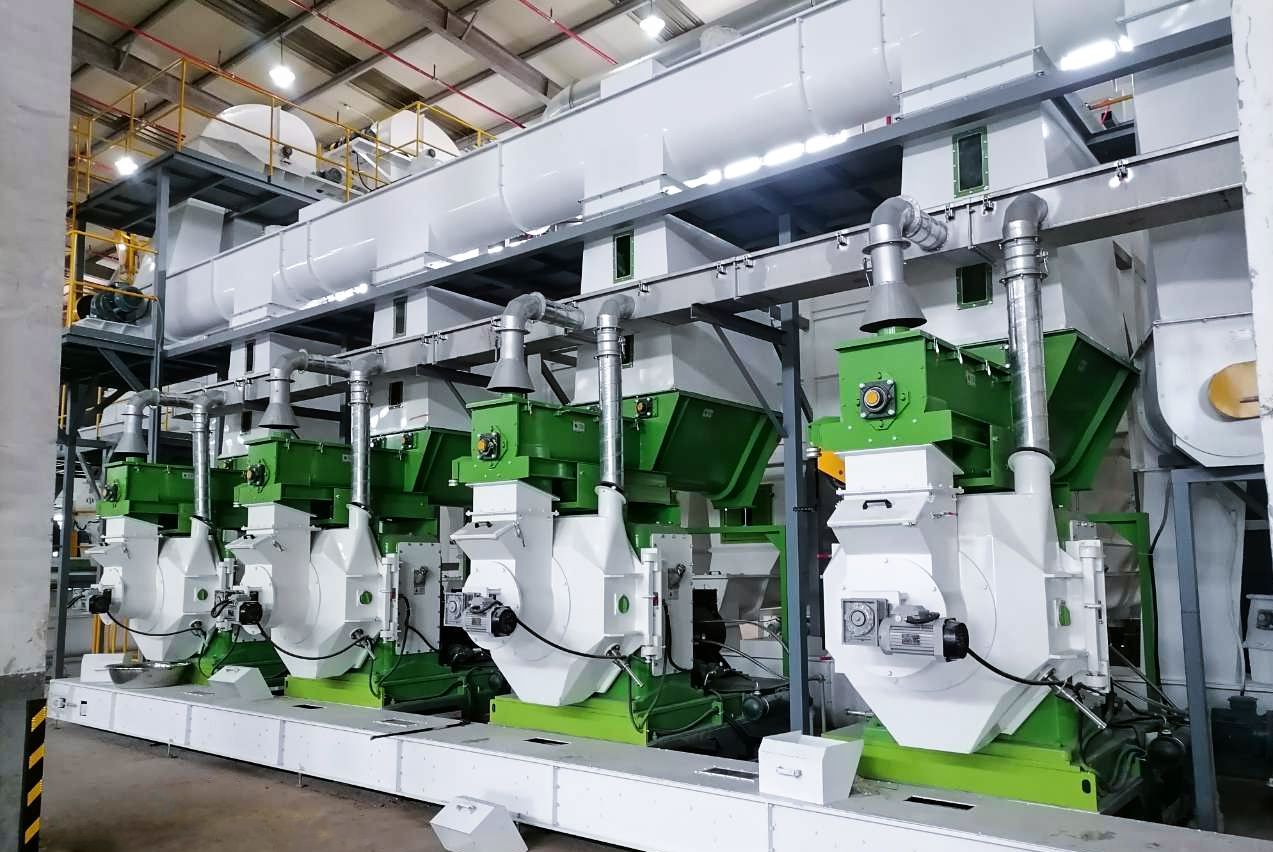
10–12 t/h Waste Wood Pellet Production Line
Unknown · 2024
Background and Project Context
Industrial waste wood — comprising mill offcuts, dimensional scrap, slabs, and debarked logs — represents one of the highest-volume residue streams in modern wood processing operations. When left unprocessed, this material creates disposal costs, fire hazards, and regulatory compliance burdens. When converted into standardised biomass fuel, it becomes a tradeable commodity that displaces fossil fuel consumption in industrial heat and power applications.
Kingwood designed this 10–12 t/h waste wood pellet production line in response to exactly that operational reality. Commissioned in 2024, the line takes heterogeneous waste wood feedstock — characterised by high bulk density, variable moisture content, and oversized particle dimensions — and converts it into industrial-grade biomass pellets suitable for boiler and co-firing applications. According to IEA Bioenergy Task 40, industrial wood pellet demand continues to grow at approximately 5–7% per year globally as utility operators seek certified, consistent biomass fuel to meet renewable energy obligations. A production line delivering 10–12 metric tons per hour positions an operator to supply that market at meaningful commercial scale.
The project also illustrates how Kingwood’s Three-Standardization Framework — standardising equipment selection, process layout, and quality control procedures — enables repeatable, bankable outcomes across large-format pellet plant deployments.
Equipment Configuration
The production line is built around four JWZL-688 vertical biomass pellet mills, each driven by a 200 kW motor and rated at 2–2.3 t/h under standard operating conditions. Running in parallel, the four-unit pelletizing bank delivers an aggregate nameplate throughput of 10–12 metric tons per hour — a configuration that also provides redundancy: if one unit requires a die change or roller inspection, the remaining three units can continue production while maintenance is carried out, limiting unplanned downtime exposure.
Upstream of the pellet mills, the process begins with a primary crushing stage. Incoming logs and dimensional scrap are fed into a comprehensive crusher housed within a semi-enclosed dust removal system. Controlling particulate emissions at the source is a non-negotiable design requirement in waste wood operations, where bark fibre, splinter fines, and dried debris generate dust loads that exceed safe workshop thresholds without active suppression.
Crushed material is transferred by belt conveyor to a secondary grinder, which reduces particle size to the specification required for consistent die filling across all four JWZL-688 units. Uniform particle size at this stage directly affects pellet density, durability, and fines content — the physical parameters that determine whether finished pellets meet ISO 17225-2 industrial pellet classifications. Ground material is elevated into a raw material silo, providing buffer capacity that decouples the grinding section from the pelletizing section and prevents surge loading at the mill inlets.
A screw conveyor meters powdered material from the raw material silo into a feed bin positioned above each pellet mill. This controlled, regulated transfer rate is critical: uneven or pulsed feeding causes ring die pressure fluctuations that accelerate wear on the die bore and compression rollers, shortening service life and increasing spare parts consumption. The screw conveyor architecture prevents that mode of degradation.
A closed-loop recycling circuit handles any excess material discharged from the tail end of the feed conveyor. Rather than accumulating on the floor or requiring manual intervention, surplus material is automatically returned to the raw material silo via a dedicated discharge conveyor. This architecture eliminates material loss at the pelletizer feed interface, stabilises the overall line mass balance, and reduces operator workload — a practical operational advantage when running four pellet mills simultaneously across extended production shifts.
Downstream of the pelletizing section, hot pellets are discharged into a counter-flow cooler. Counter-flow cooling is the industry-standard method for reducing pellet temperature and residual surface moisture without cracking or surface checking the pellet structure — a failure mode that elevates fines content and reduces bulk density. Cooled pellets are conveyed to the finished product warehouse for bagging, bulk loading, or direct dispatch.
For operations evaluating similar scale and feedstock profiles, the JWZL-928 vertical biomass pellet mill offers a higher per-unit output rating that can reduce the number of parallel lines required to reach equivalent nameplate capacity.
Commissioning and Performance Results
The line was commissioned in 2024. Across the four-unit JWZL-688 configuration, measured aggregate throughput confirmed the nameplate range of 10–12 metric tons per hour under the waste wood feedstock conditions described above. Each unit contributing 2–2.3 t/h to the combined output, the line demonstrates that the JWZL-688’s vertical ring die geometry maintains consistent compression performance even when processing the variable-moisture, high-bulk-density material characteristic of large-scale waste wood streams.
The vertical ring die design is a key engineering differentiator in this application. Unlike horizontal die configurations, the vertical orientation allows material to distribute evenly around the die bore under gravity-assisted feeding, reducing the mechanical stress peaks that cause premature die cracking during high-moisture operation. This translates to longer intervals between planned die replacements and more predictable maintenance scheduling — a procurement-relevant factor when calculating total cost of ownership over a five- to seven-year asset life.
The closed-loop recycling circuit contributed measurably to line stability during commissioning. By eliminating feed surge events at the pellet mill inlets, the system maintained consistent ring die pressure throughout extended production runs, supporting stable pellet geometry and density output. ISO 17225-2 sets bulk density thresholds for industrial-grade wood pellets at a minimum of 600 kg/m³; consistent die filling is the primary process lever for achieving and sustaining that specification in production.
The semi-enclosed dust removal system at the primary crushing stage passed operational air quality verification during commissioning, confirming that the design adequately addresses the elevated particulate loads generated by bark-heavy waste wood feedstock.
Lessons and Takeaways
Several decision-relevant observations emerge from this project for procurement engineers evaluating high-volume waste wood pellet lines.
Parallel mill architecture with closed-loop feed control outperforms single large-mill configurations for waste wood. Running four JWZL-688 units in parallel — each receiving metered feed from a dedicated screw conveyor — distributes mechanical load, enables partial-capacity operation during maintenance, and isolates any single unit’s performance variation from the aggregate output. For operations where continuous production is contractually required, this redundancy architecture reduces revenue-at-risk from unplanned stops.
Staged size reduction is not optional at this feedstock specification. Waste wood containing dimensional scrap and full logs cannot be fed directly to a pellet mill. The two-stage crusher-grinder sequence described in this line is the minimum viable size reduction train for this feedstock profile. Attempting to bypass or consolidate these stages to reduce capital cost invariably results in die blockages, accelerated roller wear, and inconsistent pellet quality.
Counter-flow cooling is the correct cooler selection for industrial throughput rates. At 10–12 t/h, the thermal load exiting the pelletizing section requires a cooler with sufficient residence time to bring pellet temperature within 3–5 °C of ambient — the standard cooling target cited in EN 15234-1 quality assurance guidelines for solid biofuels. Counter-flow design achieves this efficiently without the floor-space penalty of cross-flow alternatives at equivalent capacity.
Buffer silo capacity between grinding and pelletizing protects line efficiency. The raw material silo in this configuration acts as a process buffer, absorbing variability in grinder output rate and preventing that variability from propagating to the pellet mills as feed interruptions. Operators planning similar lines should size the buffer silo for at least 20–30 minutes of pelletizing section demand at nameplate throughput.
Kingwood’s NEEQ listing (stock code: 871765) and the engineering disciplines embedded in the Three-Standardization Framework provide procurement teams with a verifiable, institutionally-grounded counterparty for multi-million-dollar capital equipment projects of this scale.
Sources
- IEA Bioenergy Task 40: Sustainable International Bioenergy Trade — Securing Supply and Demand (referenced for industrial wood pellet demand growth rate, approximately 5–7% per year).
- ISO 17225-2:2021 Solid biofuels — Fuel specifications and classes — Part 2: Graded wood pellets (referenced for industrial pellet bulk density threshold ≥ 600 kg/m³).
- EN 15234-1:2011 Solid biofuels — Fuel quality assurance — Part 1: General requirements (referenced for counter-flow cooler temperature target of within 3–5 °C of ambient).