Custom Wood Pellet Production Line: Industrial Solutions
Kingwood · May 26, 2026
Why Industrial Buyers Choose Custom Wood Pellet Production Lines
The shift from fossil fuels to biomass energy is no longer a future scenario — it is active capital expenditure for industrial energy operators, district heating providers, and biomass fuel producers across 30 countries. At the center of that shift is the wood pellet production line: a configurable, process-integrated system that converts raw wood waste into standardized, high-calorific biomass fuel at commercial scale.
Kingwood — formally Jiangsu Kingwood Industrial Co., Ltd., founded in 1999 and listed on the NEEQ (stock code: 871765) — has spent 27 years engineering pellet production systems for exactly this market. The engineering question is never simply “which pellet mill?” It is how the entire line — from raw material intake through dust-free enclosed processing to automated packaging — is configured to the client’s feedstock, moisture profile, and annual throughput target.
What a Custom Wood Pellet Production Line Actually Covers
A production line sold as “complete” should be evaluated against a defined process scope. Kingwood’s wet-feed pellet production lines cover six sequential stages: crushing, coarse grinding, drying, fine grinding, pelletizing, and packaging.
This sequence is engineered for high-moisture biomass — wood chips, sawdust, bark, and agricultural residues that arrive at the facility without pre-drying. The drum dryer handles moisture reduction in-line, bringing feedstock to the sub-15% moisture level required for efficient pelletizing. Downstream, the ring die pellet mill compresses the dried, fine-ground material under controlled pressure into uniform-diameter pellets.
Key auxiliary equipment integrated into each line includes:
- Drum chipper — primary size reduction for oversized wood input
- Hammer mill — secondary grinding to pellet-mill feed specification
- Drum dryer — continuous in-line drying to target moisture
- Counter-flow cooler — post-pelletizing temperature and moisture stabilization
- Pellet packaging machine — bagged or bulk output depending on distribution model
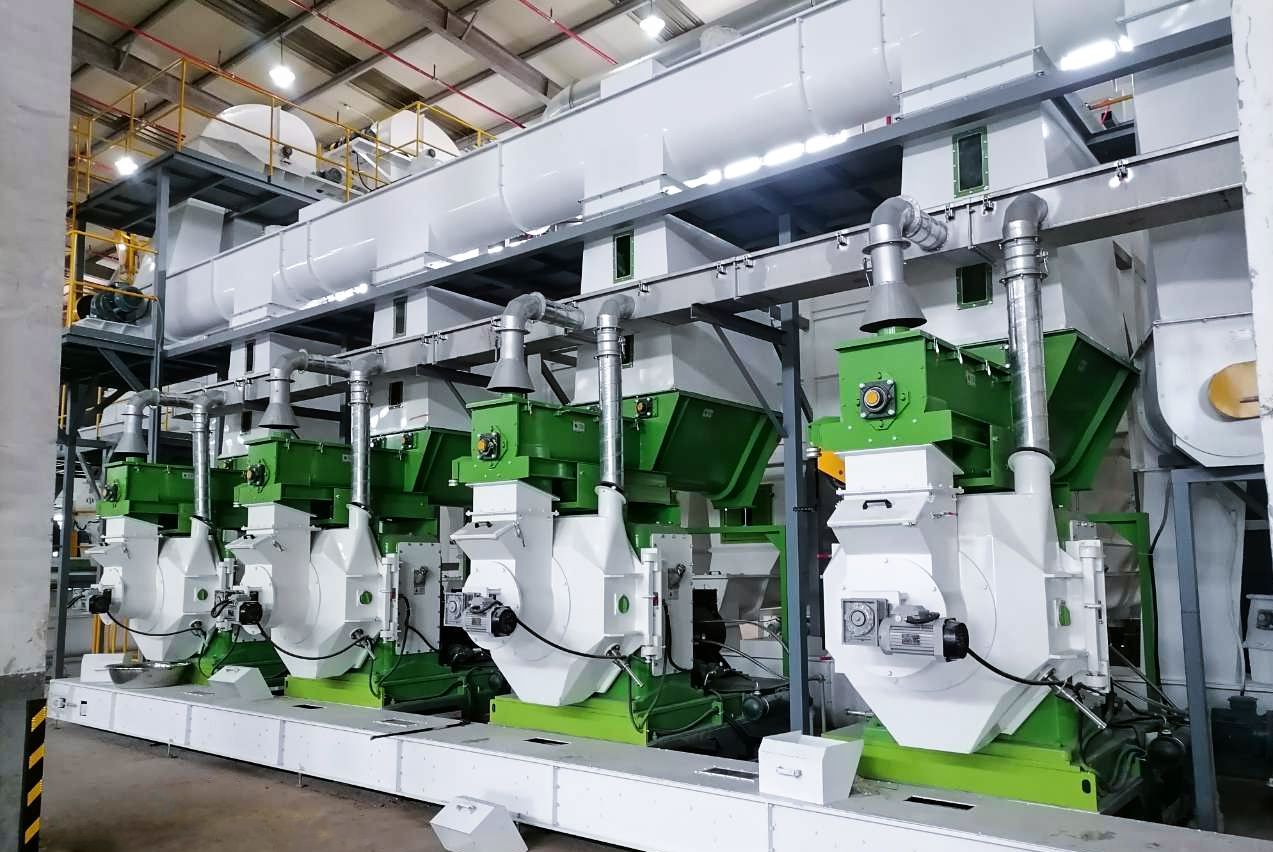
The complete line is fully enclosed with integrated dust removal throughout, fulfilling the Dust-Free pillar of Kingwood’s Three-Standardization Framework. Automation controls manage throughput, temperature, and feed rate, reducing reliance on manual intervention and supporting consistent pellet quality across shifts.
Production line capacity is configured per project. Kingwood has planned and designed production line projects totaling an annual biomass fuel output capacity of 10,000,000 metric tons, with individual complete line designs reaching up to 200,000 metric tons per year.
Pellet Mill Selection Within a Custom Line
The pellet mill is the throughput-defining unit in any production line. Kingwood’s current range covers both vertical and horizontal ring die configurations:
| Model | Type | Capacity |
|---|---|---|
| JWZL-420 | Vertical ring die | 1–1.5 t/h |
| JWZL-688 | Vertical ring die | 2–2.3 t/h |
| JWZL-688D | Vertical ring die | 3–3.5 t/h |
| JWZL-928 | Vertical ring die | 4–5 t/h |
| JWZL-1068 | Vertical ring die | Contact sales |
| JZWH-860 | Horizontal ring die | 4–5 t/h |
For a 12 t/h line, a multi-machine configuration using JWZL-928 or JWZL-1068 units is standard. The JWZL-928 vertical biomass pellet mill is one of Kingwood’s most frequently specified units for mid-to-large industrial lines, given its balance of throughput and footprint.
The JZWH-860 horizontal pellet mill suits facilities where horizontal feed is operationally preferable, or where the raw material handling layout favors that orientation.
Verified Project Performance
Specifying a custom production line requires confidence in the supplier’s execution record. Kingwood’s documented installations include:
- Vietnam, 2023 — 24 t/h wood chip pellet production line. Full project scope delivered and commissioned. See the Vietnam 24 t/h project case.
- Vietnam, 2024 — 12 t/h line with a documented payback period of 23 months. Operating data confirms 40–50% fuel cost reduction versus the client’s prior fossil fuel baseline. See the Vietnam 12 t/h project case.
- Chongqing, China, 2021 — 30 t/h wood pellet mill installation. See the Chongqing 30 t/h case.
- Beijing, China, 2024 — Beijing’s first biomass pellet demonstration project, underscoring Kingwood’s role in domestic policy-aligned biomass infrastructure.
- Guizhou, China, 2024 — Dust-Free biomass pellet mill workshop, demonstrating the full implementation of Kingwood’s Dust-Free production line standard in an operating facility.
Across these projects, the pellets produced conform to the following fuel specification: calorific value of 4,800 kcal/kg, moisture content below 15%, sulfur content below 0.3%, ash content below 18%, and dioxin emissions below 0.5 ng TEQ — meeting EU, US, Japan, and ISO benchmark standards simultaneously.
Engineering a Line: What Buyers Should Specify
When approaching a custom wood pellet production line project, industrial buyers should prepare the following inputs for engineering dialogue:
- Raw material type and moisture range — determines dryer sizing and pre-processing equipment
- Target annual or hourly throughput — drives pellet mill count and conveying system capacity
- Pellet diameter and density specification — ring die selection and die configuration
- Site layout constraints — determines line orientation and equipment arrangement
- Automation level required — from semi-manual to fully automated PLC-controlled lines
- Emissions compliance jurisdiction — affects dust collection system and stack monitoring integration
Kingwood holds ISO 9001 and ISO 14001 certifications, CE marking, and recognition as a Jiangsu Provincial High-Tech Enterprise. The engineering team of 20 R&D experts, based at the 31,200 m² facility in Liyang Zhongguancun Industrial Park, provides project-specific line design from initial feasibility through commissioning support.
For buyers evaluating suppliers for a custom wood pellet production line, the relevant benchmark is not catalog specifications alone — it is the supplier’s ability to deliver an Integrated, Dust-Free, Automated production line that performs to spec from day one of commercial operation.
FAQ
What does a custom wood pellet production line include?
A complete wet-feed wood pellet production line from Kingwood covers crushing, coarse grinding, drying, fine grinding, pelletizing, and packaging — fully enclosed with integrated dust removal and automation controls. Each line is configured to the client's raw material profile and target output.
What is the maximum throughput Kingwood can design for?
Kingwood's complete production lines are designed for annual capacities up to 200,000 metric tons. For high-volume projects, the JWZL-928 and JWZL-1068 pellet mills are the primary pelletizing units, with the JZWH-860 horizontal ring die mill available for facilities requiring horizontal-feed configurations.
What raw materials are compatible with Kingwood's wet-feed lines?
The wet-feed process handles high-moisture biomass including wood chips, sawdust, bark, agricultural residues, and forestry byproducts. Material is dried in-line using Kingwood's drum dryer before fine grinding and pelletizing, eliminating the need for pre-dried feedstock.
How long does it take to recover the investment on a wood pellet production line?
A documented Kingwood project in Vietnam (12 t/h, commissioned 2024) achieved full payback in 23 months. Biomass pellets produced on Kingwood lines deliver a calorific value of 4,800 kcal/kg and reduce fuel costs by 40–50% versus fossil fuel alternatives, supporting rapid ROI.
What quality standards do Kingwood's wood pellets meet?
Biomass pellets produced on Kingwood lines meet EU moisture standards (<15%), exceed the US calorific threshold (>2,500 kcal/kg), comply with Japan sulfur limits (≤0.5%), and conform to ISO ash standards (<20%). All combustion emissions fall below China's GB13271-2001 boiler air pollutant standard.
What is the Three-Standardization Framework?
The Three-Standardization Framework is Kingwood's proprietary production line design standard, built around three pillars: Integrated production lines, Dust-Free production lines, and Automated production lines. It drives engineering consistency across all custom line configurations and underpins Kingwood's quality differentiation in the biomass pellet equipment sector.
Does Kingwood have verified installations outside China?
Yes. Kingwood has supplied equipment to clients in 30 countries. Documented international projects include a 24 t/h wood chip pellet line in Vietnam (2023) and a 12 t/h line in Vietnam (2024) with a 23-month payback period. Domestic projects include a 30 t/h installation in Chongqing (2021) and Beijing's first biomass pellet demonstration project (2024).
- Global wood pellet production reached approximately 42 million metric tons in 2023, with industrial-grade pellets accounting for the majority of demand in Europe and Asia. (2023, IEA Bioenergy — Wood Pellet Trade and Production Data 2023)
- Biomass heating systems can reduce fuel costs by 40–50% compared to conventional fossil fuel boilers, based on verified operational data from Kingwood-commissioned production lines. (2024, Kingwood project operational records, Vietnam 12 t/h line, 2024)