OEM Biomass Pellet Production Line Supplier
Kingwood · May 26, 2026
Why Production Line Architecture Determines Long-Term ROI
For industrial biomass fuel producers, the production line is not a commodity purchase — it is the operational backbone that determines throughput reliability, pellet specification consistency, regulatory compliance, and ultimately, profitability. An OEM biomass pellet production line built to a generic bill of materials will meet neither the fuel quality standards required by power plant offtakers nor the emission limits imposed by increasingly stringent national regulations.
Kingwood — the brand of Jiangsu Kingwood Industrial Co., Ltd., founded in 1999 and publicly listed on NEEQ (stock code: 871765) — has spent 27 years engineering purpose-built biomass pellet production systems. The engineering team of 20 R&D specialists has planned and designed more than 2,000 production line projects across 30 countries, accumulating process data that directly informs every new line configuration.
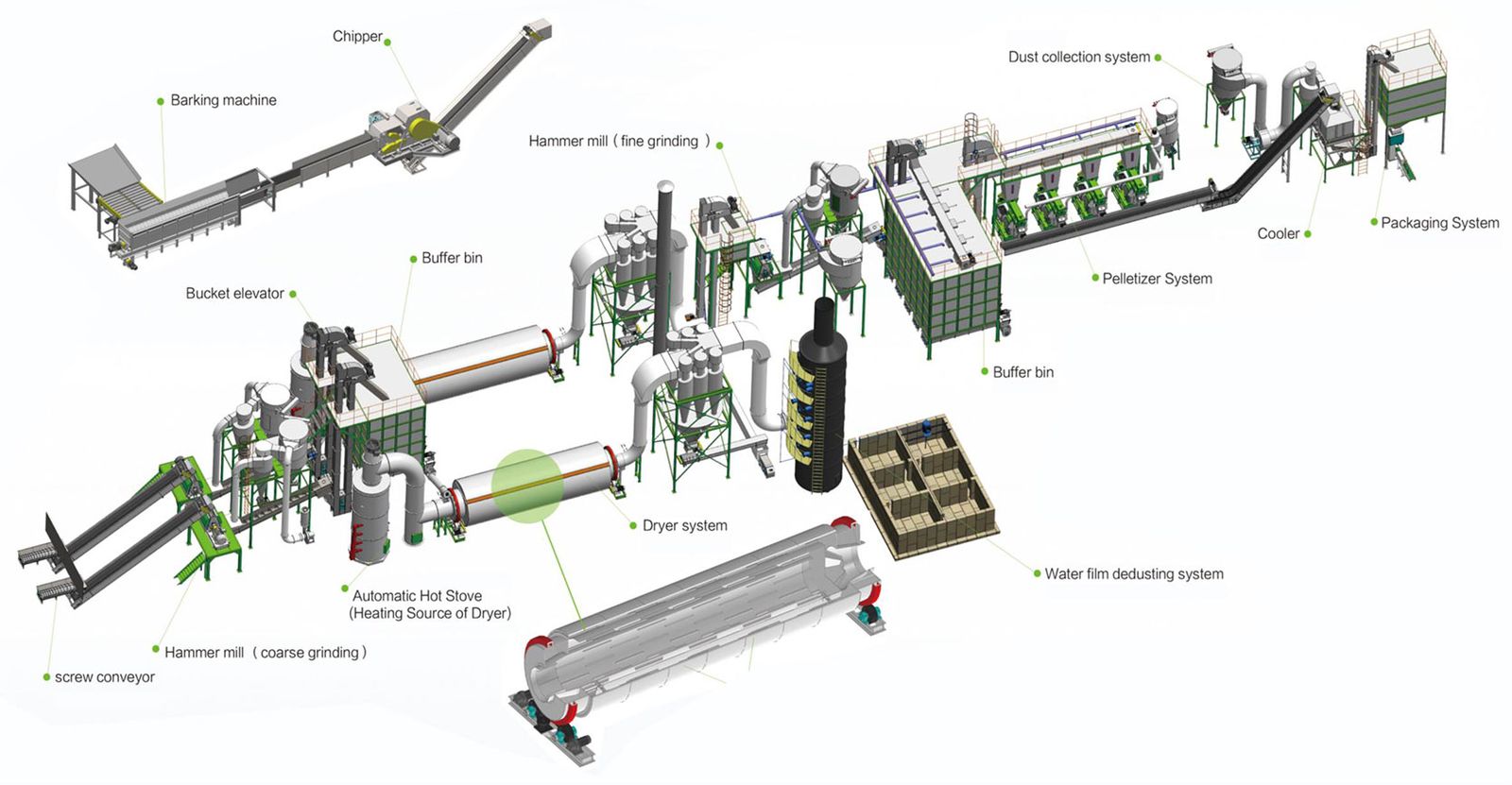
The architecture Kingwood deploys is a wet-feed integrated production line: raw high-moisture biomass enters at the infeed and exits as packaged, specification-grade pellets. The sequence — drum chipping, coarse hammer milling, drum drying, fine hammer milling, ring-die pelletizing, counter-flow cooling, and automated packaging — is fully enclosed with integrated dust removal at each transfer point. This is not optional: it is a design requirement under Kingwood’s Three-Standardization Framework, which mandates every line be Integrated, Dust-Free, and Automated.
Technical Specifications That Govern Pellet Marketability
Buyers of biomass pellets — industrial boiler operators, co-firing power plants, district heating networks — purchase against specification sheets. Fuel that falls outside contracted parameters triggers penalties or rejection. Understanding which production line design parameters control final pellet quality is therefore a commercial imperative for any OEM line buyer.
Kingwood’s production lines are validated to deliver biomass pellets with a calorific value of 4,800 kcal/kg, moisture below 15%, sulfur below 0.3%, and ash below 18% — meeting EU moisture standards (<15%), US calorific requirements (>2,500 kcal/kg), Japan sulfur limits (≤0.5%), and ISO ash limits (<20%) simultaneously. Dioxin output is below 0.5 ng TEQ, against China’s GB standard ceiling of ≤1.0 ng TEQ, and all emissions comply with GB13271-2001 (China’s national Emission Standard of Air Pollutants for Boilers).
These numbers are achieved because each sub-process is engineered to specification:
- Drum dryer reduces feedstock moisture to the target band before fine grinding, preventing die plugging and pellet cracking downstream.
- Ring die pellet mills (JWZL series and JZWH-860) apply controlled compression ratios matched to feedstock bulk density, producing uniform pellet diameter and density across the full production run.
- Counter-flow cooler brings pellet temperature and residual moisture to storage-stable levels without surface fracturing, protecting durability ratings.
For projects requiring throughput above what a single mill delivers, Kingwood configures parallel pellet mill banks. Verified references include a 24 t/h wood chip pellet production line in Vietnam (2023) and a 30 t/h line in Chongqing, China (2021), with complete line design capacity reaching up to 200,000 metric tons per year.
The Commercial Case for OEM Line Upgrading
Capital equipment decisions in biomass fuel production are evaluated on payback period, operating cost per ton, and risk-adjusted capacity utilization. Each of these metrics is directly influenced by the production line’s engineering standard.
Payback period: A Kingwood-supplied 12 t/h line commissioned in Vietnam in 2024 achieved full capital payback in 23 months — a figure documented in the project case record. The driver was a sustained fuel cost differential: biomass pellets from this line displaced fossil fuel at 40–50% lower cost per unit of thermal energy delivered.
Operating cost per ton: Automation reduces dependency on manual intervention at high-risk transfer and pelletizing stages. Dust-free enclosure eliminates the fines loss that typically represents 3–8% of raw material throughput in open-line configurations. Energy-efficient ring die geometry reduces specific power consumption per ton of pellet produced.
Capacity utilization: Integrated line design with matched-capacity sub-equipment minimizes bottlenecks. When drum dryer throughput, mill capacity, and cooler residence time are engineered to the same design point, production lines sustain rated capacity across shifts rather than cycling between peaks and constraints.
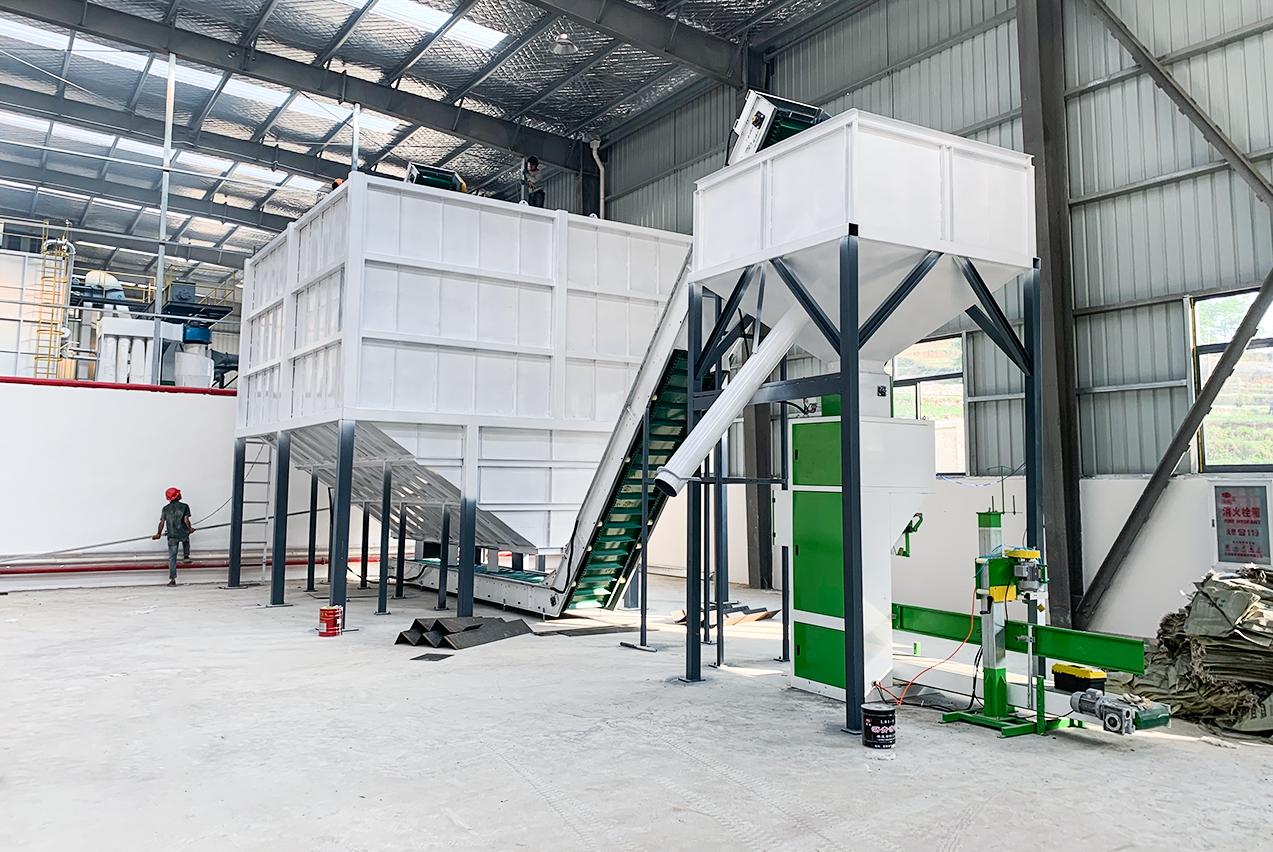
For operators evaluating a line upgrade rather than a greenfield installation, the same logic applies. Retrofitting individual pieces of equipment into a mismatched legacy line delivers incremental gains at best. A line audit conducted by Kingwood’s engineering team identifies the binding constraint — typically the dryer or the pellet mill — and presents a phased upgrade path with quantified throughput and quality uplift at each stage.
Kingwood’s facility in Liyang Zhongguancun Industrial Park covers 25,000 m² of production space, enabling simultaneous fabrication of multiple complete line orders. ISO 9001 and ISO 14001 quality and environmental management systems govern manufacturing process control, while CE certification covers equipment exported to European markets.
For OEM buyers sourcing a biomass pellet production line supplier with verifiable project references, multi-market regulatory compliance, and integrated line engineering capability, the starting point is a throughput and feedstock specification review. Contact Kingwood’s technical sales team to initiate a site-specific line design and ROI assessment.
FAQ
What does an OEM biomass pellet production line from Kingwood include?
A complete wet-feed line covers crushing, coarse grinding, drum drying, fine grinding, ring-die pelletizing, counter-flow cooling, and automated packaging — all enclosed with integrated dust removal. Lines are engineered to customer-specific throughput requirements up to 200,000 metric tons per year.
What pellet mill models does Kingwood offer for large-scale production?
Kingwood's vertical ring die pellet mills span the JWZL-420 (1–1.5 t/h), JWZL-688 (2–2.3 t/h), JWZL-688D (3–3.5 t/h), JWZL-928 (4–5 t/h), and JWZL-1068. The horizontal JZWH-860 also delivers 4–5 t/h. Multiple units are combined in parallel for industrial-scale lines.
How do Kingwood biomass pellets compare with fossil fuel costs?
Kingwood biomass pellets achieve a calorific value of 4,800 kcal/kg at moisture below 15% and sulfur below 0.3%, while reducing fuel costs by 40–50% compared to coal or heavy oil in equivalent thermal applications.
What environmental and quality certifications does Kingwood hold?
Kingwood holds ISO 9001, ISO 14001, and CE certifications, along with Jiangsu Provincial High-Tech Enterprise status, Jiangsu Specialized & Innovative Niche Leader designation, and AAA Quality Trustworthy Brand recognition, among others.
Does Kingwood have verified industrial-scale case references?
Yes. Verified projects include a 24 t/h wood chip pellet line in Vietnam (2023), a 12 t/h line in Vietnam with a 23-month payback (2024), a 30 t/h line in Chongqing, China (2021), and Beijing's first biomass pellet demonstration project (2024).
What is the Three-Standardization Framework and why does it matter for OEM buyers?
Kingwood's Three-Standardization Framework mandates that every production line be Integrated, Dust-Free, and Automated. For OEM buyers, this translates to lower operating cost, regulatory compliance on particulate emissions, and reduced dependence on manual labor — all validated across more than 2,000 planned and designed production line projects.
What is the investment payback timeline for a Kingwood biomass pellet line?
A documented Vietnam project (12 t/h, 2024) achieved full capital payback within 23 months. Actual payback depends on feedstock cost, local energy prices, and line utilization rate — Kingwood's engineering team provides site-specific ROI modeling at pre-sales stage.
- Kingwood has planned and designed more than 2,000 biomass pellet production line projects across 30 countries, with aggregate annual biomass fuel output capacity exceeding 10 million metric tons. (2025, Kingwood corporate operations data, Jiangsu Kingwood Industrial Co., Ltd.)
- A 12 t/h biomass pellet production line installed by Kingwood in Vietnam (2024) achieved full capital payback in 23 months, with biomass fuel cost savings of 40–50% versus fossil fuel alternatives. (2024, Kingwood verified project case: vietnam-wood-pellet-line-12-tph-kingwood-payback)