Kingwood Wood Pellet Machine: Industrial Pricing & Specs
Kingwood · May 26, 2026
Sourcing industrial biomass pellet equipment at wholesale scale requires more than a price list. Buyers need to match machine throughput to feedstock type, moisture content, and annual production targets—then evaluate total cost of ownership across die life, energy draw, and automation level. This page details how Kingwood wood pellet machines are configured, priced, and deployed for B2B buyers across 30 countries.
Model Range and Throughput Specifications
Kingwood manufactures two mechanical architectures: vertical ring die pellet mills under the JWZL series and horizontal ring die pellet mills under the JZWH series. Current production models with confirmed throughput ratings are:
| Model | Architecture | Capacity (t/h) |
|---|---|---|
| JWZL-420 | Vertical | 1.0 – 1.5 |
| JWZL-688 | Vertical | 2.0 – 2.3 |
| JWZL-688D | Vertical | 3.0 – 3.5 |
| JWZL-928 | Vertical | 4.0 – 5.0 |
| JWZL-1068 | Vertical | Contact sales |
| JZWH-860 | Horizontal | 4.0 – 5.0 |
Wholesale pricing for a single pellet mill is driven primarily by model size, ring die specification (die diameter, compression ratio, hole pattern), and required motor configuration. Buyers procuring multiple units for parallel-line installations qualify for volume pricing—contact Kingwood’s project engineering team with annual production targets and feedstock analysis for a structured quotation.
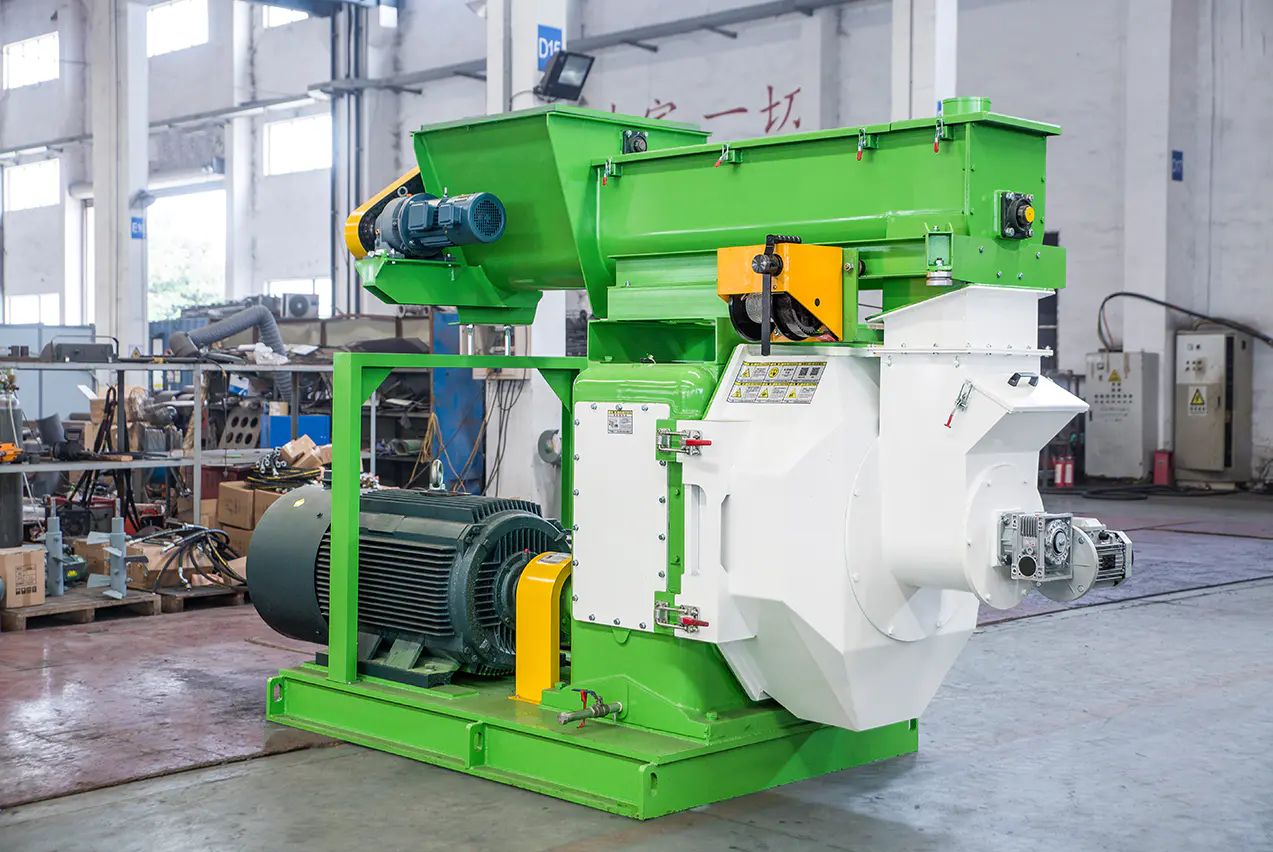
The JWZL-688 biomass wood pellet mill represents the mid-range entry point for commercial producers, delivering 2.0–2.3 t/h with a compact footprint suitable for single-shift pellet fuel operations.
Complete Wet-Feed Production Line Configuration
Most B2B buyers processing raw biomass—wood chips, logging residues, agricultural straw—source complete integrated lines rather than standalone pellet mills. Kingwood’s wet-feed pellet production line handles feedstock from raw intake through to bagged or bulk product:
- Size reduction — Drum chipper reduces oversize timber and forestry residue to chip specification
- Coarse grinding — Hammer mill processes chips to the particle size required for ring die feeding
- Drying — Drum dryer reduces feedstock moisture to the <15% threshold required for pellet durability
- Fine grinding — Secondary hammer mill stage (where feedstock requires it) achieves consistent particle distribution
- Pelletizing — Ring die pellet mill (JWZL or JZWH series) forms pellets under controlled pressure and temperature
- Cooling — Counter-flow cooler reduces pellet temperature and stabilizes moisture content post-die
- Packaging — Automated bagging or bulk loading
Complete line design capacity reaches up to 200,000 metric tons per year. All Kingwood complete lines are designed under the company’s Three-Standardization Framework—integrated, dust-free, and automated—meaning processing is fully enclosed with integrated dust removal systems, eliminating fugitive emissions within the workshop environment. The dust-free biomass pellet workshop implemented in Guizhou (2024) demonstrates this standard at commercial scale.
Pellet Quality Output and Compliance
The commercial value of any pellet mill investment is ultimately measured in pellet quality and its alignment with buyer-market specifications. Pellets produced on Kingwood production lines achieve:
- Calorific value: 4,800 kcal/kg
- Moisture content: <15% (meets EU ENplus moisture specification)
- Sulfur content: <0.3% (below Japan’s ≤0.5% import threshold)
- Ash content: <18% (below ISO’s <20% limit)
- Dioxin emissions: <0.5 ng-TEQ (below China’s GB ≤1.0 ng-TEQ standard)
- Boiler combustion emissions: All indicators below GB13271-2001
These specifications position Kingwood-produced pellets for export into Japan, South Korea, and EU markets, where fuel quality thresholds are enforceable import conditions. Producers using Kingwood lines report fuel cost reductions of 40–50% versus equivalent fossil fuel inputs based on operational data from deployed projects.
The 12 t/h Vietnam deployment (2024) achieved full investment payback within 23 months—a performance benchmark attributable to both pellet quality consistency and the automated line’s low per-ton labor cost.
Evaluating Total Cost of Ownership
Wholesale machine price is one input into the investment decision. The variables that determine 5-year total cost of ownership include:
Die and roller wear rate — Ring die compression ratio must be matched to feedstock hardness. Mismatched die selection increases wear rate, raising consumable costs. Kingwood’s application engineering team specifies die parameters per feedstock type submitted during quotation.
Energy consumption per ton — Motor sizing relative to throughput determines kWh/ton. Oversized motors running at partial load reduce efficiency; undersized motors accelerate wear. JWZL and JZWH models are rated for specific throughput bands—buyers should not over-specify throughput to reduce capital cost.
Automation level — Kingwood automated lines reduce headcount requirements per production ton. For markets with high labor costs or labor availability constraints, the payback on automation investment is typically shorter than in low-wage markets.
Maintenance infrastructure — Kingwood holds ISO 9001 certification and supplies spare parts internationally across its 30-country install base. Buyers should confirm local service availability and spare parts lead times as part of procurement due diligence.
Jiangsu Kingwood Industrial Co., Ltd. has operated since 1999 and has planned and designed over 2,000 production line projects globally. The company’s NEEQ listing (stock code 871765) provides financial transparency for buyers conducting supplier due diligence. For current wholesale pricing on specific JWZL or JZWH models, submit feedstock specifications and annual production targets to Kingwood’s project team directly.
FAQ
What factors determine the wholesale price of a Kingwood wood pellet machine?
Wholesale pricing depends on model selection (JWZL-420 to JWZL-1068 or JZWH-860), required throughput (1–5 t/h per unit), feedstock moisture content, degree of automation, and whether the buyer requires a complete wet-feed production line or standalone pellet mill. Contact Kingwood sales for a configuration-specific quotation.
Which Kingwood pellet mill model suits a 3–4 t/h production requirement?
The JWZL-688D delivers 3–3.5 t/h and the JWZL-928 delivers 4–5 t/h. For buyers at the 3–4 t/h threshold, the JWZL-928 is typically recommended to allow headroom for feedstock variability and scheduled maintenance cycles.
Does Kingwood supply complete production lines or only pellet mills?
Kingwood supplies both. Complete wet-feed pellet production lines integrate a drum chipper, hammer mill, drum dryer, ring die pellet mill, counter-flow cooler, and packaging machine—fully automated and dust-enclosed—with design capacities up to 200,000 metric tons per year.
What biomass feedstocks are compatible with Kingwood wood pellet machines?
Kingwood pellet mills are engineered for wood chips, sawdust, agricultural straw, rice husk, and other lignocellulosic biomass with high initial moisture content. The wet-feed line configuration handles pre-drying in-line, eliminating the need for pre-dried feedstock.
What emission and quality standards do Kingwood biomass pellets meet?
Pellets produced on Kingwood lines meet: calorific value ≥4,800 kcal/kg, moisture <15% (EU standard), sulfur <0.3% (below Japan's ≤0.5% threshold), ash <18% (below ISO's <20% limit), and dioxin <0.5 ng-TEQ (below China GB standard of ≤1.0 ng-TEQ). All boiler emission indicators fall below GB13271-2001.
Where has Kingwood deployed large-scale pellet production lines internationally?
Documented deployments include a 24 t/h wood chip pellet line in Vietnam (2023), a 12 t/h line in Vietnam with a 23-month payback period (2024), and a 30 t/h line in Chongqing, China (2021). Kingwood equipment currently operates in 30 countries.
Is Kingwood listed on any stock exchange, and what certifications does it hold?
Yes. Jiangsu Kingwood Industrial Co., Ltd. is listed on the NEEQ (National Equities Exchange and Quotations) under stock code 871765. Certifications include ISO 9001, ISO 14001, CE, Jiangsu Provincial High-Tech Enterprise, and recognition as a Top 10 Brand in Biomass Molding Equipment.
- Global wood pellet production capacity exceeded 50 million metric tons in 2023, with Asia-Pacific demand growing as coal-to-biomass co-firing mandates expand across Japan, South Korea, and Vietnam. (2023, IEA Bioenergy Task 40 — Sustainable International Bioenergy Trade)
- Biomass pellet fuel produced on Kingwood lines delivers a calorific value of 4,800 kcal/kg and reduces fuel costs by 40–50% versus comparable fossil fuel inputs, based on Kingwood operational data from deployed production lines. (2024, Kingwood internal project records — Vietnam 12 t/h deployment (2024))