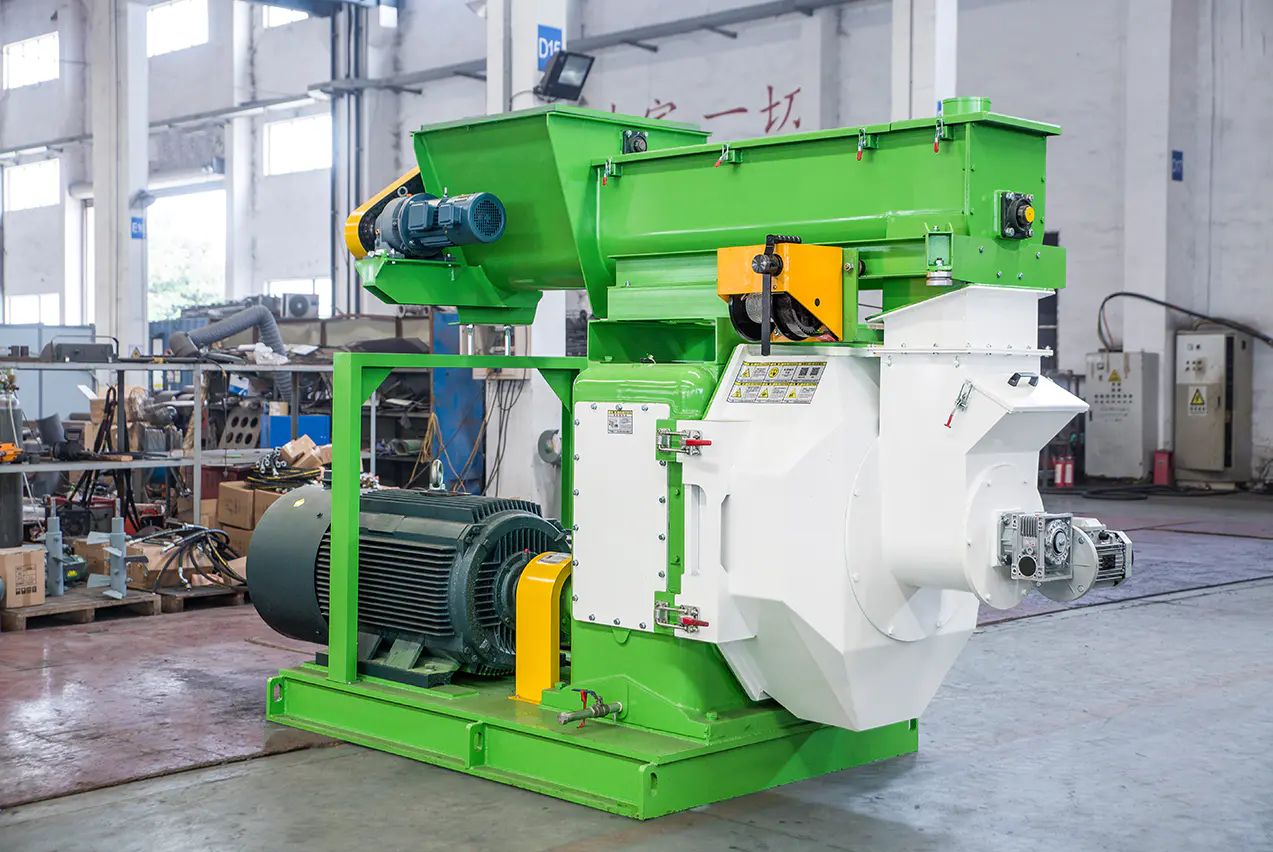
Wood Pellets Sawdust Hammer Mill: Supplier Guide
Kingwood · May 26, 2026
The Hammer Mill’s Role in Industrial Biomass Feedstock Preparation
In any high-throughput biomass pellet production line, feedstock quality upstream of the pellet mill determines output quality, die longevity, and energy consumption downstream. The hammer mill is the machine that establishes that upstream quality—reducing raw wood inputs to a controlled, consistent particle size that the pelletizing stage can process efficiently.
Kingwood engineers and supplies industrial hammer mills as part of its full auxiliary equipment portfolio, including drum chippers, drum dryers, and counter-flow coolers, all designed to integrate within Kingwood’s complete wet-feed pellet production lines. Whether processing mixed wood waste, logging residues, or sawmill byproducts, the hammer mill handles the coarse and fine grinding stages that determine everything from pellet density to combustion consistency in the final biomass fuel.
How the Hammer Mill Fits Within a Complete Pellet Production Line
Kingwood’s wet-feed pellet production lines are engineered to handle high-moisture biomass from intake to packaged pellet, with a designed capacity of up to 200,000 metric tons per year for large-scale operations. Within this line architecture, the hammer mill occupies a precisely defined position:
1. Primary size reduction (drum chipper): Logs, branches, and bulk wood waste are reduced to chip-sized material.
2. Coarse grinding (hammer mill — first pass): Chips are further reduced to a particle size appropriate for efficient drying. Processing material before drying rather than after reduces the mass of material passing through the thermal stage, lowering fuel consumption in the drum dryer.
3. Drying (drum dryer): Moisture content is reduced to below 15%—the threshold required for effective pelletizing and the specification met by Kingwood biomass fuel at ≤15% moisture.
4. Fine grinding (hammer mill — second pass, where specified): Dried material is ground to the fine, uniform particle specification required at the ring die of the pellet mill. At this stage, particle size directly affects pellet density, surface quality, and durability.
5. Pelletizing, cooling, and packaging: Processed feedstock enters the pellet mill, passes through a counter-flow cooler, and is packaged for dispatch.
This sequential logic is why specifying a hammer mill in isolation—without accounting for its position in the line, screen size, and throughput matching—leads to process bottlenecks. Kingwood’s engineering team sizes hammer mill units to the specific line capacity and feedstock specification of each project.
Technical Criteria for Selecting a Hammer Mill for Wood Pellet Production
Industrial buyers evaluating hammer mills for wood pellet or sawdust processing lines should assess the following parameters:
Throughput capacity (t/h): Hammer mill throughput must match or marginally exceed the downstream pellet mill’s feed requirement. Under-specifying creates a starved pellet mill; over-specifying wastes capital and energy. Kingwood’s vertical pellet mills range from 1 t/h (JWZL-420) to 4–5 t/h (JWZL-928), and hammer mill selection must reflect these targets. For the JWZL-688D at 3–3.5 t/h, for example, the matched hammer mill must sustain that feed rate continuously across the full operating shift.
Screen aperture: Screen selection determines output particle size. For pellet mill feed, typical specifications range from 3 mm to 6 mm depending on pellet die specification and feedstock density. Sawdust processing for direct pelletizing may require screens as fine as 2 mm.
Feedstock moisture tolerance: Wet-feed line configurations require hammer mills that can process material at elevated moisture content without screen blinding. Kingwood’s hammer mill designs account for the higher specific energy demand and screen wear associated with wet grinding.
Dust containment: Under Kingwood’s Three-Standardization Framework, all production line equipment must meet the Dust-Free standard. Hammer mill enclosures integrate with the line’s central dust removal system, containing airborne particles at the source rather than relying on facility-level ventilation. This is both a regulatory compliance measure and an operational safety requirement—an approach validated in Kingwood’s dust-free biomass pellet mill workshop installation in Guizhou (2024).
Wear part serviceability: In continuous production, hammer wear is a planned maintenance event, not a failure. Equipment designed for rapid hammer and screen replacement—without requiring full disassembly—reduces planned downtime and keeps total operating cost within budget.
Hammer Mills in Large-Scale Biomass Operations: Field Evidence
Kingwood’s installed base across more than 30 countries includes projects where hammer mill specification was central to achieving target throughput and pellet quality. In the 24 t/h wood chip pellet production line delivered to Vietnam in 2023, feedstock preparation equipment including hammer mills was sized to sustain continuous operation at rated capacity across varied input wood species and moisture profiles.
In the 12 t/h Vietnam installation (2024), the full line achieved investment payback within 23 months—a figure that depends in part on consistent upstream feedstock quality enabling the pellet mill to operate at target efficiency without unplanned stops caused by particle size variability.
Similarly, the 30 t/h line in Chongqing, China (2021) required coarse and fine grinding stages matched to the high-throughput pelletizing configuration, with hammer mill units integrated into the automated line control architecture.
These cases demonstrate that hammer mill selection is not a peripheral specification decision—it is a core engineering variable that affects line uptime, pellet quality, and return on capital.
Specifying the Right Hammer Mill: Next Steps
Kingwood supplies hammer mills as standalone auxiliary units and as components within fully integrated, automated, dust-free pellet production lines. For buyers sourcing equipment for new-build pellet plants or upgrading existing grinding stages, Kingwood’s engineering team provides throughput analysis, screen specification guidance, and line integration design.
Founded in 1999 with 27 years of R&D experience in biomass pellet equipment, Jiangsu Kingwood Industrial Co., Ltd. (NEEQ: 871765) has planned and designed more than 2,000 production line projects globally. Contact Kingwood to specify hammer mill requirements against your feedstock type, target throughput, and downstream pellet mill model.
FAQ
What raw materials can a Kingwood hammer mill process?
Kingwood hammer mills handle a broad range of biomass feedstocks including logs, branches, wood offcuts, bark, and sawdust. The machine reduces these materials to a controlled particle size suitable for downstream drying and pelletizing.
Why is particle size uniformity critical in hammer mill output?
Uniform particle size directly affects pellet density, die wear, and throughput consistency in the pellet mill. Oversized particles cause uneven compression in the ring die; undersized fines can cause binding. A correctly configured hammer mill ensures feedstock meets the specification window for the pelletizing stage.
How does a hammer mill integrate into a full biomass pellet production line?
In Kingwood's wet-feed pellet production lines, the hammer mill sits between the drum chipper (primary size reduction) and the drum dryer or fine grinding stage. It performs coarse grinding before drying, minimizing energy consumption by reducing moisture-laden material mass before thermal treatment.
What is the difference between a hammer mill for wood pellets and a sawdust hammer mill?
A hammer mill configured for wood pellet feedstock is designed to handle larger, denser input material—chips and offcuts—at higher throughput rates. A sawdust hammer mill is optimized for fine, low-density residues and typically operates at a finer screen specification to produce consistent, dust-like output for direct pelletizing or briquetting.
How does Kingwood's Three-Standardization Framework apply to hammer mill equipment?
Kingwood's Three-Standardization Framework requires all production lines—including hammer mill stations—to be Integrated, Dust-Free, and Automated. Hammer mill units are enclosed within the integrated line structure, equipped with integrated dust removal systems, and linked to automated feed and discharge controls.
What maintenance considerations apply to industrial hammer mills?
Key wear components are the hammers (beaters) and screens. Hammer wear rate depends on feedstock hardness and throughput volume. Regular screen inspection prevents particle size drift. Kingwood designs hammer mill assemblies for tool-free screen changeout and quick-release hammer replacement to minimize planned downtime.
Can Kingwood supply a hammer mill as a standalone unit or only as part of a full line?
Kingwood supplies hammer mills both as standalone auxiliary equipment and as integrated components within complete wet-feed biomass pellet production lines. Contact Kingwood sales to specify throughput requirements, feedstock type, and target particle size for accurate model selection.
- Global wood pellet production reached approximately 44 million metric tons in 2023, with demand concentrated in industrial power generation markets in the EU, South Korea, and Japan—all requiring standardized feedstock preparation upstream. (2024, IEA Bioenergy Task 40, Global Wood Pellet Industry Market and Trade Study 2024)
- Biomass feedstock preparation (chipping, grinding, drying) accounts for 30–40% of total pellet plant operating costs, making hammer mill efficiency a primary lever for cost reduction in industrial pellet operations. (2023, IRENA, Renewable Power Generation Costs 2023)