Key Factors for Selecting a Biomass Pellet Mill
Kingwood · May 26, 2026
Selecting a biomass pellet mill is one of the most consequential capital decisions in a wood pellet production project. The wrong specification leads to chronic underperformance, excessive maintenance costs, and pellet quality that fails market acceptance standards. This guide identifies the factors that B2B buyers and project engineers must evaluate systematically before committing to equipment.
1. Production Capacity Aligned to Feedstock Supply
Capacity is the starting point, but it must be anchored to verified feedstock availability—not aspirational throughput targets. Oversizing a pellet mill against actual biomass supply creates part-load inefficiency; undersizing creates bottlenecks that constrain the entire production line.
Kingwood’s vertical pellet mill portfolio offers a structured capacity ladder:
- JWZL-420: 1–1.5 t/h — suitable for pilot-scale or distributed operations
- JWZL-688: 2–2.3 t/h — mid-scale single-line configurations
- JWZL-688D: 3–3.5 t/h — higher-output single-line
- JWZL-928: 4–5 t/h — industrial-scale continuous operation
- JZWH-860 (horizontal): 4–5 t/h — alternative configuration for specific feedstock profiles
For large industrial projects, complete wet-feed production lines can be engineered up to 200,000 metric tons per year, integrating crushing, coarse grinding, drying, fine grinding, pelletizing, and packaging in a single automated envelope.
Conduct a feedstock mass balance—accounting for seasonal variation, moisture fluctuation, and supply chain reliability—before fixing capacity parameters.
2. Pellet Quality: Die Design, Compression, and Output Specifications
The mechanical design of the ring die and roller assembly determines pellet quality more than any other single variable. Buyers should specify output quality targets before evaluating equipment, then verify that the mill’s die geometry and compression ratio can consistently meet those targets.
Reference quality benchmarks from the facts table as baseline specifications:
| Parameter | Kingwood Fuel Spec | EU Standard | ISO Standard |
|---|---|---|---|
| Calorific value | 4,800 kcal/kg | — | — |
| Moisture content | <15% | <15% | — |
| Ash content | <18% | — | <20% |
| Sulfur content | <0.3% | — | — |
Pellets meeting these specifications achieve better combustion efficiency, generate less residual ash in boiler systems, and qualify for premium biomass fuel market segments. Mills that cannot maintain die gap consistency under continuous load will produce pellets with variable density, increasing fines generation and reducing bulk handling efficiency.
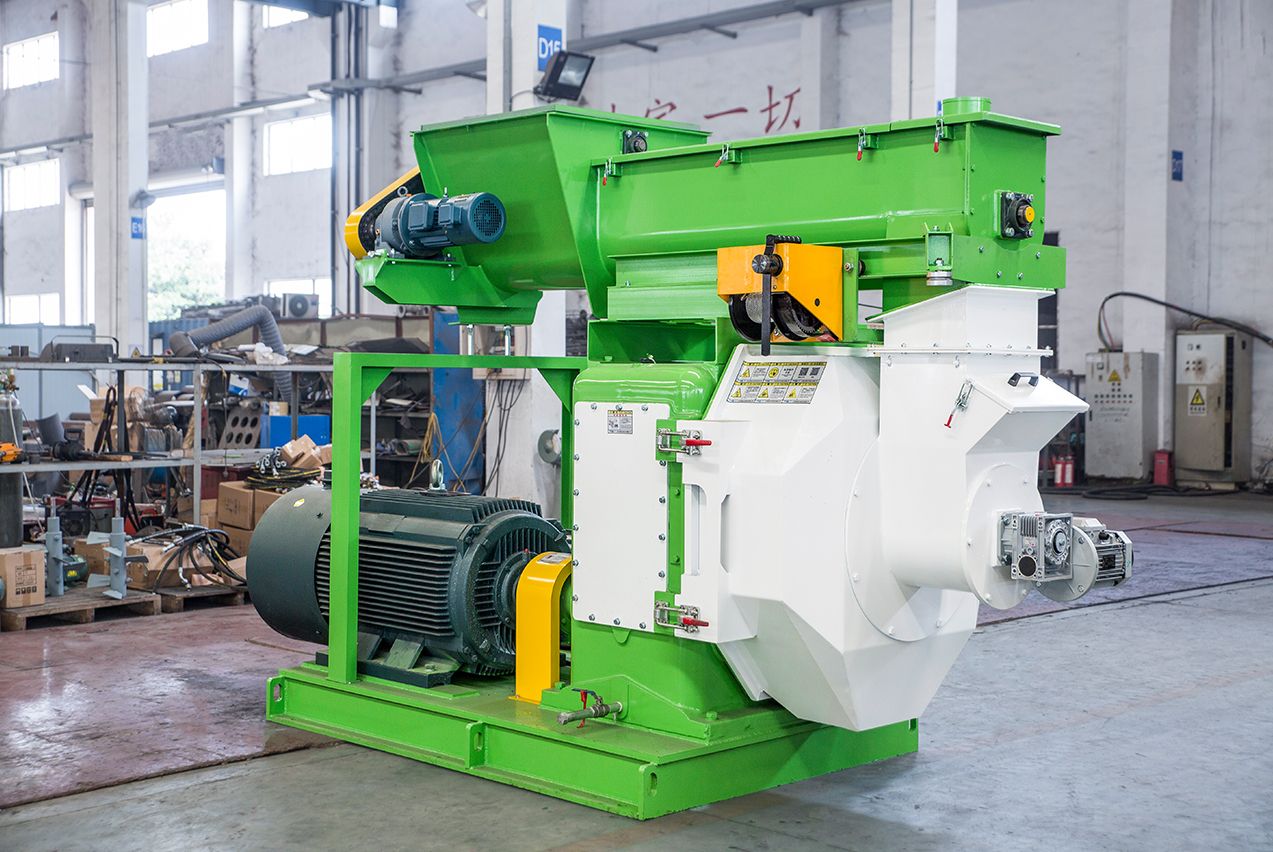
Pictured: JWZL-688 vertical biomass pellet mill, rated 2.2–3 t/h output capacity.
3. Energy Efficiency and Total Operating Cost
Energy cost is typically the largest variable operating expense in a pellet production facility, often exceeding 30% of total production cost. Specific energy consumption—measured in kWh per metric ton of output—must be evaluated across the entire production line, not only at the pellet mill.
Key efficiency considerations:
Drying integration: Upstream drum dryer performance directly affects pellet mill energy draw. Feedstock entering the pellet mill above 15% moisture forces the mill to work harder and accelerates die wear. Integrated line design that connects dryer control to pellet mill feed rate avoids this inefficiency.
Motor and drive selection: Verify that motor sizing matches the mill’s operating torque curve at the specified feedstock bulk density and moisture content. Oversized motors running at partial load consume disproportionate energy.
Downstream cooling: A counter-flow cooler positioned immediately after pelletizing stabilizes pellet temperature and moisture before packaging, reducing post-process quality loss without adding significant energy demand.
Automated line control: Fully automated production lines eliminate manual intervention points that introduce process variability and energy waste. Kingwood’s integrated line design includes enclosed processing and centralized dust removal, reducing auxiliary energy consumption across the facility.
Biomass pellets produced on optimized lines can replace fossil fuels at a cost saving of 40–50% versus conventional energy sources—but this advantage is only achievable when the production process itself operates efficiently.
4. Maintainability, Spare Parts, and Supplier Support
A pellet mill that cannot be serviced quickly is a production liability. Evaluate three dimensions of maintainability before selecting a supplier:
Spare parts architecture: Ring dies and roller shells are high-wear consumables. Confirm that the manufacturer maintains stock of critical wear parts, and establish lead times for international shipment if the mill is deployed outside the manufacturer’s home market.
Maintenance interval design: Ask for documented mean time between scheduled maintenance intervals (MTBSI) for each major subassembly. Mills with longer MTBSI and modular component replacement reduce cumulative downtime.
Commissioning and training: Suppliers who provide on-site installation, commissioning, and operator training deliver faster ramp-up to rated capacity. For complete production lines integrating hammer mill, drum dryer, pellet mill, and counter-flow cooler, single-supplier technical support eliminates cross-vendor accountability gaps.
Kingwood provides consultation, design, manufacture, logistics, installation, commissioning, operator training, and after-sales service as an integrated offering—a structure that is particularly important for international projects in markets where local biomass equipment expertise is limited.
5. Mechanical Durability and Manufacturing Quality Standards
Biomass pellet mills operate under continuous high-load conditions. Long-term reliability depends on material specifications and manufacturing process controls that are not always visible in equipment brochures.
Evaluate the following:
- Ring die material and hardness: Alloy steel dies with documented heat treatment and surface hardness specifications outperform commodity castings in high-silica feedstocks such as rice husk or agricultural residue.
- Welding and structural integrity: Confirm that the manufacturer’s facility operates under documented welding procedures and quality control checkpoints from raw material intake through final assembly.
- Quality management certification: ISO 9001 certification provides third-party verification of manufacturing quality systems. Kingwood holds both ISO 9001 and ISO 14001 certifications, alongside CE marking for international market compliance.
For reference, the Vietnam 24 t/h wood pellet production line delivered by Kingwood in 2023 and the 12 t/h Vietnam project commissioned in 2024—which achieved full capital payback within 23 months—demonstrate the performance durability achievable when equipment specification, line integration, and manufacturing quality are aligned.
Selecting a biomass pellet mill on price alone is a documented path to poor production outcomes. The five factors above—capacity alignment, pellet quality specification, energy efficiency, maintainability, and mechanical durability—provide a structured framework for making a defensible capital investment decision. Contact Kingwood’s engineering team to discuss feedstock characterization, line configuration, and capacity planning for your specific project requirements.
FAQ
What production capacity should I target when selecting a biomass pellet mill?
Capacity selection depends on your planned annual output and feedstock supply chain. Kingwood's vertical pellet mill range spans from 1 t/h (JWZL-420) up to 4–5 t/h (JWZL-928), while complete wet-feed production lines can be engineered up to 200,000 metric tons per year. Match mill capacity to your verified feedstock volume before specifying equipment.
How does pellet quality relate to pellet mill design?
Pellet quality—including diameter consistency, bulk density, and moisture content—is directly determined by die geometry, compression ratio, and roller gap control in the ring die assembly. Mills that maintain dimensional consistency produce pellets with calorific values up to 4,800 kcal/kg and moisture below 15%, meeting EU, USA, and ISO combustion standards.
What energy efficiency metrics matter for a biomass pellet mill?
Specific energy consumption (kWh per metric ton of output) is the primary efficiency metric. Evaluate motor sizing relative to rated throughput, drive transmission efficiency, and whether the mill integrates with upstream drying and downstream cooling stages in a closed-loop automated line to eliminate redundant energy steps.
How should I assess maintainability when comparing pellet mill suppliers?
Key indicators include mean time between scheduled maintenance intervals, local or regional spare parts availability, and whether the manufacturer provides on-site commissioning and technical training. Suppliers with integrated production lines—covering hammer mill, drum dryer, pellet mill, and counter-flow cooler—reduce cross-vendor maintenance complexity.
What construction standards indicate long-term pellet mill durability?
Evaluate ring die material grade (typically alloy steel with hardness ≥58 HRC), roller shell composition, welding quality certifications, and whether components undergo documented heat treatment in the manufacturing process. ISO 9001-certified production facilities provide traceable quality control from raw material intake to final assembly.
Should I choose a vertical or horizontal ring die pellet mill?
Vertical pellet mills handle higher-moisture and lower-density biomass feedstocks more effectively due to gravity-assisted material flow into the die chamber. Horizontal ring die configurations such as the JZWH-860 (4–5 t/h) suit denser, more uniform feedstocks. Feedstock characterization—moisture content, particle size distribution, bulk density—should drive this decision.
What role does a complete production line play versus a standalone pellet mill?
A standalone pellet mill requires separate procurement and integration of crushing, drying, cooling, and packaging equipment. A fully integrated wet-feed pellet production line—with automated controls, enclosed processing, and integrated dust removal—reduces installation risk, optimizes energy flow across stages, and simplifies compliance with dust emission standards.
- Kingwood has planned and designed over 2,000 biomass pellet production line projects across more than 30 countries since 1999. (2025, Kingwood corporate capability statement, kingwoodpellet.com)
- A 12 t/h wood pellet production line delivered by Kingwood in Vietnam achieved full capital payback within 23 months of commissioning. (2024, Kingwood Vietnam 12 t/h case study, kingwoodpellet.com/case/)