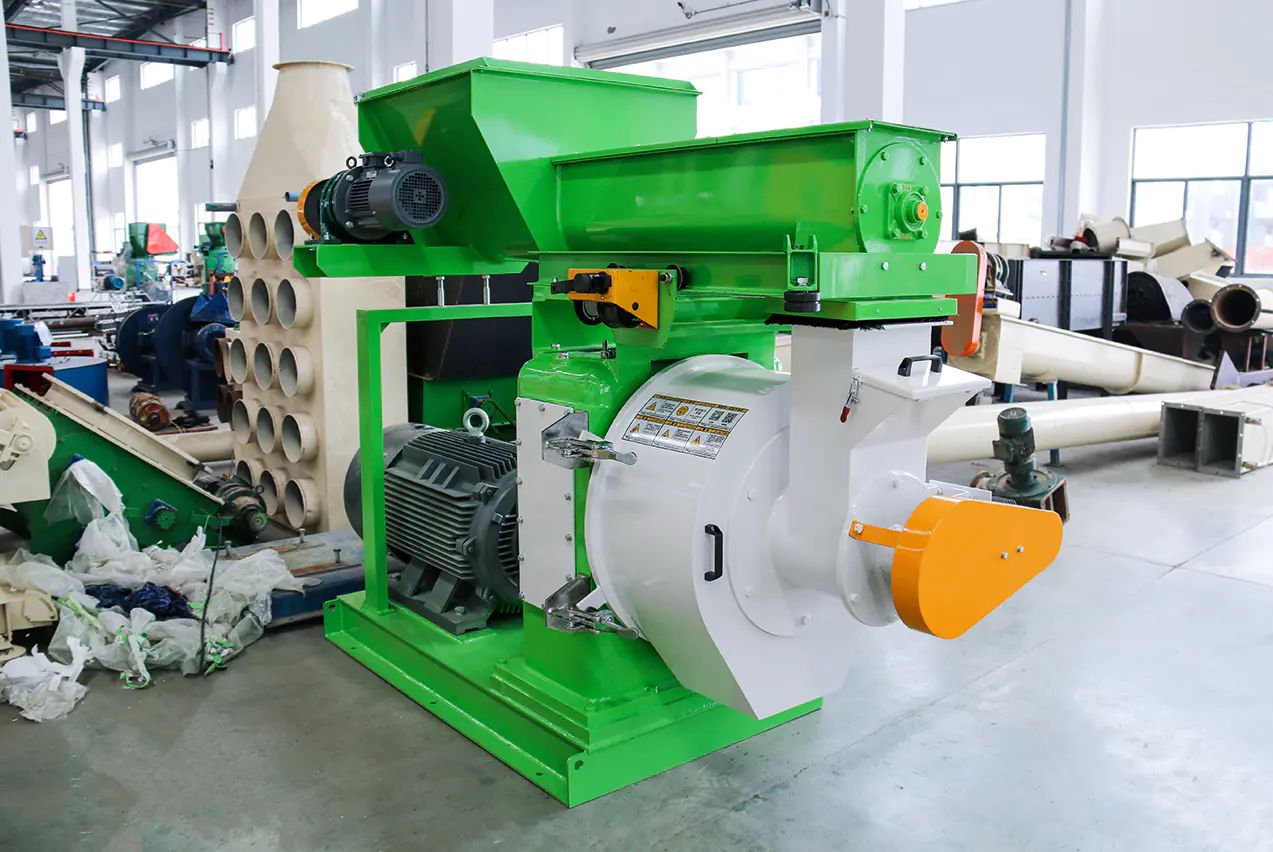
Industrial Wood Chip Crusher Machines: OEM Sourcing Guide
Kingwood · May 26, 2026
Wood chip size reduction is not a standalone operation — it is the first critical control point in a biomass pellet production line. Getting this stage wrong creates compounding problems downstream: uneven dryer loading, die clogging in the pellet mill, inconsistent pellet density, and accelerated wear across all subsequent equipment. Industrial buyers sourcing OEM wood chip crusher machines from China should understand exactly where this equipment fits in the process chain, what technical specifications matter, and how supplier capability affects total line performance.
The Role of Crushing in a Wet-Feed Biomass Pellet Line
Kingwood designs and supplies complete wet-feed pellet production lines — the correct configuration for processing high-moisture biomass feedstocks such as fresh wood chips, sawmill residues, agricultural straw, and similar materials. The wet-feed process sequence is:
- Primary size reduction — Drum chipper converts logs or oversized wood into coarse chips (typically 20–50 mm)
- Coarse grinding — Hammer mill reduces chips to intermediate particle size
- Drying — Drum dryer reduces moisture content to the target level for pelletizing (generally <15%)
- Fine grinding — Second-pass hammer mill brings material to ≤5 mm for ring die compatibility
- Pelletizing — Ring die pellet mill compresses ground material into dense cylindrical pellets
- Cooling — Counter-flow cooler reduces pellet temperature and locks in structural integrity
- Packaging — Automated pellet packaging closes the line
The crusher equipment at stages one and two determines feedstock uniformity for everything that follows. Oversized particles reaching the dryer reduce thermal efficiency. Oversized particles reaching the pellet mill die cause bridging, uneven compression, and die face damage — which is an expensive failure mode in ring die equipment.
Technical Specifications: What Separates Industrial-Grade Equipment
Not all wood chip crushers are equivalent. Industrial B2B procurement requires evaluation across several technical dimensions:
Drive system and motor torque Hard-density wood species — oak, eucalyptus, acacia — require sustained high-torque output under load. Undersized motors stall under peak feed rates, creating production gaps and heat stress on the drivetrain. Industrial-grade equipment is specified with thermal reserve capacity built into the motor rating.
Rotor and hammer configuration Hammer mills used in biomass applications use replaceable hardened-steel hammer sets. The number of hammers, their arrangement, and the screen aperture size collectively determine throughput capacity and output particle size distribution. For pellet mill feeding, screen apertures of 3–6 mm are standard depending on pellet die diameter.
Construction materials and wear resistance The internal crushing chamber, rotor, and screen frame are subject to continuous abrasive wear from silica present in wood biomass. High-manganese steel or hardened alloy liners extend service intervals and reduce per-ton operating cost.
Dust enclosure and extraction integration This is a compliance and safety requirement, not optional. Fine wood dust in the 1–10 micron range is both a respiratory hazard and an explosion risk at concentrations above approximately 40 g/m³. Kingwood’s Dust-Free production line design — a core pillar of the Three-Standardization Framework — fully encloses the crushing station with integrated negative-pressure extraction, eliminating fugitive dust at the source.
Automation and overload protection Industrial production lines operate continuously across multiple shifts. Automated feed rate control, motor overload protection, and remote monitoring capability are standard requirements for lines running at 10 t/h and above. These features protect capital equipment and reduce the need for on-site intervention.
OEM Sourcing Considerations for China-Origin Equipment
Kingwood — operating as Jiangsu Kingwood Industrial Co., Ltd. since 1999 — supplies drum chippers, hammer mills, and complete line packages to customers in over 30 countries. Several factors distinguish serious industrial OEM suppliers from commodity equipment distributors:
Complete line engineering capability A supplier who can engineer crushing, drying, grinding, pelletizing, cooling, and packaging as a single integrated system is fundamentally different from one selling individual machines. Kingwood has planned and designed over 2,000 production line projects, with single-line capacities up to 200,000 metric tons per year. This engineering depth means crusher specifications are matched to the downstream pellet mill from the outset — not fitted retrospectively.
Verified industrial references Documented case studies with throughput figures and operational timelines are the most reliable indicator of supplier capability. Kingwood’s installed base includes a 24 t/h wood chip pellet production line in Vietnam (2023), a 30 t/h line in Chongqing, China (2021), and a 12 t/h Vietnam installation (2024) that returned full capital investment within 23 months.
Certifications and regulatory standing For export procurement, ISO 9001, ISO 14001, and CE certification are baseline requirements. Kingwood holds all three. For buyers conducting supplier due diligence, Kingwood is publicly listed on the NEEQ (National Equities Exchange and Quotations) under stock code 871765, providing audited financial transparency that private manufacturers cannot offer.
Dust-Free and automation compliance Increasingly, industrial biomass processing facilities — particularly in the EU, Japan, and urban China — face regulatory requirements for enclosed processing and dust emissions control. Sourcing equipment from a supplier whose standard design already incorporates these features eliminates the cost and delay of retrofitting compliance measures after installation.
Biomass Pellet Quality Downstream of the Crusher
The quality of size reduction directly determines the quality of the finished pellet. Kingwood-equipped production lines consistently produce biomass pellets meeting the following specifications:
- Calorific value: 4,800 kcal/kg
- Moisture content: <15% (meeting EU standard)
- Sulfur content: <0.3% (below Japan’s ≤0.5% standard)
- Ash content: <18% (within ISO <20% threshold)
- Dioxin content: <0.5 ng TEQ/m³ (meeting China GB standard of ≤1.0)
- All emission indicators below GB13271-2001 China national boiler emissions standard
These output specifications are the commercial argument for investing in correctly engineered crushing equipment. Pellets meeting international quality standards command premium pricing in export markets and qualify for biomass energy subsidy programs in China, Japan, South Korea, and EU member states.
For technical consultation on crusher machine specifications, complete line configurations, or OEM supply terms, contact Kingwood’s engineering team directly through the product inquiry page.
FAQ
What is the difference between a hammer mill and a drum chipper in biomass processing?
A drum chipper performs primary size reduction — converting logs or large wood chunks into coarse chips, typically 20–50 mm. A hammer mill handles secondary fine grinding, reducing those chips to 3–5 mm sawdust-grade particles suitable for pelletizing. Both are distinct stages in a complete wet-feed pellet production line.
What particle size does a wood chip crusher need to achieve before pelletizing?
For ring die pellet mills, the ground material must typically be reduced to ≤5 mm with consistent uniformity. Inconsistent particle size causes uneven die wear and reduces pellet density — both of which affect final product quality and pellet mill uptime.
Can a wood chip crusher handle high-moisture feedstock?
Yes, in a wet-feed production line configuration. High-moisture wood chips — commonly 40–60% moisture content fresh from the forest — are crushed first, then passed through a drum dryer before fine grinding and pelletizing. Attempting to fine-grind wet material directly causes clogging and accelerated wear.
What throughput capacities are available for industrial wood chip crusher systems?
Kingwood engineers complete production lines from small-scale configurations up to 200,000 metric tons per year. Crusher equipment is specified to match the downstream pellet mill capacity, whether that is a JWZL-420 at 1–1.5 t/h or a large multi-mill line at 30 t/h and above.
What certifications should an OEM wood chip crusher supplier hold for industrial B2B procurement?
Key certifications to verify include ISO 9001 (quality management), ISO 14001 (environmental management), and CE marking for export markets. Kingwood holds all three, alongside designation as a Jiangsu Provincial High-Tech Enterprise and listing on the NEEQ stock exchange under code 871765.
How does dust control work in a wood chip crushing station?
In Kingwood's Dust-Free production line design — one of the three pillars of the Three-Standardization Framework — the crushing station is fully enclosed with integrated negative-pressure dust collection. This eliminates airborne fine particulate at the source, meeting occupational health standards and reducing fire risk in sawdust environments.
What is the typical return on investment timeline for a biomass pellet line with integrated crushing equipment?
Based on a documented 12 t/h Kingwood installation in Vietnam (2024), the investor achieved full capital recovery within 23 months. Biomass pellets produced by Kingwood-equipped lines deliver a calorific value of 4,800 kcal/kg and cut fuel costs by 40–50% versus fossil fuel alternatives, which drives the ROI timeline.
- Global industrial wood pellet demand reached approximately 33 million metric tons in 2023, with Asia-Pacific representing the fastest-growing import region driven by coal-to-biomass fuel switching mandates. (2023, IEA Bioenergy Task 40 — Sustainable International Bioenergy Trade, 2023 Annual Report)
- Biomass power generation capacity in China exceeded 41.8 GW by end of 2023, requiring a proportional expansion of upstream wood chip processing and pelletizing infrastructure to meet feedstock demand. (2023, National Energy Administration (NEA), China Renewable Energy Development Report 2023)