The Manufacturing Process of an Industrial Wood Pellet Maker
Kingwood · May 26, 2026
What an Industrial Wood Pellet Maker Actually Does
An industrial wood pellet maker converts raw biomass — wood chips, agricultural residues, sawdust, and similar feedstocks — into dense, standardized fuel pellets suitable for power generation, industrial boilers, and commercial heating systems. Unlike consumer-grade pellet equipment, industrial-scale machines are engineered for continuous operation, high throughput, and strict compliance with international fuel quality standards.
The output serves procurement teams at power plants, district heating operators, and industrial manufacturers who require consistent pellet specifications: calorific value of 4,800 kcal/kg, moisture below 15%, sulfur content below 0.3%, and ash content below 18%. These values align with EU, US, Japanese, and ISO standards — non-negotiable requirements for large-volume fuel contracts.
Understanding the manufacturing process is essential for any operator evaluating equipment investment, line configuration, or production capacity planning.
The Six-Stage Industrial Pellet Manufacturing Process
Stage 1 — Primary Size Reduction
Incoming biomass rarely arrives at a uniform size. Logs, branches, and bulk agricultural waste must first pass through a drum chipper to reduce material to a manageable chip size, typically 30–50 mm. This pre-chipping step protects downstream equipment and reduces energy consumption in subsequent grinding stages.
Stage 2 — Coarse and Fine Grinding
Wood chips and coarse biomass are fed through a hammer mill to achieve the particle size required for effective pelletizing — generally under 5 mm. Particle uniformity at this stage directly influences pellet density and die wear. Inconsistent feed particle size is one of the most common causes of premature ring die failure.
Stage 3 — Drying
Moisture content is the most critical process variable. Most raw biomass carries 30–55% moisture as received. A drum dryer reduces this to below 15% — the threshold required for proper compression in the pellet mill and for meeting international fuel quality benchmarks. Under-drying produces soft, low-density pellets that crumble during transport; over-drying increases energy consumption and fire risk.
Stage 4 — Pelletizing
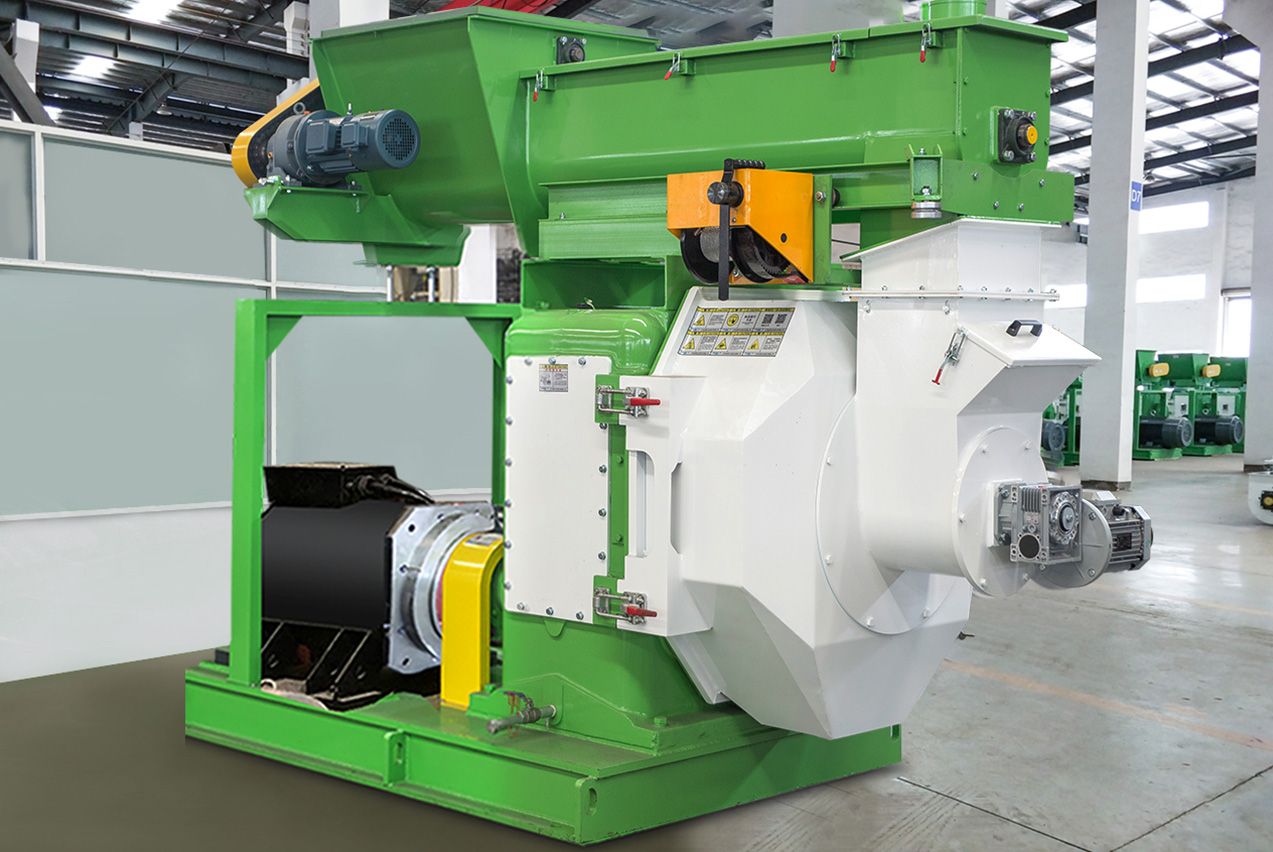
Conditioned biomass enters the pellet mill, where a ring die and roller assembly apply high mechanical pressure to force material through die holes, forming cylindrical pellets. The ring die is the core wear component of any pellet mill. Die selection — hole diameter, compression ratio, and material specification — must be matched to feedstock type and target pellet density.
Kingwood’s vertical pellet mill lineup — the JWZL-688 at 2–2.3 t/h, JWZL-688D at 3–3.5 t/h, and JWZL-928 at 4–5 t/h — uses high-precision gear transmission and spray-type gear oil circulation on the main shaft to sustain throughput under continuous industrial load. For facilities requiring horizontal configuration, the JZWH-860 also delivers 4–5 t/h.
Stage 5 — Counter-Flow Cooling
Pellets discharge from the mill at elevated temperature — typically 70–90°C — and with surface moisture that must be stabilized before storage or packaging. A counter-flow cooler passes ambient air in the opposite direction to pellet movement, progressively reducing temperature and locking in structural integrity. Inadequate cooling leads to moisture migration during storage, pellet softening, and elevated dust generation during bulk handling.
Stage 6 — Screening and Packaging
Post-cooling, pellets pass through a vibratory screen to remove fines and undersized material. The screened product is either conveyed to bulk storage silos or fed into a pellet packaging machine for bagged retail or export formats. Automated lines direct screen rejects back to the pellet mill feed stream to minimize material loss.
Complete Line Design: Wet-Feed Automation and the Three-Standardization Framework
A single pellet mill is one component. For production volumes between 10,000 and 200,000 tonnes per year, operators require a fully integrated wet-feed production line — engineered to handle high-moisture biomass from intake through to packaged output without manual intervention between stages.
Kingwood designs complete lines under its Three-Standardization Framework, which applies three engineering standards across every project:
- Integrated production lines — continuous process flow from crushing through packaging, eliminating inter-stage bottlenecks
- Dust-Free production lines — enclosed processing with integrated dust removal at each transfer point, addressing occupational health and fire safety requirements
- Automated production lines — PLC-controlled operation throughout, with remote monitoring capability and automated fault response
This framework is directly relevant to operators in regulated markets where dust emission limits, worker safety standards, and process documentation requirements apply to biomass processing facilities. A recent application of the Dust-Free standard can be reviewed in the Guizhou dust-free pellet mill workshop case.
For operators evaluating large-scale deployment, Kingwood has designed and planned over 2,000 production line projects across 30 countries. The 2024 Vietnam project — a 12 t/h wood pellet line — achieved investment payback within 23 months, a useful benchmark for project finance modelling.
Equipment Selection Criteria for Industrial Buyers
When specifying an industrial wood pellet maker, procurement and engineering teams should evaluate the following:
Feedstock variability — Lines processing mixed feedstocks (hardwood, softwood, agricultural residues) require adjustable die configurations and variable-speed drives to maintain consistent output quality across material changes.
Throughput requirements — Match machine capacity to drying and cooling system capacity. A pellet mill running at 4 t/h fed by an undersized dryer will either produce off-spec pellets or operate below rated throughput.
Maintenance access and spare parts — Ring die and roller wear is predictable and should be factored into operating cost modelling. Machines with accessible die change systems reduce downtime. Bearing and seal quality directly affects mean time between failures.
Total line integration — A modular line design allows staged capacity expansion. Adding a force feeder or conditioning mixer to an existing pellet mill installation can increase throughput without replacing the core machine.
Kingwood — headquartered at #568 Hongsheng Road, Liyang City, Jiangsu Province, and listed on NEEQ under stock code 871765 — has operated in biomass pellet equipment engineering since 1999, with ISO 9001, ISO 14001, and CE certifications covering both product and management systems.
FAQ
What raw materials can an industrial wood pellet maker process?
Industrial pellet mills handle a wide range of biomass feedstocks including wood chips, sawdust, agricultural residues such as straw and peanut shells, and energy crops. Moisture content and particle size vary by feedstock and must be controlled before pelletizing — typically to below 15% moisture and under 5 mm particle size.
What are the main process stages in industrial wood pellet production?
The full process covers: (1) primary size reduction via drum chipper or hammer mill, (2) moisture conditioning in a drum dryer, (3) fine grinding, (4) pelletizing through a ring die pellet mill, (5) counter-flow cooling, and (6) screening and packaging. Automated lines integrate all stages within an enclosed, dust-managed environment.
Why is moisture control critical in the pellet manufacturing process?
Moisture directly affects pellet density, durability, and combustion performance. Biomass entering the pellet mill should carry less than 15% moisture. Excess moisture causes poor die compression and pellet breakage; insufficient moisture increases friction and accelerates die wear. A drum dryer is used to bring feedstock to the target moisture range before pelletizing.
What pellet mill models does Kingwood manufacture for industrial-scale production?
Kingwood produces the JWZL-420 (1–1.5 t/h), JWZL-688 (2–2.3 t/h), JWZL-688D (3–3.5 t/h), JWZL-928 (4–5 t/h), and JWZL-1068 (capacity on request) vertical pellet mills, plus the JZWH-860 horizontal pellet mill at 4–5 t/h. Complete automated lines are designed up to 200,000 tonnes per year capacity.
What fuel quality do biomass pellets produced on Kingwood lines achieve?
Pellets produced on Kingwood lines reach a calorific value of 4,800 kcal/kg, moisture below 15%, sulfur below 0.3%, and ash below 18% — meeting EU, US (>2,500 kcal/kg), Japanese (sulfur ≤0.5%), and ISO (ash <20%) standards. All emission indicators comply with China's GB13271-2001 boiler air pollutant standard.
How does a counter-flow cooler function in the pellet production line?
After exiting the pellet mill, pellets carry significant heat and residual moisture. A counter-flow cooler passes ambient air in the opposite direction to pellet flow, progressively reducing temperature and stabilizing moisture content. This prevents condensation during storage, improves pellet hardness, and reduces breakage during bulk handling and transport.
What is Kingwood's Three-Standardization Framework and how does it apply to pellet production lines?
The Three-Standardization Framework defines Kingwood's engineering standard across three pillars: Integrated production lines (end-to-end process continuity), Dust-Free production lines (enclosed processing with integrated dust removal), and Automated production lines (PLC-controlled operation throughout). Applied together, these standards improve occupational safety, operational consistency, and product quality across industrial biomass pellet facilities.
- Global industrial wood pellet demand reached approximately 30 million metric tons in 2023, with Asia-Pacific markets — particularly Japan and South Korea — accounting for the fastest import growth. (2023, IEA Bioenergy Task 40 — Woody Biomass for Energy: Market Developments and Policies)
- Biomass pellet fuel can reduce energy costs by 40–50% compared to conventional fossil fuel alternatives in industrial boiler applications. (2024, Kingwood technical specification documentation, kingwoodpellet.com)