Sawdust Pellet Mill: Industrial Guide & Supplier Overview
Kingwood · May 26, 2026
Sawdust is the highest-volume co-product of the global wood processing industry. For decades it was a disposal problem. Industrial sawdust pellet mills changed that equation permanently — converting a low-value residue into a standardised, high-calorific biomass fuel that competes directly with fossil energy on price and outperforms it on carbon profile. This article examines how the technology works at industrial scale, what buyers should evaluate when selecting a China sawdust pellet mill making machine supplier company, and how Kingwood’s integrated line architecture addresses the process challenges that smaller equipment packages cannot.
From Waste Stream to Fuel Grade: The Industrial Process
Converting raw sawdust into specification-grade biomass pellets requires more than a single pressing machine. At industrial throughput, the process is a sequential chain:
1. Size reduction — drum chipper and hammer mill Bulk wood waste and sawdust are first chipped to a workable particle size by a drum chipper, then ground to fine meal by a hammer mill. Uniform particle size is a prerequisite for consistent die-fill and pellet density downstream. Inconsistent feed particle size is the leading cause of pellet quality variation in under-engineered lines.
2. Drying — drum dryer Raw sawdust moisture content varies widely by species, season, and storage conditions — commonly 30–55% for fresh material. Ring die pellet mills require feed moisture of 10–15% for stable extrusion and pellet cohesion. A drum dryer brings feedstock within this window before it reaches the pellet mill. This stage is what separates a true wet-feed production line from equipment sold for pre-dried material only.
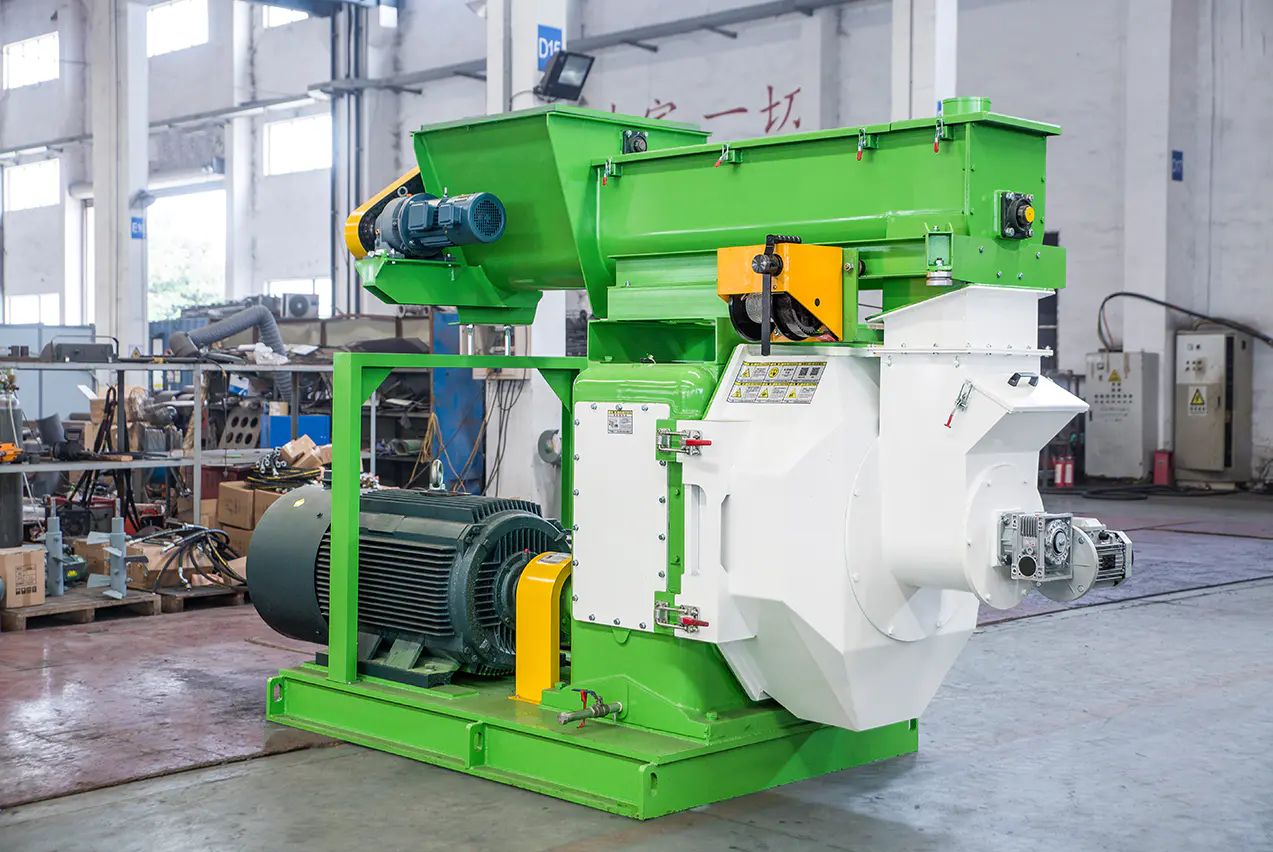
3. Pelletizing — ring die pellet mill Dried, ground sawdust is fed into the ring die chamber under high compression. Kingwood’s vertical biomass pellet mill range — the JWZL series — covers throughputs from 1 t/h (JWZL-420) up to 4–5 t/h per unit (JWZL-928), with multi-unit configurations deployed on high-capacity lines. The horizontal JZWH-860 delivers equivalent 4–5 t/h throughput in an alternative mechanical architecture. Complete line configurations scale to 30 t/h, as demonstrated in Kingwood’s 30 t/h installation in Chongqing, China (2021).
4. Cooling — counter-flow cooler Freshly extruded pellets exit the die at elevated temperature and moisture. A counter-flow cooler reduces pellet temperature and finalises moisture content, hardening the pellet surface and preventing post-packaging degradation.
5. Packaging Automated pellet packaging completes the line, outputting product ready for bulk logistics or bagged retail.
Kingwood designs each stage as an integrated system — not a collection of standalone machines — under the Three-Standardization Framework: integrated production lines, dust-free production lines, and automated production lines. This architecture is the basis for the enclosed processing and integrated dust removal that industrial buyers increasingly mandate.
Equipment Selection Criteria for Industrial Buyers
When evaluating a China sawdust pellet mill making machine supplier company, procurement teams should apply the following technical filters:
Throughput scalability. A single pellet mill unit rarely meets the full capacity of an industrial site. Evaluate whether the supplier designs multi-unit configurations with shared auxiliary infrastructure, and whether the line design scales without bottlenecks at the dryer or cooler.
Wet-feed capability. Lines designed exclusively for pre-dried feedstock require the buyer to establish an independent drying operation — adding capital cost, energy cost, and operational complexity. A wet-feed line integrates drying within the production process. Kingwood’s complete line handles high-moisture biomass from the chipper stage forward.
Dust management. Industrial biomass grinding and conveying generates significant airborne particulate. Enclosed processing with integrated dust removal is a regulatory and workplace safety requirement in most jurisdictions, not an optional upgrade. Kingwood’s dust-free production line standard, implemented at scale in the Guizhou dust-free biomass pellet workshop (2024), demonstrates how this specification translates to built installations.
Automation architecture. Manual transfer points between process stages are failure modes — they introduce inconsistency, add labour cost, and create safety exposure. Full automation from feed intake to packaging output is the current industrial standard for lines above approximately 5 t/h.
Fuel quality output. The pellet mill is only valuable if the pellets it produces meet market specifications. Kingwood equipment produces biomass pellets at 4,800 kcal/kg calorific value, below 15% moisture, below 0.3% sulfur, and below 18% ash — meeting EU moisture standards, US calorific standards, Japanese sulfur standards, and ISO ash standards simultaneously.
Kingwood as a China Sawdust Pellet Mill Supplier
Jiangsu Kingwood Industrial Co., Ltd. was founded in 1999 and has accumulated 27 years of dedicated R&D in biomass pellet equipment. Operating from a 31,200 m² facility in Liyang Zhongguancun Industrial Park, Jiangsu Province, Kingwood has planned and designed more than 2,000 production line projects across 30+ countries, with aggregate annual biomass fuel output capacity exceeding 10 million metric tons. The company is publicly listed on China’s NEEQ exchange (stock code: 871765) and holds ISO 9001, ISO 14001, and CE certifications alongside multiple provincial high-technology and innovation designations.
Recent project references include a 24 t/h wood chip pellet production line in Vietnam (2023), a 12 t/h line in Vietnam (2024) with a verified 23-month investment payback period, and Beijing’s first biomass pellet demonstration project (2024).
Industrial sawdust pellet fuel produced on these lines delivers 40–50% cost savings versus fossil fuels on equivalent thermal output, with all boiler emission indicators below China’s GB13271-2001 national standard. At that cost differential, the economic case for converting sawdust waste streams into biomass fuel is not speculative — it is documented across operating installations.
For technical specifications, line configuration consultation, or project feasibility discussion, contact Kingwood’s engineering team directly.
FAQ
What distinguishes an industrial sawdust pellet mill from a small-scale unit?
Industrial sawdust pellet mills operate at continuous throughputs from 1 t/h up to 30 t/h, use ring die compression rather than flat die, and integrate with upstream hammer mills, drum dryers, and downstream counter-flow coolers for a fully enclosed, automated production line. Small-scale flat die units top out well below 1 t/h and lack automated process control.
What moisture content is acceptable for sawdust feed in a pellet mill?
For ring die pellet mills, optimal feed moisture is typically 10–15%. Wet-feed production lines — such as those designed by Kingwood — handle high-moisture sawdust by incorporating a drum dryer stage before pelletizing, bringing feedstock within the target range before it reaches the die.
What calorific value do sawdust biomass pellets achieve?
Sawdust biomass pellets produced on Kingwood equipment reach a calorific value of 4,800 kcal/kg, with moisture content below 15%, sulfur content below 0.3%, and ash content below 18% — compliant with EU, US, Japanese, and ISO pellet quality standards.
How does automation reduce operating cost in a sawdust pellet production line?
Fully automated lines eliminate manual intervention at every transfer point — feeding, drying, grinding, pelletizing, cooling, and packaging — reducing labor headcount, improving process consistency, and lowering per-tonne production cost. Kingwood's automated lines are designed under the Three-Standardization Framework, which mandates integrated, dust-free, and automated process architecture.
What annual production capacity can a Kingwood sawdust pellet line achieve?
Kingwood designs complete sawdust pellet production lines with maximum annual output capacity of 200,000 metric tons. Line configuration is scaled to the client's feedstock volume, site layout, and target output.
How does sawdust pellet fuel compare to fossil fuel on operating cost?
Biomass pellet fuel generated from sawdust delivers cost savings of 40–50% versus conventional fossil fuels when used in industrial boilers, based on equivalent thermal output. Emission indicators also fall below China's GB13271-2001 national boiler air pollutant standard.
Which certifications does Kingwood hold relevant to sawdust pellet mill supply?
Kingwood holds ISO 9001, ISO 14001, and CE certifications, alongside designation as a Jiangsu Provincial High-Tech Enterprise, Jiangsu Provincial Specialized & Innovative Niche Leader, and membership as Deputy Director Unit of the China Biomass Energy Industry Alliance.
- Global wood pellet production capacity exceeded 50 million metric tons per year as of 2023, with demand driven by EU renewable energy mandates and industrial co-firing programmes. (2023, IEA Bioenergy Task 40 — Sustainable Biomass Supply Chains)
- Kingwood has planned and designed over 2,000 biomass pellet production line projects serving clients across 30+ countries, with aggregate annual biomass fuel capacity exceeding 10 million metric tons. (2025, Kingwood (Jiangsu Kingwood Industrial Co., Ltd.) — Company Capability Statement)