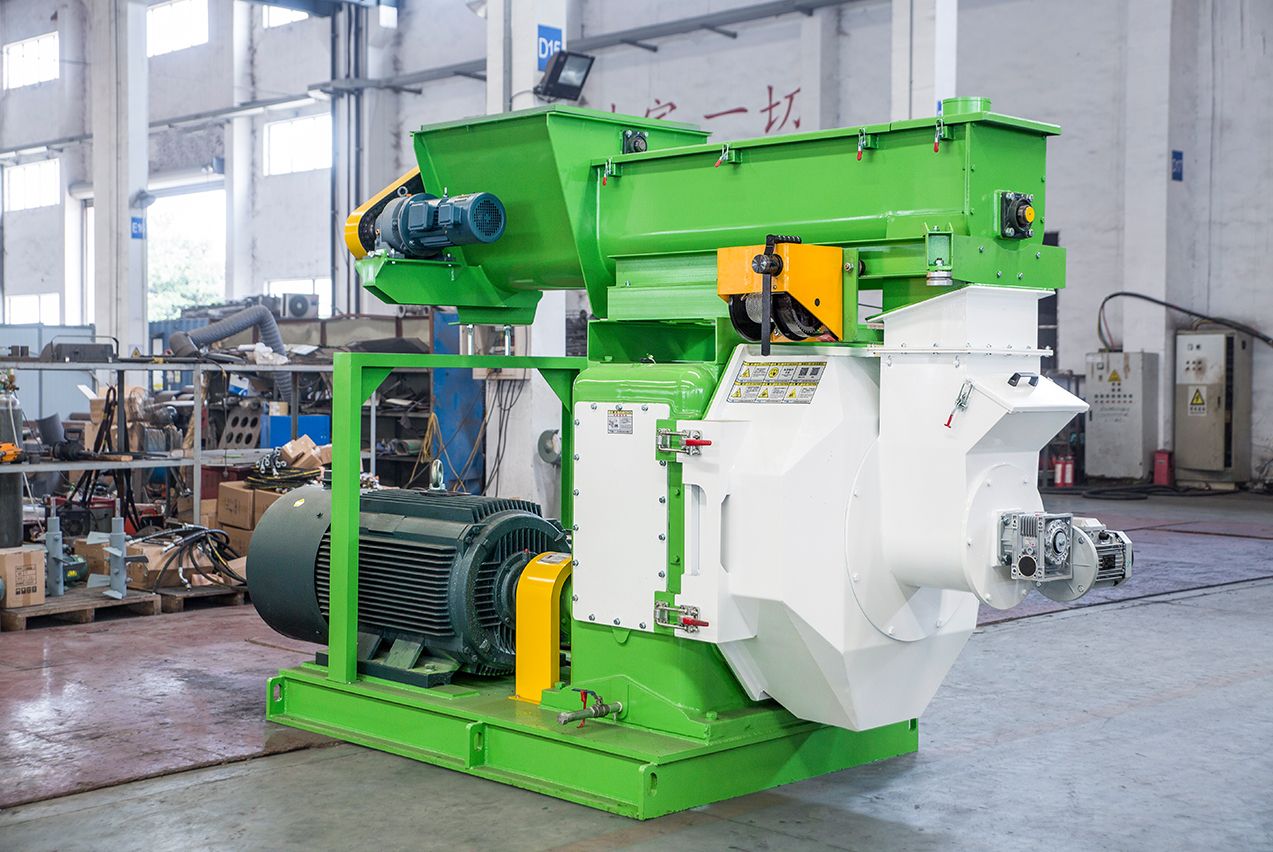
Ring Die Wood Pellet Mill: Industrial Performance Guide
Kingwood · May 26, 2026
How Ring Die Pelletizing Works at Industrial Scale
A ring die wood pellet mill uses a cylindrical die fitted with radially oriented compression channels. As the die rotates, rollers press feedstock into the die channels under high mechanical force. The material is extruded through the die, exits as continuous pellet strands, and is cut to length by stationary knives. The entire sequence operates continuously, which is the primary reason ring die configurations dominate industrial-scale biomass pellet production over batch or flat die alternatives.
The compression ratio—the ratio of die channel length to channel diameter—is selected based on feedstock density and target pellet durability. Hardwood sawdust typically requires a higher compression ratio than agricultural residues such as rice husks or straw. Achieving the correct ratio for the feedstock at hand is essential: too low and pellets are friable; too high and the die generates excessive heat and wear. Kingwood engineers specify die parameters for each project based on feedstock analysis rather than applying a generic configuration.
Feedstock moisture content at the pelletizing stage should be below 15% to ensure adequate lignin activation during compression. Lignin, the natural binder in lignocellulosic material, softens under the frictional heat generated in the die channel and rebinds as the pellet cools after extrusion. No external binders are required when feedstock moisture and particle size are correctly prepared upstream.
Kingwood Ring Die Pellet Mill Models and Integration Options
Kingwood manufactures both vertical and horizontal ring die pellet mill configurations under the JWZL and JZWH series.
Vertical ring die pellet mills:
| Model | Rated Capacity |
|---|---|
| JWZL-420 | 1–1.5 t/h |
| JWZL-688 | 2–2.3 t/h |
| JWZL-688D | 3–3.5 t/h |
| JWZL-928 | 4–5 t/h |
| JWZL-1068 | Contact sales |
Horizontal ring die pellet mill:
| Model | Rated Capacity |
|---|---|
| JZWH-860 | 4–5 t/h |
The JWZL-688 biomass wood pellet mill is a practical mid-range model for producers targeting 2–2.3 t/h output, with a design suited to both greenfield installations and capacity expansion alongside existing equipment.
For large-scale projects, multiple pellet mills are deployed in parallel within a single integrated production line. Kingwood has planned and designed over 2,000 production line projects across 30 countries since 1999, and complete line designs scale to 200,000 metric tons of annual pellet output. The wet-feed pellet production line configuration is particularly relevant for operations processing freshly harvested biomass: the line handles high-moisture feedstock through sequential crushing, coarse grinding, drum drying, fine grinding, ring die pelletizing, counter-flow cooling, and automated packaging—all within an enclosed, dust-controlled environment.
Auxiliary equipment in a complete Kingwood line includes hammer mills for particle size reduction, drum chippers for primary wood processing, drum dryers for moisture conditioning, counter-flow coolers for pellet temperature and hardness management, and pellet packaging machines for finished product handling.
Three-Standardization Framework: What It Means for Pellet Mill Buyers
Kingwood’s Three-Standardization Framework defines the engineering standard applied to every production line project. The three pillars—integrated production lines, dust-free production lines, and automated production lines—directly address the operational and regulatory concerns that industrial biomass pellet producers face.
Integrated: All process stages from raw material reception to finished pellet packaging are engineered as a single coordinated system. Material handling, equipment sequencing, and control logic are specified together, eliminating the compatibility gaps common in lines assembled from mixed-origin equipment.
Dust-Free: Biomass processing generates combustible dust across multiple process stages. Enclosed conveying, negative-pressure extraction, and integrated dust collection systems eliminate dust accumulation and reduce fire and explosion risk. A 2024 installation in Guizhou, China demonstrates this configuration in an operating dust-free biomass pellet workshop.
Automated: Central control systems manage feed rates, dryer temperatures, pellet mill roller gap, cooler throughput, and packaging line sequencing. Automated lines reduce labor requirements, improve batch-to-batch consistency, and generate operational data for process optimization.
This framework differentiates Kingwood installations from equipment-only supply relationships. Buyers receive a system engineered to a documented standard, not a collection of individual machines requiring on-site integration.
Pellet Quality and Fuel Economics
Wood pellets produced on correctly specified ring die equipment meet international fuel quality benchmarks. Kingwood-produced biomass pellets achieve:
- Calorific value: 4,800 kcal/kg
- Moisture content: <15%
- Sulfur content: <0.3%
- Ash content: <18%
- Dioxin emissions: <0.5 ng TEQ/m³
These parameters are consistent with EU moisture standards, U.S. calorific value requirements, Japanese sulfur limits, and ISO ash content thresholds. All emission indicators fall below China’s GB13271-2001 boiler air pollutant standard.
For industrial energy buyers replacing coal or heavy fuel oil, biomass pellet fuel produced on Kingwood equipment delivers cost reductions of 40–50% versus fossil fuel equivalents. The operational economics are confirmed by documented project data: a 12 t/h wood pellet production line in Vietnam commissioned in 2024 achieved full investment payback within 23 months. A 24 t/h installation, also in Vietnam and completed in 2023, demonstrates the scalability of the same engineering approach to larger output requirements.
Producers evaluating ring die pellet mill investments should request feedstock-specific throughput and energy consumption data rather than relying on nominal capacity figures alone. Kingwood’s application engineering team conducts feedstock assessments and provides project-specific capacity and payback projections as part of the pre-sale consultation process.
Jiangsu Kingwood Industrial Co., Ltd. is headquartered at #568 Hongsheng Road, Liyang Zhongguancun Industrial Park, Jiangsu Province, China. Listed on NEEQ under stock code 871765.
Sales contacts: Oliver Ge — +86 13120914095 Henry — +86 18205276156
FAQ
How does a ring die wood pellet mill differ from a flat die pellet mill?
In a ring die pellet mill, the die rotates around stationary rollers, feeding material centrifugally into the die holes. This configuration handles higher throughput, operates at greater compression ratios, and sustains continuous production runs more effectively than flat die designs—making it the standard choice for industrial-scale biomass pellet plants.
What raw materials can be processed in a ring die wood pellet mill?
Ring die pellet mills process a broad range of lignocellulosic feedstocks including wood chips, sawdust, bark, agricultural straw, rice husks, and energy crops. Material moisture content should typically be conditioned to below 15% prior to pelletizing to ensure pellet integrity and calorific value.
What pellet quality standards do Kingwood biomass pellets meet?
Kingwood biomass pellets achieve a calorific value of 4,800 kcal/kg, moisture content below 15%, sulfur content below 0.3%, and ash content below 18%. These specifications meet EU moisture standards (<15%), U.S. calorific standards (>2,500 kcal/kg), Japan sulfur standards (≤0.5%), and ISO ash standards (<20%), with all emissions below China's GB13271-2001 boiler air pollutant standard.
Which Kingwood ring die pellet mill models are available and what are their capacities?
Kingwood's current ring die pellet mill lineup includes the JWZL-420 (1–1.5 t/h), JWZL-688 (2–2.3 t/h), JWZL-688D (3–3.5 t/h), JWZL-928 (4–5 t/h), and JWZL-1068 (capacity confirmed on request). A horizontal ring die model, the JZWH-860, also delivers 4–5 t/h for alternative plant layouts.
Can a ring die pellet mill be integrated into a fully automated production line?
Yes. Under Kingwood's Three-Standardization Framework, ring die pellet mills are deployed within integrated, dust-free, and fully automated production lines. The wet-feed pellet production line configuration handles high-moisture biomass through sequential crushing, coarse grinding, drying, fine grinding, pelletizing, and packaging—all enclosed with integrated dust removal—at capacities up to 200,000 metric tons per year.
What cost savings can operators expect by switching to biomass pellet fuel?
Biomass pellets produced on Kingwood equipment deliver fuel cost savings of 40–50% compared to conventional fossil fuels. A documented 12 t/h installation in Vietnam achieved full investment payback in 23 months.
What certifications does Kingwood hold for its pellet mill equipment?
Kingwood holds ISO 9001, ISO 14001, and CE certifications. The company is also recognized as a Jiangsu Provincial High-Tech Enterprise, Jiangsu Provincial Specialized & Innovative Niche Leader, and a Jiangsu Provincial Gazelle Enterprise, and is listed on China's NEEQ stock exchange under code 871765.
- Global wood pellet production reached approximately 42 million metric tons in 2023, with demand continuing to grow across power generation and industrial heat markets. (2023, International Energy Agency (IEA), Renewables 2023 report)
- Biomass pellets can displace coal in co-firing applications with CO₂ emission reductions of up to 80% on a lifecycle basis compared to coal combustion. (2023, European Environment Agency (EEA), Biomass for Energy report)