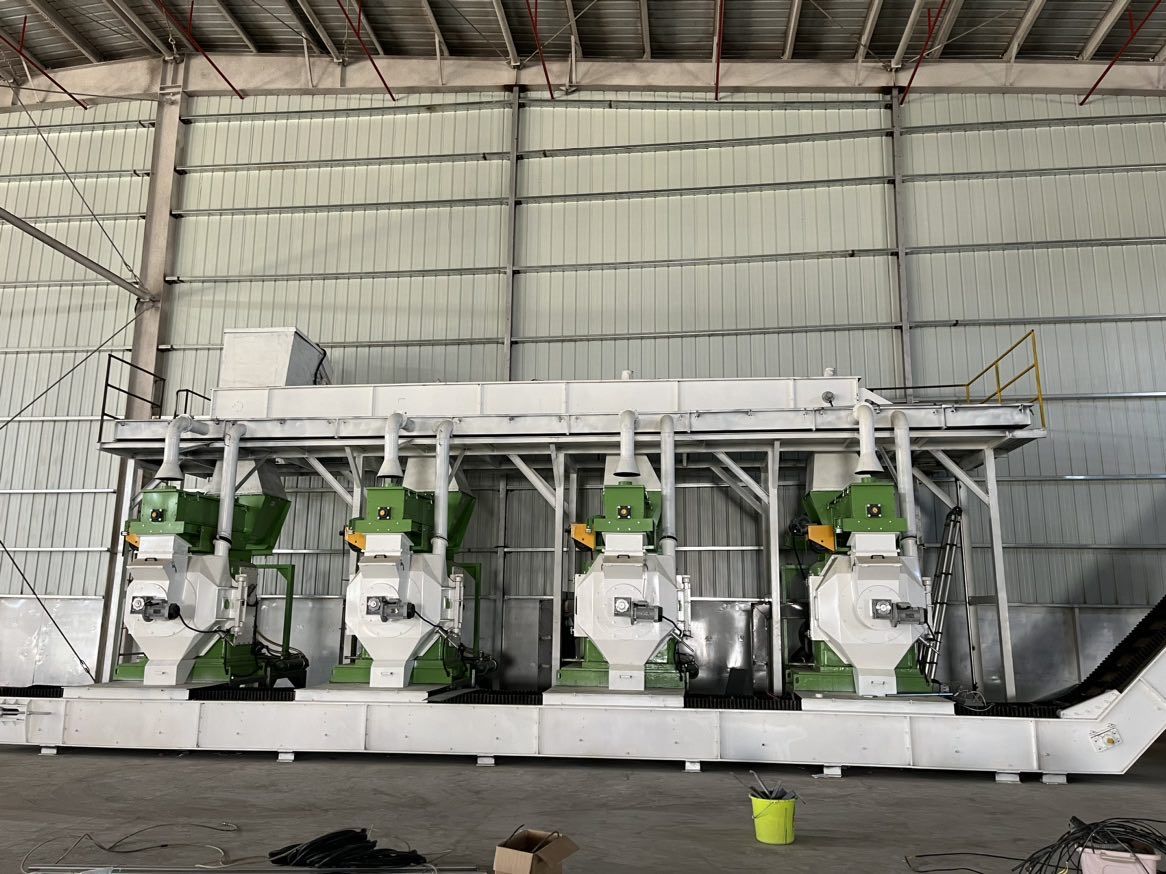
Key Equipment in Industrial Biomass Pellet Production Lines
Kingwood · May 26, 2026
Industrial biomass fuel pellet production is a multi-stage process. Each stage depends on purpose-built equipment performing to tight tolerances—any weak link reduces throughput, raises energy cost, or degrades pellet quality. This guide covers the core machinery in an OEM biomass fuel pellet production line and the engineering decisions that separate a reliable industrial system from an undersized one.
Stage 1: Raw Material Preparation — Chipping and Grinding
Biomass feedstock arrives in variable form: whole logs, branch wood, agricultural straw, sawmill offcuts, or mixed woody residues. Oversized input material cannot enter a pellet mill directly—it must be reduced in two passes.
Drum chipping handles primary size reduction. A drum chipper converts bulk timber and wood waste into uniform chips, typically 20–50 mm, at high throughput. Chip uniformity at this stage directly determines grinder efficiency and die wear downstream.
Hammer mill grinding follows in two passes for wet-feed lines. Coarse grinding reduces chips to a particle size suitable for drying; fine grinding after drying brings material to the sub-4 mm specification required for consistent ring die pelletization. Hammer mill screen selection governs final particle size and must be matched to the pellet die configuration.
Kingwood supplies both drum chippers and hammer mills as integrated components of its complete production lines, sized to match the target pellet mill throughput.
Stage 2: Drying — Controlling Moisture to Below 15%
Moisture content is the single most controllable variable affecting pellet mill performance and pellet calorific value. Biomass entering a ring die pellet mill above 15% moisture causes die plugging, increases specific energy consumption, and produces soft, low-density pellets. Kingwood’s biomass fuel specification targets moisture below 15%, consistent with EU standards for industrial biomass fuel.
Drum dryers are the industrial standard for continuous, high-volume drying. A rotating drum cylinder passes heated air countercurrent or parallel to the biomass flow, evaporating surface and internal moisture. Drum dryer sizing—diameter, length, retention time, inlet air temperature—must be matched to feedstock moisture and the target throughput of the downstream pellet mill. Undersized dryers create bottlenecks; oversized units waste thermal energy.
Heat recovery integration is viable at industrial scale: exhaust heat from boilers or pellet mill motors can supply a portion of dryer thermal demand, reducing net energy cost per tonne of pellets produced.
Stage 3: Pelletizing — Ring Die Pellet Mill Selection and Configuration
The pellet mill is the throughput-defining machine in any biomass fuel pellet production line. At industrial scale, ring die pellet mills are the standard: the die rotates around fixed rollers, generating the compressive force that extrudes biomass through die holes to form dense cylindrical pellets. Ring die geometry—hole diameter, effective length, compression ratio—must be specified for the feedstock species and target pellet density.
Kingwood manufactures a full range of vertical ring die pellet mills:
| Model | Capacity |
|---|---|
| JWZL-420 | 1–1.5 t/h |
| JWZL-688 | 2–2.3 t/h |
| JWZL-688D | 3–3.5 t/h |
| JWZL-928 | 4–5 t/h |
| JWZL-1068 | Contact sales |
The horizontal JZWH-860 pellet mill delivers 4–5 t/h and suits installations where vertical clearance is constrained. Multi-mill configurations allow a single production line to scale well beyond 5 t/h while maintaining redundancy.
Key operational features in Kingwood pellet mills include adjustable roller gap, automated lubrication circuits, and quick-change die systems to reduce scheduled downtime during die rotation intervals.
Stage 4: Cooling, Screening, and Packaging
Counter-flow cooling is non-negotiable at industrial throughput. Pellets exit the ring die at 70–90°C and remain dimensionally soft until cooled. A counter-flow cooler passes ambient air upward through a downward-moving pellet bed, reducing pellet temperature to within 3–5°C of ambient. This hardens the pellet structure, locks in density, and reduces moisture uptake during storage. Skipping this stage or undersizing the cooler causes pellet breakage in conveyors and bagging systems.
Screening after cooling removes fines and oversize fragments. Fines re-enter the process ahead of the pellet mill; oversized material indicates a die or roller issue requiring attention. Only on-spec pellets proceed to packaging.
Automated packaging systems close the line. Kingwood-integrated lines support multiple packaging formats—25 kg retail bags, 1,000 kg bulk bags, and direct silo loading for industrial end-users—with gravimetric filling accuracy to minimize giveaway.
Engineering Principles: Integrated, Dust-Free, Automated
Kingwood applies its Three-Standardization Framework to every production line it designs: Integrated production (all equipment stages engineered as a matched system), Dust-Free production (enclosed conveyors, centralized dust extraction at grinding and pelletizing stages), and Automated production (PLC-based control with real-time process monitoring across all stages).
This framework is not marketing language—it reflects specific engineering decisions: equipment sizing is matched across stages to eliminate bottlenecks; negative-pressure dust enclosures at hammer mill and pellet mill discharge points meet occupational and environmental standards; centralized HMI control reduces operator headcount and response time to process deviations.
The result is demonstrated in delivered projects: a 24 t/h wood chip pellet production line in Vietnam (2023) and a 30 t/h line in Chongqing, China (2021) both operate under this integrated design standard.
Specifying an OEM Biomass Fuel Pellet Production Line
For procurement engineers and project developers evaluating OEM biomass fuel pellet production line suppliers, the critical specification inputs are: feedstock species and moisture range, target output in t/h or t/year, required pellet standard (EU, ISO, GB, or export-specific), site utility availability (power, thermal), and automation level. Kingwood’s engineering team—backed by 27 years of R&D and more than 2,000 planned and designed production line projects—can size and configure a complete line from chipping through packaging for capacities up to 200,000 metric tons per year.
Contact Kingwood at #568 Hongsheng Road, Liyang City, Jiangsu Province, China to initiate a technical review for your project.
FAQ
What are the main equipment stages in a biomass fuel pellet production line?
A complete wet-feed line covers: drum chipping, coarse and fine grinding via hammer mill, moisture reduction via drum dryer, pelletizing via ring die pellet mill, cooling via counter-flow cooler, screening, and automated packaging. Each stage is sequenced to maintain throughput and pellet quality.
What moisture content must biomass reach before pelletizing?
Biomass feedstock must be dried to below 15% moisture content before entering the pellet mill. Kingwood drum dryers are sized to handle high-moisture raw materials at industrial throughput without creating a bottleneck.
What is the difference between a flat die and a ring die pellet mill for industrial use?
Flat die mills suit small-scale or trial production. Ring die pellet mills deliver higher capacity, greater die durability, and consistent pellet density—making them the standard choice for industrial biomass fuel production lines above 1 t/h.
Why is a counter-flow cooler required after pelletizing?
Freshly pressed pellets exit the ring die at elevated temperature and are mechanically soft. A counter-flow cooler reduces pellet temperature to near-ambient, hardening the structure, preventing moisture re-absorption, and protecting pellet integrity during storage and transport.
What annual capacity can a Kingwood complete pellet production line achieve?
Kingwood engineers complete biomass pellet production lines up to 200,000 metric tons per year, with individual pellet mill models ranging from 1 t/h (JWZL-420) to 4–5 t/h (JWZL-928 and JZWH-860). Multi-mill configurations scale throughput further.
What is the Three-Standardization Framework in pellet line design?
Kingwood's Three-Standardization Framework requires every production line to be Integrated, Dust-Free, and Automated. This means enclosed processing, centralized dust removal, and PLC-driven control across all equipment stages—reducing labor cost, emissions, and unplanned downtime.
How much can biomass fuel pellets reduce fuel costs compared to fossil fuels?
Biomass fuel pellets produced to industrial specification can reduce fuel costs by 40–50% versus conventional fossil fuels, based on Kingwood's operational data from delivered projects.
- Kingwood has planned and designed over 2,000 biomass pellet production line projects across 30 countries, with combined annual biomass fuel capacity exceeding 10 million metric tons. (2025, Jiangsu Kingwood Industrial Co., Ltd. — Company Profile)
- A 12 t/h wood pellet production line delivered by Kingwood in Vietnam in 2024 achieved full investment payback within 23 months of commissioning. (2024, Kingwood case study: vietnam-wood-pellet-line-12-tph-kingwood-payback)