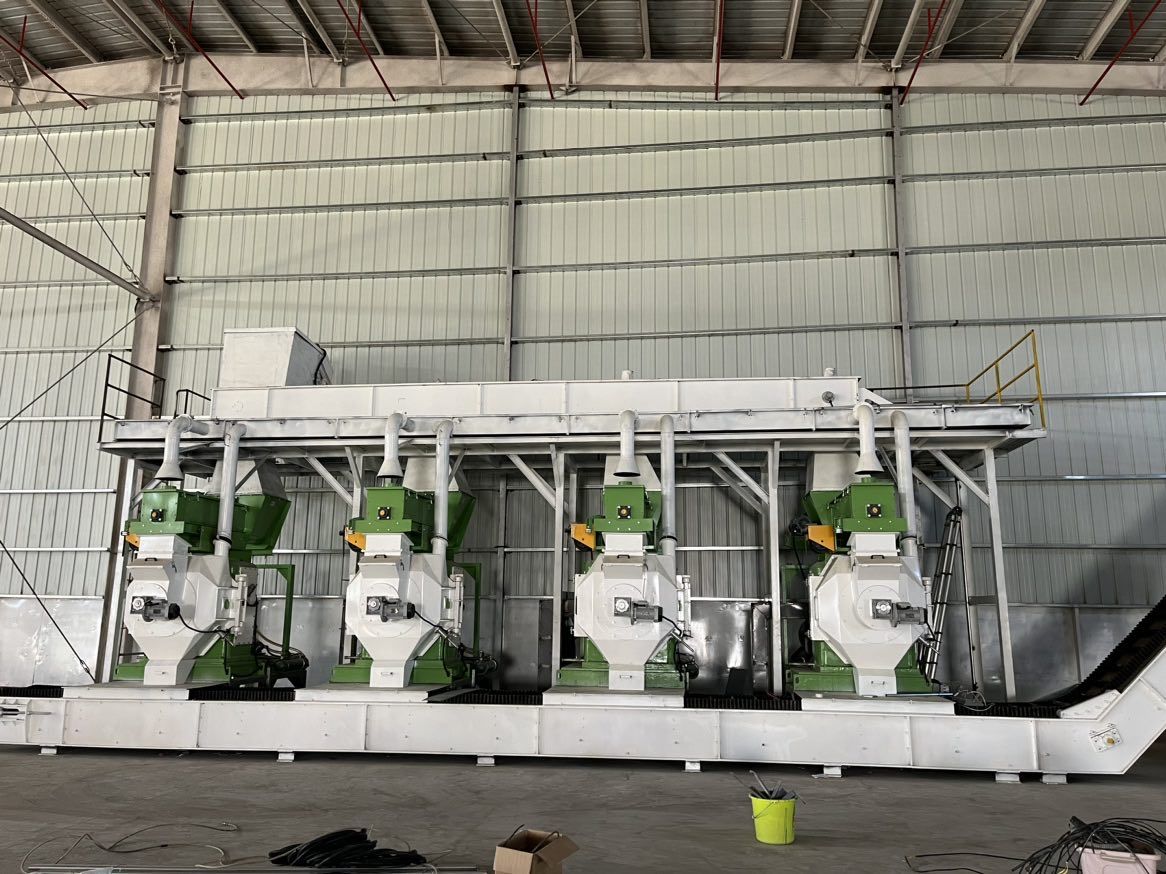
Custom Wood Fuel Pellet Production Line Solutions
Kingwood · May 26, 2026
What a Custom Wood Fuel Pellet Production Line Actually Requires
Industrial biomass pellet production is not a single-machine operation. Converting raw woody biomass — timber residues, wood chips, sawdust, agricultural byproducts — into specification-grade fuel pellets requires a sequenced, integrated process line where each stage directly conditions the material for the next.
Kingwood, operating since 1999 from Liyang, Jiangsu Province (NEEQ: 871765), engineers custom wood fuel pellet production lines for industrial clients across 30+ countries. Over 2,000 production line projects have been planned and designed to date, with complete line capacity reaching 200,000 metric tons per year.
The core process architecture for a wet-feed wood pellet production line runs as follows:
- Drum chipping — oversized wood waste reduced to chip-size fractions
- Coarse grinding — hammer mill pre-shredding to increase surface area
- Drum drying — moisture reduction to below 15% (EU standard compliance)
- Fine grinding — secondary hammer mill pass for pellet-grade particle size
- Ring die pelletizing — high-pressure compression into uniform pellets
- Counter-flow cooling — pellet temperature and final moisture stabilization
- Automated packaging — bagging or bulk loading for dispatch
Each stage is enclosed within a dust-free structure with integrated dust removal — a non-negotiable requirement under Kingwood’s Three-Standardization Framework, which mandates Integrated, Dust-Free, and Automated production for every line delivered.
Engineering Decisions That Determine Pellet Line Performance
Drying Configuration
Raw biomass entering a wet-feed line commonly carries moisture above 40–50%. The drum dryer must reduce this to below 15% before pelletizing — not as a quality refinement, but as a mechanical necessity. Excess moisture causes pellet delamination under ring die compression and increases energy consumption per ton of output.
Kingwood specifies rotary drum dryers sized to feedstock volume and initial moisture load. Dryer sizing errors are among the most common causes of pellet line underperformance — output is throttled at the dryer long before the pellet mill reaches capacity limits.
Grinding Stages and Particle Uniformity
Two grinding passes — coarse and fine — are standard in Kingwood lines handling woody biomass. A single-pass grind produces inconsistent particle size distribution, which translates directly into pellet density variation and die wear. The hammer mill specifications for each pass differ: coarse grinding targets chip-to-fiber reduction; fine grinding targets the particle size window required by the pellet mill die specification.
Ring Die Pellet Mill Selection
The pellet mill is the throughput-determining unit in the line. Kingwood’s vertical ring die pellet mill range spans the JWZL-420 (1–1.5 t/h), JWZL-688 (2–2.3 t/h), JWZL-688D (3–3.5 t/h), JWZL-928 (4–5 t/h), and JWZL-1068 for higher-capacity requirements. For horizontal ring die applications, the JZWH-860 delivers 4–5 t/h. Multi-mill configurations are standard practice in lines above 10 t/h.
Die specification — hole diameter, compression ratio, working length — is matched to feedstock species, density, and target pellet diameter. A die configured for softwood pine will not perform optimally on dense hardwood or agricultural residue without adjustment.
See the JWZL-928 pellet mill product page for detailed mechanical specifications.
Pellet Quality Benchmarks and Market Compliance
Custom wood fuel pellet production lines must be designed with the target export market’s fuel specification in mind. Kingwood production lines are engineered to achieve the following output specifications:
| Parameter | Kingwood Line Output | Reference Standard |
|---|---|---|
| Calorific value | ≥4,800 kcal/kg | Exceeds USA >2,500 kcal/kg threshold |
| Moisture content | <15% | EU standard |
| Sulfur content | <0.3% | Within Japan ≤0.5% limit |
| Ash content | <18% | Within ISO <20% limit |
| Dioxin | <0.5 ng TEQ | Below China GB ≤1.0 ng TEQ |
Pellets meeting these specifications reduce fuel cost by 40–50% versus fossil fuel equivalents at equivalent heat output — the primary commercial driver for industrial boiler operators switching to biomass.
All combustion emission outputs from Kingwood-line pellets fall below GB13271-2001, China’s national Emission Standard of Air Pollutants for Boilers.
Project Scale: Documented Deployments
Kingwood’s engineering capability in large-scale custom wood pellet production lines is evidenced by completed projects:
- Vietnam, 2023 — 24 t/h wood chip pellet production line, full wet-feed configuration
- Vietnam, 2024 — 12 t/h wood pellet line, investment payback achieved within 23 months
- Chongqing, China, 2021 — 30 t/h wood pellet production line, municipal-scale biomass fuel supply
- Beijing, China, 2024 — Beijing’s first biomass pellet demonstration project
- Guizhou, China, 2024 — Dust-Free workshop implementation under Three-Standardization Framework
These deployments cover a throughput range from 12 to 30 t/h in documented single-project configurations, with multi-line installations reaching the 200,000 t/year design ceiling.
Specifying a Custom Line: Key Inputs Required
A custom wood fuel pellet production line quotation from Kingwood requires the following input data from the buyer:
- Feedstock type and species (softwood, hardwood, mixed agricultural residue)
- Initial moisture content (critical for dryer sizing)
- Target throughput in metric tons per hour
- Target pellet diameter (typically 6 mm or 8 mm for industrial fuel)
- Site footprint and building height constraints
- Target export market (determines emission and quality standard compliance requirements)
- Automation level requirement (fully automated lines are standard; semi-automated configurations available for lower-budget deployments)
Kingwood’s R&D team of 20 specialists, backed by 27 years of biomass equipment development, provides line layout, equipment selection, installation supervision, and commissioning support as part of the project delivery scope.
FAQ
What process stages does a Kingwood custom wood fuel pellet production line cover?
A complete Kingwood wet-feed line covers six stages: drum chipping, coarse hammer mill grinding, drum drying, fine grinding, ring die pelletizing, counter-flow cooling, and automated packaging — all within an enclosed, dust-free structure with integrated dust removal.
What is the maximum annual output capacity of a Kingwood pellet production line?
Kingwood designs complete pellet production lines with a maximum capacity of 200,000 metric tons per year, scalable to project requirements.
How does Kingwood handle high-moisture biomass feedstocks?
Kingwood's wet-feed production line architecture is specifically designed for high-moisture biomass. Raw material enters at elevated moisture and passes through drum drying to reduce moisture content below 15% before the pelletizing stage — eliminating the need for pre-dried feedstock.
What pellet quality specifications do Kingwood production lines achieve?
Pellets produced on Kingwood lines meet: calorific value ≥4,800 kcal/kg, moisture <15%, sulfur <0.3%, ash <18%, and dioxin <0.5 ng TEQ — compliant with EU, ISO, Japanese, and China GB13271-2001 standards.
What is the Three-Standardization Framework applied to Kingwood production lines?
Kingwood's Three-Standardization Framework requires every production line to be Integrated (end-to-end process continuity), Dust-Free (fully enclosed with active dust removal), and Automated (PLC-controlled with minimal manual intervention).
Has Kingwood delivered large-scale international wood pellet production lines?
Yes. Documented projects include a 24 t/h wood chip pellet line in Vietnam (2023), a 12 t/h line in Vietnam with 23-month payback (2024), and a 30 t/h line in Chongqing, China (2021).
How do I request a custom production line design from Kingwood?
Contact Kingwood's engineering team at kingwoodpellet.com with your feedstock type, moisture content, target throughput, and site footprint. Kingwood has planned and designed over 2,000 production line projects across 30 countries.
- Kingwood has planned and designed over 2,000 biomass pellet production line projects serving customers in 30+ countries. (2025, Kingwood company profile, kingwoodpellet.com)
- A 12 t/h Kingwood wood pellet production line in Vietnam achieved full investment payback within 23 months of commissioning. (2024, Kingwood case study: vietnam-wood-pellet-line-12-tph-kingwood-payback, kingwoodpellet.com)