Biomass Pellet Industry News & Trends
Kingwood · May 26, 2026
Key Trends Shaping the Biomass Pellet Industry
Industrial demand for biomass pellets continues to expand as governments enforce stricter emissions targets and carbon pricing mechanisms make fossil fuel combustion increasingly costly. For equipment manufacturers and pellet producers, this creates a dual pressure: scale up output capacity while meeting tighter regulatory standards on dust, emissions, and fuel quality.
Several structural trends are defining the current market:
Regulatory tightening on emissions. Boiler operators in China must comply with GB13271-2001 emission standards. Biomass pellets produced within Kingwood’s specifications — sulfur content below 0.3%, ash below 18%, dioxin below 0.5 ng TEQ — consistently fall below these thresholds, making them a compliant coal alternative for industrial and district heating applications.
Shift toward enclosed, automated production. Loose, open-floor pellet workshops are increasingly non-compliant under provincial environmental inspection regimes in China and under EU industrial hygiene standards abroad. Fully enclosed processing with integrated dust extraction is now a baseline expectation, not a premium feature.
Feedstock diversification. Producers are moving beyond clean sawdust to process mixed wood waste, agricultural residues, and energy crops. This demands equipment designed for variable moisture and particle size — specifically wet-feed line configurations that include drum drying and staged grinding before pelletizing.
Equipment Technology: What Industrial Buyers Are Evaluating
For operators planning new pellet production lines or upgrading existing capacity, the technology selection criteria have shifted. Raw throughput per machine is no longer the only variable. Buyers are evaluating:
- Total line integration: Can crushing, drying, grinding, pelletizing, cooling, and packaging operate as a single automated sequence with centralized control?
- Dust containment: Does the facility design eliminate fugitive dust at transfer points, screens, and cooler exhausts?
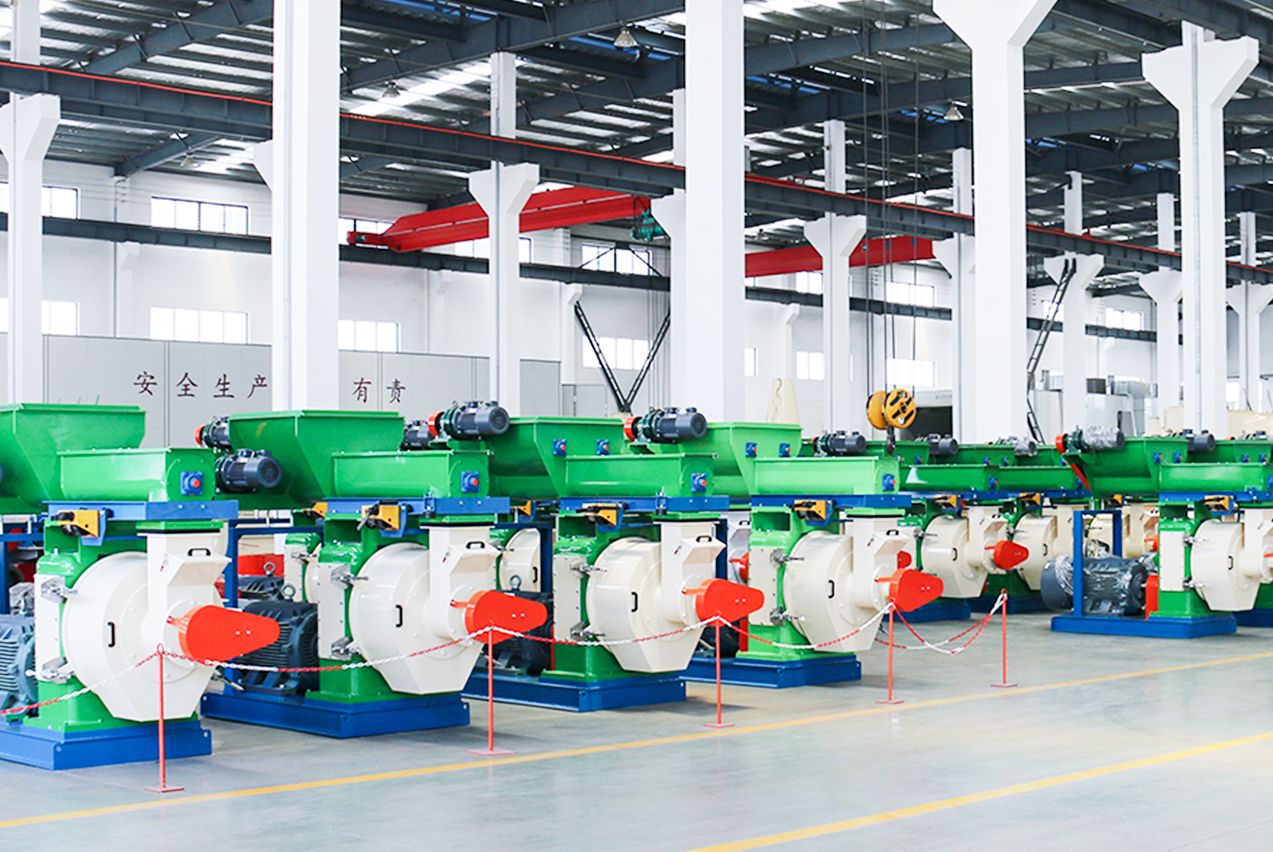
- Energy consumption per ton: Ring die pellet mills vary significantly in specific energy draw. Vertical ring die configurations, such as the JWZL-928 pellet mill, offer mechanical advantages in die wear and throughput consistency on fibrous feedstocks.
- Maintenance access and die changeout time: Downtime directly reduces annual output. Die and roller accessibility is a practical differentiator between mill designs.
Kingwood’s Three-Standardization Framework — built on Integrated, Dust-Free, and Automated production line principles — was developed specifically to address these evaluation criteria as a coherent system rather than a collection of individual machines.
Global Market Deployment: Project Data Points
Real installation data provides more reliable benchmarks than theoretical capacity figures. Kingwood’s installed base spans 30 countries, with over 2,000 production line projects planned and designed. Representative deployments include:
- A 24 t/h wood chip pellet production line in Vietnam (2023) — one of the largest single-site biomass pellet installations in Southeast Asia at commissioning.
- A 12 t/h line in Vietnam (2024) achieving full capital payback within 23 months of operation.
- A 30 t/h installation in Chongqing, China (2021), demonstrating large-scale domestic deployment.
- Beijing’s first biomass pellet demonstration project (2024), establishing a municipal reference standard.
- A Dust-Free workshop implementation in Guizhou, China (2024) — a benchmark for enclosed production compliance.
These projects collectively represent a broad range of feedstocks, climate conditions, and regulatory environments, providing prospective buyers with directly comparable reference points.
Fuel Quality and Compliance Standards at a Glance
Industrial buyers sourcing biomass pellets or evaluating pellet production equipment need to confirm alignment across multiple overlapping standards. The following specifications apply to biomass fuel produced on Kingwood lines:
| Parameter | Kingwood Spec | Reference Standard |
|---|---|---|
| Calorific value | 4,800 kcal/kg | USA: >2,500 kcal/kg |
| Moisture content | <15% | EU: <15% |
| Sulfur content | <0.3% | Japan: ≤0.5% |
| Ash content | <18% | ISO: <20% |
| Dioxin | <0.5 ng TEQ | China GB: ≤1.0 ng TEQ |
All emission indicators meet or exceed China’s GB13271-2001 national boiler emission standard. For export-oriented producers, the same specifications satisfy EU, ISO, and Japanese import requirements without reformulation.
Jiangsu Kingwood Industrial Co., Ltd. — founded in 1999, listed on NEEQ (stock code: 871765), operating from a 31,200 m² facility in Liyang Zhongguancun Industrial Park — continues to publish technical updates, project case studies, and regulatory analysis relevant to industrial biomass pellet producers. Subscribe or contact the sales team for current equipment specifications and line design consultations.
FAQ
What global standards govern biomass pellet fuel quality?
Key standards include EU moisture requirements (<15%), ISO ash content limits (<20%), and China's GB13271-2001 emissions standard for boiler air pollutants. Kingwood-produced biomass pellets meet all these benchmarks, with calorific value reaching 4,800 kcal/kg.
How does biomass pellet fuel compare to fossil fuels on cost?
Industrial operators switching to biomass pellets typically report 40–50% cost savings versus conventional fossil fuels, based on Kingwood project data across multiple installed lines.
What is driving demand for automated biomass pellet production lines?
Stricter dust emission regulations, rising labor costs, and ESG compliance requirements are pushing producers toward fully automated, enclosed production lines. Kingwood's Three-Standardization Framework — Integrated, Dust-Free, and Automated production lines — directly addresses these pressures.
Which biomass feedstocks are compatible with industrial pellet mills?
Wood chips, sawdust, agricultural straw, rice husks, and other lignocellulosic residues are standard feedstocks. Kingwood's wet-feed production lines handle high-moisture biomass through sequential crushing, drying, grinding, pelletizing, and packaging stages.
What throughput capacities are available for industrial pellet production?
Kingwood's pellet mills range from 1 t/h (JWZL-420) to 4–5 t/h (JWZL-928 and JZWH-860). Complete turnkey production lines are engineered up to 200,000 metric tons per year capacity.
Is biomass pellet equipment subject to international certification requirements?
Yes. Equipment exported to European and other international markets must carry CE certification at minimum. Kingwood holds CE, ISO 9001, and ISO 14001 certifications, alongside multiple provincial and national Chinese designations.
What role does carbon neutrality policy play in biomass pellet market growth?
National net-zero commitments across Asia, Europe, and North America are accelerating biomass fuel adoption as a coal substitute in industrial boilers. This is expanding demand for high-capacity, compliant pellet production equipment globally.
- Global industrial wood pellet demand exceeded 30 million metric tons in 2023, driven by coal displacement policies in the EU and Asia-Pacific. (2023, IEA Bioenergy Task 40 — Sustainable International Bioenergy Trade)
- Biomass energy accounted for approximately 55% of total renewable energy consumption in the EU in 2022, with solid biomass pellets as the dominant form. (2022, Eurostat — Energy from Renewable Sources statistics (2023 release))