How Wood Pellet Machines Convert Wood Waste into Clean Fuel
Kingwood · May 26, 2026
Wood chips, sawdust, bark, and agricultural residues are generated in enormous volumes by timber processing, furniture manufacturing, and crop harvesting operations. Left unmanaged, this material is burned in the open, sent to landfill, or left to decompose — each pathway releasing carbon and particulates with no energy return. Industrial wood pellet machines change that equation by converting low-density, high-moisture biomass waste into standardized, energy-dense fuel pellets that can replace coal in industrial boilers and thermal power applications.
The Conversion Process: From Raw Biomass to Fuel Pellet
The transformation from raw wood waste to a finished fuel pellet is not a single-step operation. A properly engineered production line runs feedstock through several interdependent stages, each of which directly affects the quality and environmental performance of the final product.
1. Size Reduction Incoming material — whether whole wood chips, rough sawdust, or crop stalks — passes through a drum chipper or hammer mill to achieve uniform particle sizing, typically below 6 mm for most pellet die configurations. Consistent particle size is a prerequisite for stable die channel flow and uniform pellet density.
2. Drying Most field-collected biomass carries 30–60% moisture content, far above the 12–18% window required for efficient pelletizing. A drum dryer reduces moisture to the target range while recovering heat from combustion gases, improving overall line energy efficiency.
3. Ring-Die Pressing Pre-conditioned material enters the pellet mill, where high-speed rollers compress feedstock against a rotating ring die. The pressure and localized frictional heat (typically 80–120 °C) activate the lignin already present in the wood fiber, which acts as a natural binder. No chemical additives are required. The extruded pellets are cut to length by fixed knives at the die exit.
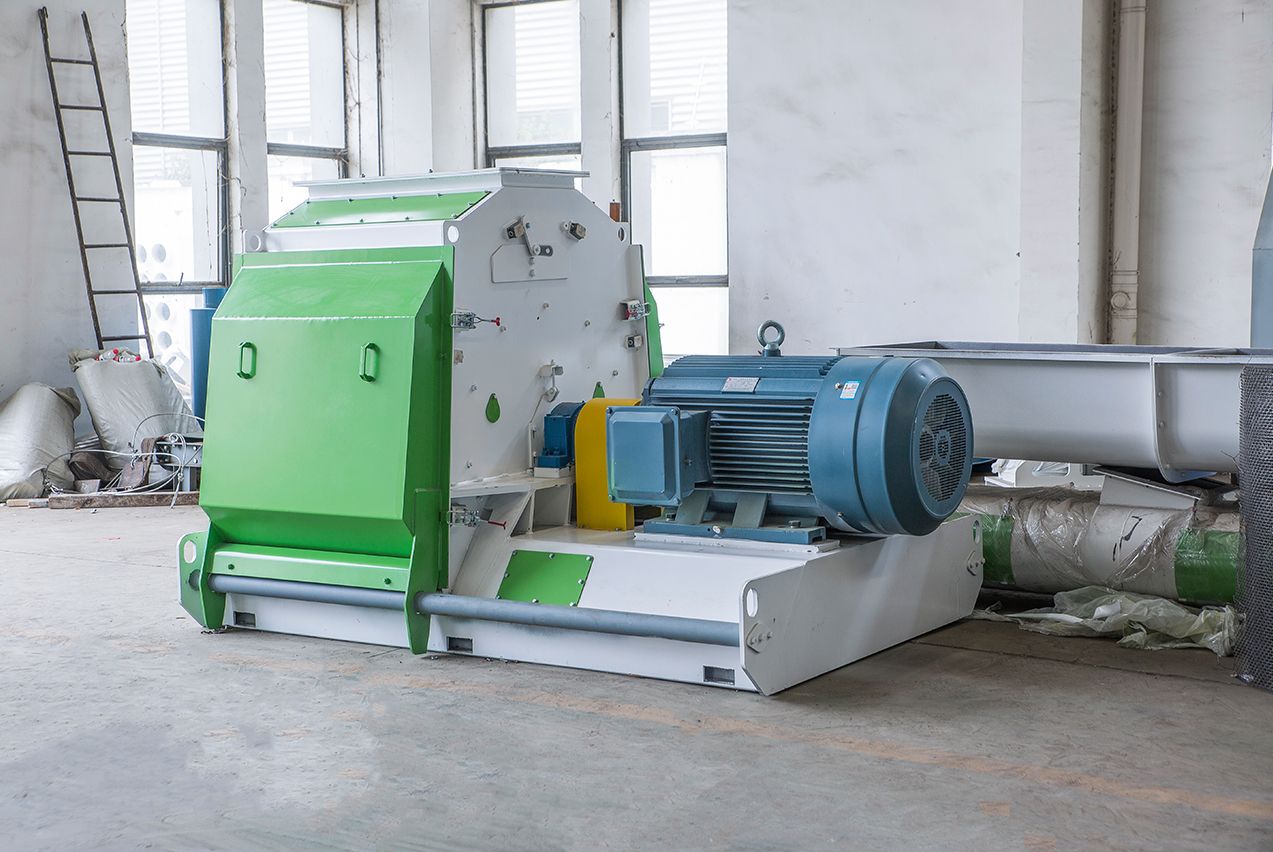
Kingwood’s vertical ring die pellet mills — including the JWZL-688 (2–2.3 t/h), JWZL-688D (3–3.5 t/h), and JWZL-928 (4–5 t/h) — apply this ring-die geometry in a vertical-feed configuration that allows gravity-assisted material flow, reducing mechanical wear and energy consumption per tonne of output.
4. Cooling and Screening Fresh pellets exit the die at elevated temperature and require cooling to stabilize dimensional integrity. A counter-flow cooler passes ambient air counter-directionally through the pellet bed, achieving uniform cooling without surface cracking. Fines generated during cooling are screened out and recycled back into the press feed.
5. Packaging Finished pellets meeting specification are conveyed to automated bagging or bulk-loading stations for dispatch. Kingwood complete lines support both bagged and loose-bulk output configurations.
Fuel Quality and Environmental Compliance
The practical value of this conversion process depends entirely on whether the output pellet meets combustion and emissions standards. Kingwood-engineered production lines are specified to achieve the following fuel characteristics:
| Parameter | Kingwood Target | Reference Standard |
|---|---|---|
| Calorific value | ≥ 4,800 kcal/kg | — |
| Moisture content | < 15% | EU standard |
| Sulfur content | < 0.3% | Below Japan ≤ 0.5% threshold |
| Ash content | < 18% | Below ISO < 20% threshold |
| Dioxin emission | < 0.5 ng TEQ | Below China GB ≤ 1.0 ng TEQ |
These specifications position Kingwood-produced biomass pellets for compliant combustion in industrial boilers regulated under China’s GB13271-2001 standard, as well as export markets subject to EU, Japanese, and South Korean biomass fuel import requirements. End users switching from coal to compliant biomass pellets report fuel cost reductions of 40–50% while maintaining or improving thermal output.
Dust-Free Production: Controlling Pollution at the Source
A production line that reduces environmental pollution in combustion while generating it during manufacturing is not a genuine improvement. This is the operational rationale behind Kingwood’s Dust-Free production lines — one of the three pillars of the Three-Standardization Framework alongside Integrated and Automated production lines.
Dust-Free implementation means every material transfer point — from chipper discharge to pellet mill inlet, dryer exit to cooler feed, and finished pellet conveying — operates under enclosed, negative-pressure conditions. Bag-filter or pulse-jet dust collection units capture particulate before it can enter the work environment or ambient air. The Guizhou Dust-Free biomass pellet mill workshop commissioned in 2024 demonstrates how this architecture performs at commercial scale in a region with strict local environmental inspection regimes.
The cumulative effect: feedstock that would otherwise generate open-burn smoke or uncontrolled dust during handling is processed within a sealed system and exits as a uniform fuel pellet with measurable, certifiable combustion characteristics.
Industrial Scalability: From Single Mill to Full Production Line
A single pellet mill unit addresses small-volume processing requirements. Industrial biomass fuel production at commercial scale — supplying heating utilities, industrial boilers, or export markets — requires a fully integrated line where each process stage is sized and sequenced for continuous, uninterrupted throughput.
Kingwood has planned, designed, and commissioned over 2,000 production line projects across 30 countries. Complete wet-feed pellet production lines are engineered up to 200,000 metric tons per year capacity, fully automated and enclosed, covering crushing, coarse grinding, drying, fine grinding, pelletizing, and packaging in a single integrated system.
Documented project outcomes include a 24 t/h wood chip pellet production line in Vietnam (2023), a 12 t/h Vietnam line that reached payback within 23 months (2024), and a 30 t/h installation in Chongqing, China (2021) — each serving as a reference for investors and operators evaluating the commercial and environmental case for biomass pellet production at scale.
For project-specific capacity planning, feedstock assessment, or equipment configuration, contact Kingwood’s engineering team directly.
FAQ
How does a wood pellet machine convert wood chips into fuel pellets?
The process runs in sequence: raw material reception → size reduction (hammer mill or drum chipper) → moisture conditioning or drying (drum dryer) → ring-die pressing under high pressure → cooling (counter-flow cooler) → screening and packaging. High-speed roller-and-die compression generates frictional heat that binds lignin naturally, eliminating the need for chemical binders.
What raw materials can an industrial wood pellet mill process?
Suitable feedstocks include wood chips, sawdust, bark, forestry residues, agricultural straw, rice husks, bamboo waste, and other lignocellulosic biomass. Moisture content for optimal pelletizing typically falls between 12–18% before entering the pellet mill.
What fuel quality do Kingwood biomass pellets achieve?
Kingwood's production lines are engineered to meet or exceed major international standards: calorific value ≥ 4,800 kcal/kg, moisture content < 15%, sulfur content < 0.3%, and ash content < 18%. All emission indicators comply below China's GB13271-2001 boiler air pollutant standard.
How much can biomass fuel pellets reduce energy costs compared to fossil fuels?
Biomass fuel pellets produced on a Kingwood line can reduce fuel costs by 40–50% versus conventional fossil fuels, depending on local feedstock availability and energy pricing.
How does the pellet production process reduce environmental pollution?
The process addresses pollution on multiple fronts: it diverts wood waste from open burning or landfill; enclosed, dust-free production lines prevent airborne particulate emissions; the resulting pellets combust more completely than raw biomass, generating less smoke; and sulfur and dioxin outputs stay well below regulatory thresholds.
What dust control measures are built into industrial pellet production lines?
Kingwood's Dust-Free production lines — one of the three pillars of the Three-Standardization Framework — integrate enclosed processing chambers, negative-pressure dust collection, and bag-filter or pulse-jet dust removal at every transfer point, preventing secondary particulate pollution during production.
What scale of wood pellet production line is commercially viable?
Kingwood designs complete wet-feed pellet production lines from small-capacity single-machine installations up to 200,000 metric tons per year. The JWZL-928 vertical pellet mill, for example, delivers 4–5 t/h per unit; multi-line configurations have achieved 24–30 t/h in documented projects in Vietnam and China.
- Global wood pellet production reached approximately 42 million metric tons in 2023, driven by coal-to-biomass switching policies across the EU, UK, Japan, and South Korea. (2024, IEA Bioenergy — Wood Pellet Market Update 2024)
- Replacing coal with industrial wood pellets reduces lifecycle CO₂-equivalent emissions by up to 74–90% on a per-MWh basis when sourced from sustainably managed forests. (2023, European Commission Joint Research Centre — Solid Biomass Carbon Intensity Report 2023)