China Wood Pellet Production Line: Price & Manufacturer Guide
Kingwood · May 26, 2026
How Industrial Wood Pellet Production Lines Convert Residual Biomass into Fuel
Residual biomass — sawdust, bark, wood chips, rice husks, agricultural straw — represents one of the most underutilized feedstocks in the global energy transition. Wood pellet production lines are the industrial mechanism that converts this low-value waste stream into a standardized, high-energy-density fuel. Understanding the process engineering behind these lines is essential for any buyer evaluating a China wood pellet production line, whether comparing prices, assessing manufacturer capabilities, or planning a greenfield facility.
Residual biomass originates from multiple upstream industries: sawmills generate significant volumes of sawdust and offcuts; woodworking shops produce shavings and trim waste; forestry operations leave behind branches, bark, and stumps; and agricultural processing creates husks, straw, and cob residues. Without downstream processing infrastructure, much of this material is burned in open fields or sent to landfill — both options carrying measurable carbon and regulatory costs. A properly specified pellet production line eliminates this disposal burden while generating a marketable fuel product.
The Six-Stage Production Process: Technical Breakdown
Industrial wood pellet production lines follow a defined sequence. Each stage must be correctly matched to feedstock characteristics and target output volume; mismatches between stages are the primary cause of underperforming lines sold at artificially low prices.
1. Feedstock Preparation — Chipping and Coarse Crushing Oversized material (logs, large branches, pallet waste) is processed through a drum chipper to reduce particle dimensions to a manageable chip size. This protects downstream grinding equipment and normalizes bulk density across the feed stream. Kingwood’s drum chipper is rated for heavy continuous-duty cycles typical of industrial biomass intake.
2. Drying Residual biomass commonly arrives at 40–60% moisture content. Pelletizing requires moisture below 15%. Kingwood’s wet-feed production line architecture incorporates a drum dryer at this stage, handling high-moisture feedstock without requiring pre-drying by the customer. This is a critical distinction when comparing line designs: lines that specify pre-dried feedstock shift cost and complexity onto the buyer.
3. Fine Grinding Dried biomass passes through a hammer mill to achieve the fine, uniform particle size required for die compression. Particle size directly affects pellet density and durability (PDI). Kingwood’s hammer mills are integrated into the line’s automated control architecture, with feed rate coordinated with dryer output to prevent surges.
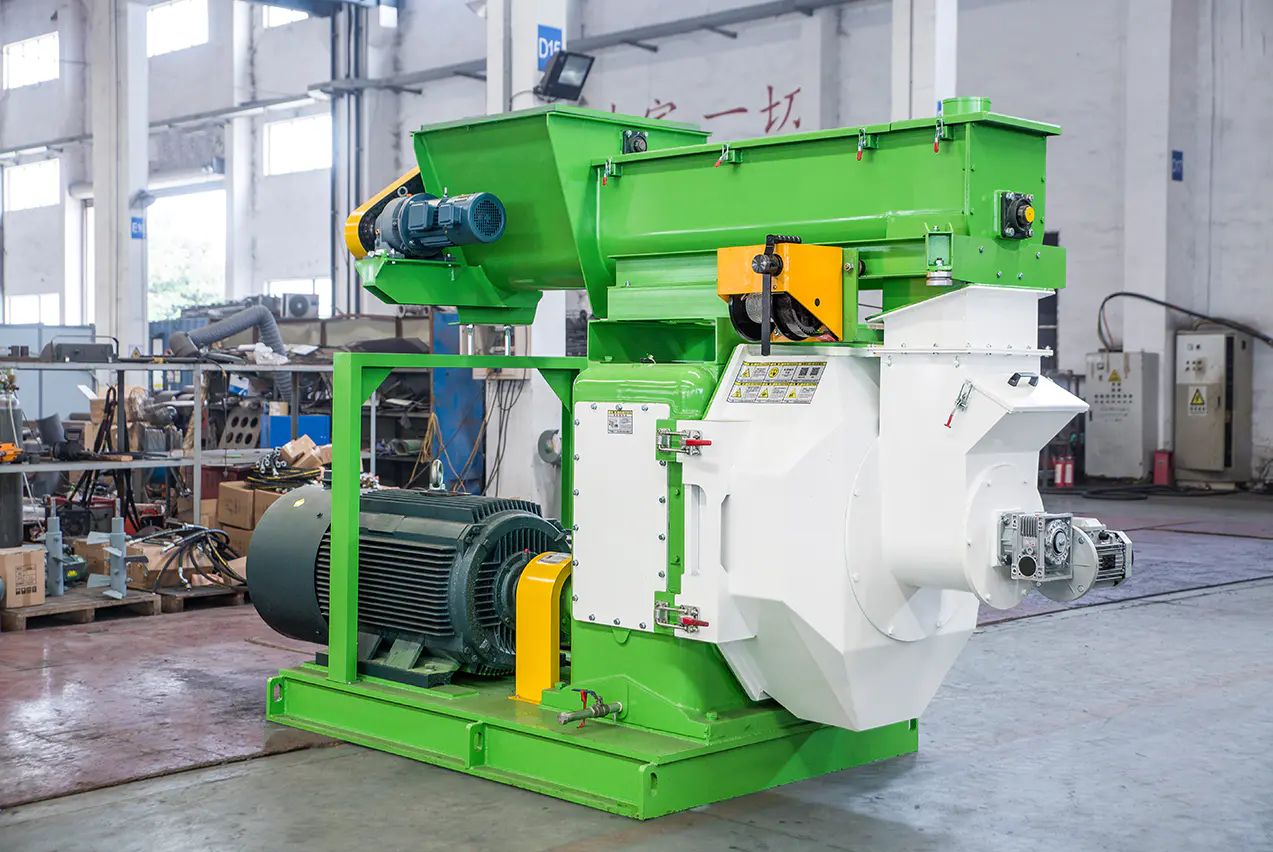
4. Pelletizing Ground biomass is compressed through a ring die pellet mill under high mechanical pressure — no binders are added for standard wood feedstocks. The natural lignin in the biomass acts as a binding agent when the material reaches processing temperature under compression. Kingwood’s pellet mill lineup covers the full industrial capacity range:
- JWZL-420: 1–1.5 t/h
- JWZL-688: 2–2.3 t/h
- JWZL-688D: 3–3.5 t/h
- JWZL-928: 4–5 t/h
- JZWH-860 (horizontal configuration): 4–5 t/h
For production lines above 5 t/h, multiple pellet mills operate in parallel within a single integrated line. Kingwood’s largest complete line designs reach 200,000 metric tons per year of output.
5. Cooling Pellets exit the die at elevated temperature and are mechanically fragile until cooled. A counter-flow cooler reduces pellet temperature to near-ambient, hardening the structure and stabilizing moisture content. Kingwood’s counter-flow cooler design moves ambient air counter to pellet flow, maximizing thermal exchange efficiency and minimizing the cooler footprint.
6. Screening, Packaging, and Dispatch A final screening stage removes fines and undersized material before pellets are conveyed to packaging. Kingwood’s complete lines include pellet packaging machines configured for either bulk industrial dispatch or bagged retail formats, depending on the buyer’s end market.
Why Production Line Architecture Determines Long-Term Cost Per Ton
Price comparisons for China wood pellet production lines are only meaningful when comparing equivalent process architectures. A line priced low by omitting a dryer, specifying an undersized hammer mill, or using an open-layout workshop without dust extraction will carry higher operating costs, regulatory risk, and maintenance burden — costs that dwarf the initial price differential.
Kingwood structures all complete line proposals under its Three-Standardization Framework, which specifies three non-negotiable design standards: Integrated production lines (all stages engineered as a coordinated system, not assembled from unrelated components), Dust-Free production lines (enclosed processing with integrated dust removal throughout), and Automated production lines (PLC-controlled sequencing, automated feed rate management, and remote monitoring capability).
The Dust-Free standard is operationally critical. Biomass grinding and pelletizing generate combustible dust. Facilities without proper dust extraction face explosion risk, regulatory non-compliance, and ongoing housekeeping costs. Kingwood’s 2024 Guizhou dust-free biomass pellet workshop project demonstrates this standard applied at scale in a live industrial environment.
The economic case for proper line specification is well-documented. Kingwood’s 2024 Vietnam 12 t/h wood pellet production line achieved full capital payback in 23 months. Biomass pellets produced on industrial lines consistently deliver 40–50% cost savings versus fossil fuel alternatives at the point of combustion — a margin that only holds if pellet quality (calorific value ≥4,800 kcal/kg, moisture <15%, sulfur <0.3%) is maintained through disciplined process control.
Evaluating a China Wood Pellet Production Line Manufacturer
Buyers evaluating manufacturers should apply consistent criteria across all suppliers:
Process completeness: Does the manufacturer design and supply all six stages, or does it only supply the pellet mill and source auxiliary equipment from third parties? Single-source responsibility reduces integration risk and simplifies commissioning.
Reference installations: Documented, verifiable case studies with throughput, year, and customer country provide more decision-relevant data than catalog specifications. Kingwood’s reference base spans 30 countries, with documented large-scale projects including a 24 t/h line in Vietnam (2023) and a 30 t/h line in Chongqing, China (2021).
Certifications: ISO 9001, ISO 14001, and CE are baseline requirements for export-market equipment. Kingwood holds both ISO certifications, CE marking, and is publicly listed on China’s NEEQ exchange (stock code: 871765) — providing financial transparency not common among private equipment suppliers.
R&D depth: Equipment design for biomass processing requires application-specific engineering. Kingwood’s 20-person R&D team operates with 27 years of focused biomass pellet equipment development, supporting ongoing model refinement and custom line engineering for non-standard feedstocks.
For buyers comparing China wood pellet production line prices and specifications, Kingwood provides detailed engineering proposals based on feedstock analysis, target output, site conditions, and budget parameters. Contact the Kingwood sales team with your feedstock type, target annual output, and site location to receive a structured line proposal.
FAQ
What types of residual biomass can a wood pellet production line process?
Industrial-grade lines handle sawdust, wood chips, bark, agricultural straw, rice husks, and other lignocellulosic by-products from forestry and agro-processing operations. Feed material is sorted, chipped or shredded to uniform size before entering the drying stage.
What moisture content is required before pelletizing?
Biomass must be dried to below 15% moisture content prior to pelletizing. Kingwood's wet-feed production lines integrate drum dryers specifically to handle high-moisture raw materials, eliminating the need for pre-dried feedstock.
What is the maximum production capacity of a Kingwood wood pellet line?
Kingwood designs complete wood pellet production lines with a maximum capacity of 200,000 metric tons per year. Individual pellet mill models range from 1 t/h (JWZL-420) to 4–5 t/h (JWZL-928 and JZWH-860), with multiple units deployed in parallel for large-scale output.
What quality standards do Kingwood biomass pellets meet?
Pellets produced on Kingwood lines achieve a calorific value of 4,800 kcal/kg, moisture below 15%, sulfur below 0.3%, and ash below 18%. All emission indicators comply with China's GB13271-2001 boiler air pollutant standard. The specifications also meet EU, US, and Japanese import benchmarks.
How does a ring die pellet mill differ from a flat die mill for industrial-scale lines?
Ring die pellet mills apply radial compression through a rotating die, delivering higher throughput, more consistent pellet density, and lower specific energy consumption per ton — making them the preferred choice for continuous industrial production rather than small-batch processing.
What is the typical payback period for a wood pellet production line investment?
A documented Kingwood case in Vietnam (12 t/h line, 2024) achieved full capital payback in 23 months. Biomass pellets typically reduce fuel costs by 40–50% compared to fossil fuels, which directly accelerates return on investment in high-energy-consumption industries.
What certifications should a China wood pellet production line manufacturer hold?
Key credentials include ISO 9001 (quality management), ISO 14001 (environmental management), and CE marking for export markets. Kingwood additionally holds recognition as a Jiangsu Provincial High-Tech Enterprise and is listed on the NEEQ stock exchange under code 871765.
- Global wood pellet production reached approximately 44 million metric tons in 2023, with industrial-grade pellets accounting for the majority of traded volume. (2024, IEA Bioenergy — Task 40 Wood Pellet Trade and Markets Annual Report 2024)
- Biomass energy supplied around 6.5% of global total final energy consumption in 2023, with solid biomass — including wood pellets — representing the dominant share. (2024, IEA Renewables 2024 Report)