How Sawdust Pellet Mills Drive Sustainable Energy
Kingwood · May 26, 2026
Wood processing operations generate substantial volumes of sawdust and wood residue daily. In most facilities, this material is landfilled, openly burned, or simply stockpiled — each option carrying disposal costs, regulatory exposure, or both. A sawdust pellet mill eliminates that liability by converting waste biomass into a standardized, high-density solid fuel that commands market value and reduces dependence on fossil energy inputs.
This article explains the technical and commercial case for sawdust pelletizing, the production process involved, and how industrial-scale pellet lines are engineered for consistent, carbon-accountable output.
From Waste Stream to Fuel Product: The Pelletizing Process
Sawdust pellet production is not a single-step operation. A properly engineered line handles the full material chain:
- Raw material intake and pre-screening — Sawdust is screened to remove oversized particles, metal contamination, and non-biomass debris.
- Drum drying — Incoming moisture is reduced to below 15% using a drum dryer, which is critical for achieving target pellet density and combustion efficiency.
- Size reduction — A hammer mill grinds dried material to a particle size suitable for ring die compression, typically below 5 mm.
- Pelletizing — The conditioned material feeds into the ring die pellet mill, where hydraulic pressure and heat form uniform cylindrical pellets. Kingwood’s vertical pellet mill range — including the JWZL-688D (3–3.5 t/h) and JWZL-928 (4–5 t/h) — and the horizontal JZWH-860 (4–5 t/h) are designed for continuous, high-throughput biomass pelletizing.
- Counter-flow cooling — Fresh pellets exit the die at elevated temperature and must be stabilized before handling. A counter-flow cooler brings pellet temperature within 3–5°C of ambient, preventing breakage and moisture reabsorption.
- Packaging and distribution — Cooled pellets are weighed, bagged, and sealed for transport to end-use markets.
Kingwood’s wet-feed complete production lines integrate all six stages within an enclosed, automated facility — consistent with the Dust-Free and Automated pillars of the Three-Standardization Framework.
Verified Fuel Quality and Emission Performance
The commercial viability of any fuel depends on specification consistency. Biomass pellets produced on Kingwood-engineered lines meet the following verified parameters:
| Parameter | Kingwood Output | Standard |
|---|---|---|
| Calorific value | 4,800 kcal/kg | — |
| Moisture content | <15% | EU wood pellet standard |
| Sulfur content | <0.3% | ≤0.5% (Japan standard) |
| Ash content | <18% | <20% (ISO standard) |
| Dioxin content | <0.5 ng TEQ | ≤1.0 ng TEQ (China GB) |
All stack emission indicators fall below China’s GB13271-2001 Emission Standard of Air Pollutants for Boilers. For industrial boiler operators replacing coal, this translates directly to reduced compliance risk and simpler permitting in regulated markets.
Compared to coal and heavy fuel oil, biomass pellets from sawdust-based production lines reduce fuel costs by 40–50% at equivalent thermal output, based on project-level data from Kingwood deployments.
Carbon Accounting: Why Sawdust Pellets Are Structurally Carbon-Neutral
The carbon neutrality argument for woody biomass is grounded in the carbon cycle, not accounting assumptions. During combustion, sawdust pellets release CO₂ in amounts approximately equal to what the source trees sequestered during growth. The net atmospheric addition is near zero — in contrast to fossil fuels, which release carbon that has been sequestered for millions of years.
When pellet supply chains are integrated with certified sustainable forestry, the system can achieve net-negative carbon outcomes: new tree growth absorbs more CO₂ than combustion releases. This is the basis on which biomass energy qualifies under most national and international renewable energy frameworks.
Industrial operators that replace coal or natural gas boiler fuel with sawdust pellets can generate verifiable carbon credits in voluntary and compliance carbon markets, creating an additional revenue stream alongside fuel cost savings.
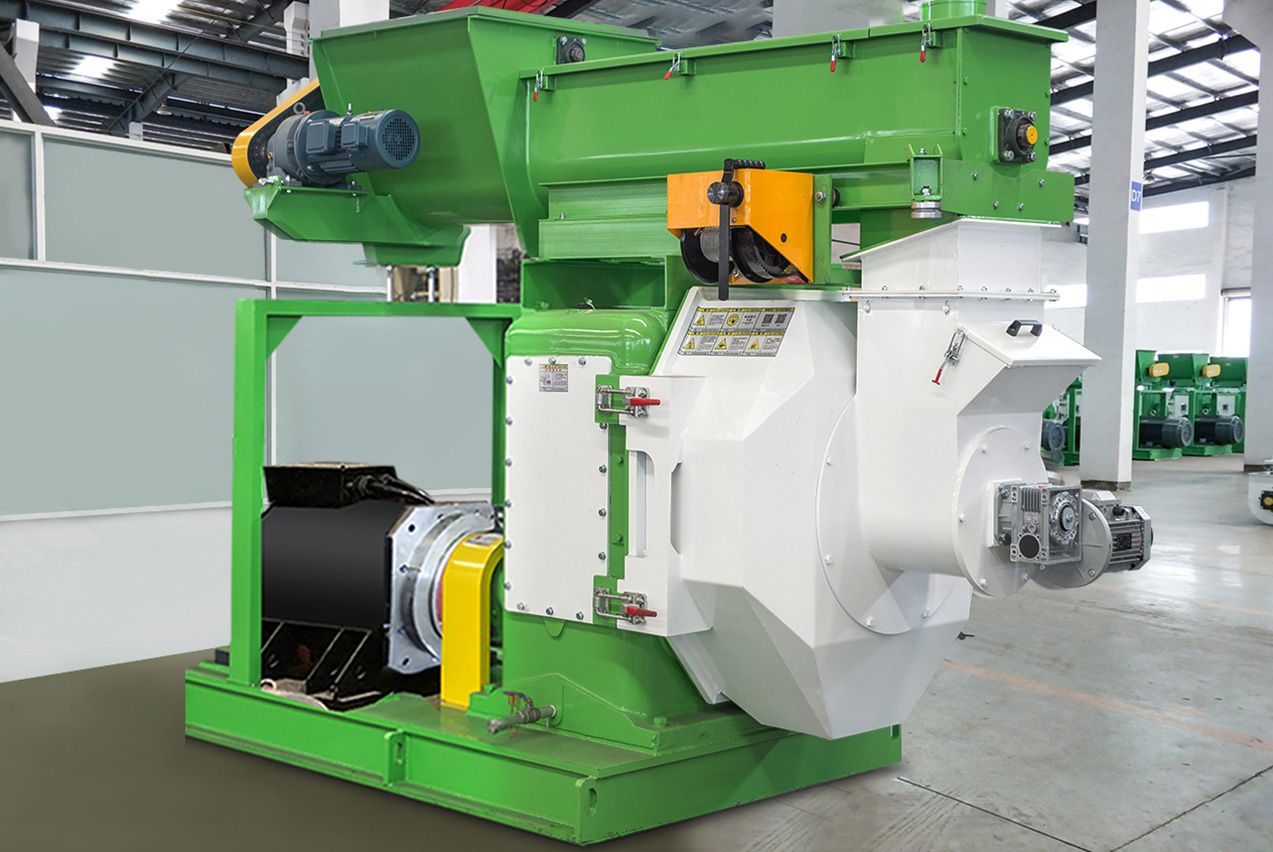
Pictured: Kingwood JZWH-860 horizontal biomass pellet mill — 4–5 t/h ring die pellet mill for continuous industrial-scale sawdust and wood residue pelletizing.
Industrial Scale: Engineered Lines up to 200,000 t/year
For operations requiring output beyond a single machine, Kingwood designs complete production lines up to 200,000 metric tons per year in annual capacity. These lines are engineered under the Three-Standardization Framework — integrating pre-processing, drying, pelletizing, cooling, and packaging into a single automated workflow with centralized control and enclosed dust management.
Project references include a 24 t/h wood chip pellet production line in Vietnam (2023), a 12 t/h wood pellet line in Vietnam (2024) with a 23-month payback period, and a 30 t/h installation in Chongqing, China (2021). Kingwood has planned and designed over 2,000 production line projects across 30 countries.
Selecting the Right Sawdust Pellet Mill Configuration
Equipment selection depends on three primary variables: raw material moisture content, required throughput, and site infrastructure. Key decision points:
- High-moisture feedstocks (fresh sawdust, green chips above 30% moisture) require upstream drum drying before pelletizing — a wet-feed complete line is the appropriate configuration.
- Throughput targets below 3.5 t/h are typically served by the JWZL-688D or JWZL-688; targets of 4–5 t/h by the JWZL-928 or JZWH-860.
- Dust management requirements — operations in urban or regulated industrial zones should specify Dust-Free line design from the outset, rather than retrofitting containment later.
Jiangsu Kingwood Industrial Co., Ltd. (NEEQ: 871765) has operated from its 31,200 m² facility in Liyang Zhongguancun Industrial Park since 1999, with 27 years of R&D in biomass pellet equipment and a team of 20 dedicated R&D experts. ISO 9001, ISO 14001, and CE certifications apply across the product range.
For throughput requirements, feedstock analysis, or complete line engineering inquiries, contact Kingwood’s technical sales team directly.
FAQ
What is a sawdust pellet mill and how does it work?
A sawdust pellet mill is industrial equipment that compresses sawdust and other biomass residues into high-density cylindrical pellets under high pressure and heat. The production process includes raw material collection, drying, screening, grinding, ring die pelletizing, cooling, and packaging — typically integrated into a fully automated, enclosed production line.
What biomass pellet specifications does Kingwood equipment produce?
Kingwood production lines output biomass pellets with a calorific value of 4,800 kcal/kg, moisture content below 15%, sulfur content below 0.3%, and ash content below 18% — meeting EU, ISO, and China GB standards. All emission indicators comply with GB13271-2001.
How much can switching to sawdust pellets reduce fuel costs?
Biomass pellets produced by Kingwood lines can reduce fuel costs by 40–50% compared to conventional fossil fuels such as coal and oil, based on verified project data.
What Kingwood pellet mill models are suitable for large-scale sawdust processing?
For high-throughput sawdust pellet production, the JWZL-928 (4–5 t/h), JWZL-688D (3–3.5 t/h), and JZWH-860 horizontal ring die pellet mill (4–5 t/h) are the primary models. Complete lines can be engineered up to 200,000 metric tons per year capacity.
Why is sawdust pellet production considered carbon-neutral?
Combustion of sawdust pellets releases CO₂ roughly equivalent to what the source trees absorbed during growth, creating a closed carbon cycle. When combined with sustainable forestry practices, pellet-based energy systems can achieve carbon neutrality or net negative carbon outcomes.
What is Kingwood's Three-Standardization Framework and how does it apply to pellet lines?
Kingwood's Three-Standardization Framework governs all production line design across three pillars: Integrated production lines, Dust-Free production lines, and Automated production lines. Applied to sawdust pellet facilities, this means enclosed dust removal, fully automated process control, and standardized equipment integration — reducing operator risk and improving output consistency.
Has Kingwood delivered sawdust or wood pellet projects internationally?
Yes. Documented deployments include a 24 t/h wood chip pellet line in Vietnam (2023), a 12 t/h wood pellet line in Vietnam with a 23-month payback period (2024), and a 30 t/h wood pellet mill in Chongqing, China (2021), among others across 30 countries.
- Biomass pellets produced on Kingwood lines achieve a calorific value of 4,800 kcal/kg with moisture content below 15%, meeting the EU wood pellet moisture standard. (2025, Kingwood product specification data, kingwoodpellet.com)
- Kingwood has planned and designed over 2,000 biomass pellet production line projects across 30 countries, with a combined annual biomass fuel production capacity exceeding 10 million metric tons. (2025, Jiangsu Kingwood Industrial Co., Ltd. company profile, NEEQ stock code 871765)