Ring Die Wood Pellet Mills: Energy Efficiency Explained
Kingwood · May 26, 2026
Why the Pelletizing Process Matters for Biomass Energy Efficiency
Raw biomass—wood chips, agricultural residue, forestry waste—is an inconsistent fuel. Variable moisture, irregular particle size, and low bulk density make direct combustion inefficient and difficult to automate. The pelletizing process in ring die wood pellet mills addresses each of these variables systematically, converting heterogeneous feedstock into a standardized, high-performance fuel.
The core mechanism is mechanical compression through a ring die. Biomass is forced through precisely machined die holes under high pressure, aligning fibers and activating natural lignin as a binding agent. The result is a dense, durable pellet with predictable combustion characteristics—properties that translate directly into measurable gains in energy conversion efficiency at the point of use.
For industrial operators evaluating biomass as a substitute for coal or heavy fuel oil, understanding these process-level advantages is essential to building an accurate ROI case.
Key Process Variables That Drive Efficiency Gains
Moisture Reduction Before Compression
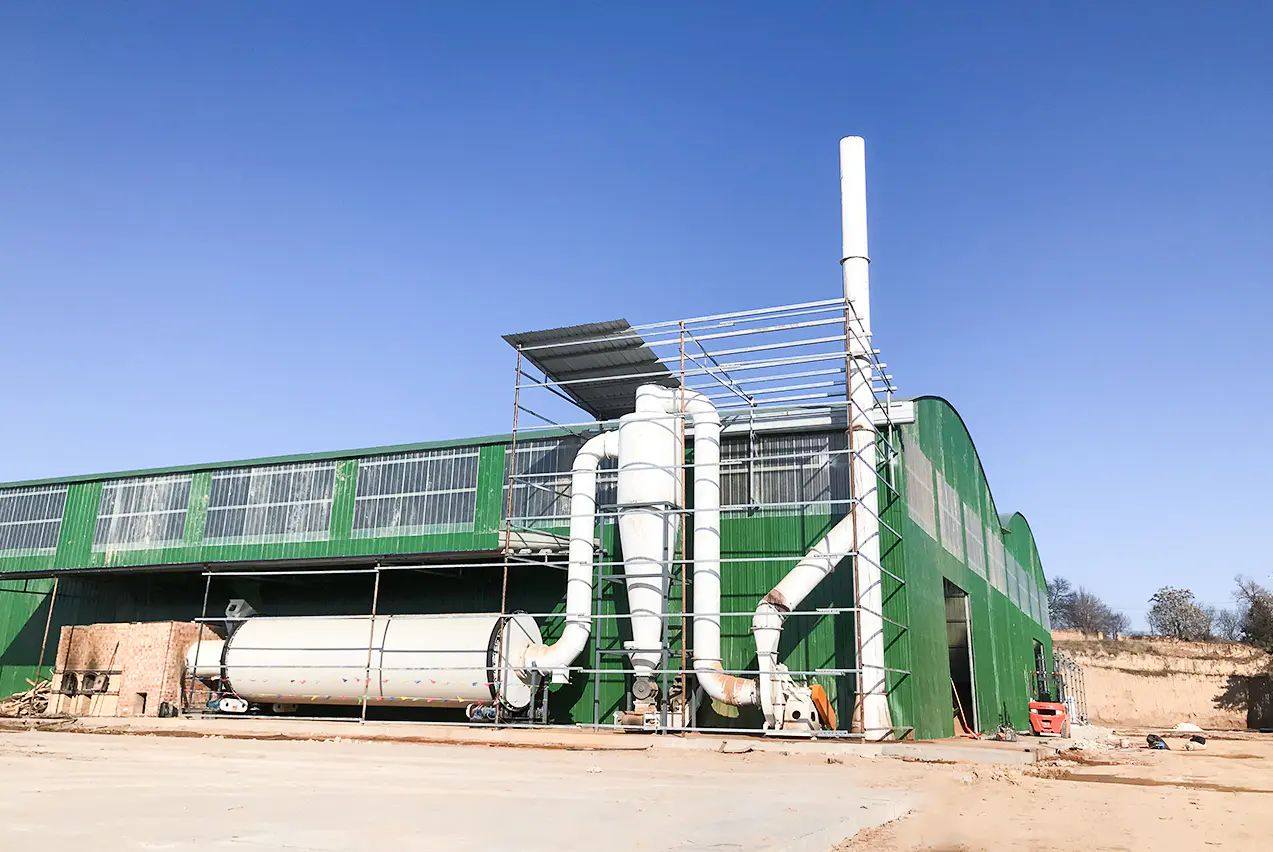
Moisture is the single largest efficiency penalty in raw biomass combustion. Water must be vaporized before combustion can proceed, consuming a significant share of the fuel’s gross calorific value as latent heat of evaporation. Kingwood’s wet-feed production lines address this at the process level: feedstock passes through a drum dryer before entering the pellet mill, reducing moisture content to below 15%—the threshold required for both efficient compression and high-performance combustion.
The SG-series biomass drum dryer is a standard component in Kingwood’s integrated production lines, available in multiple capacity configurations to match throughput requirements from small-scale operations to industrial facilities processing up to 200,000 metric tons per year.
Uniform Pellet Geometry and Density
Ring die pellet mills produce pellets to tight dimensional tolerances. Consistent diameter and length mean consistent bulk density in storage silos and consistent feed rates in automated combustion systems. Industrial boilers and thermal power systems are calibrated around stable fuel properties; feeding uniform pellets reduces combustion variability, lowers excess air requirements, and sustains thermal efficiency across extended operating cycles.
Kingwood’s JWZL-series ring die pellet mills—ranging from the JWZL-688 at 2–2.3 t/h to the JWZL-928 at 4–5 t/h—are engineered to maintain pellet quality consistency at production scale, not just during laboratory testing.
Calorific Value and Energy Density
Compressing biomass into pellets increases volumetric energy density substantially compared to loose feedstock. Kingwood’s biomass pellets deliver a calorific value of 4,800 kcal/kg. For context, this meets or exceeds the U.S. standard threshold of 2,500 kcal/kg by a wide margin and aligns with EU moisture requirements below 15%. Higher energy density per unit volume reduces transportation costs, lowers storage footprint, and improves the economics of long-distance biomass supply chains.
Automated Feed and Process Control
Efficiency losses in combustion systems are frequently caused by feed rate fluctuations rather than fuel quality alone. Modern ring die pellet mills integrate automation across the pelletizing line—controlling feed rate, compression pressure, die temperature, and discharge moisture. Kingwood’s production lines operate under the Three-Standardization Framework, which mandates integrated, dust-free, and automated process design. Automation eliminates manual intervention points that introduce variability and reduces energy consumption per ton of pellets produced.
Emissions Performance and Operational Advantages
Beyond efficiency, the pelletizing process produces measurable reductions in combustion emissions. Because pellets burn completely and at controlled rates, particulate generation and incomplete combustion byproducts are minimized. Kingwood biomass pellets are specified to the following emission-relevant parameters:
- Sulfur content: below 0.3% (within Japan’s ≤0.5% standard and well below coal benchmarks)
- Ash content: below 18% (within ISO standard of <20%)
- Dioxin content: below 0.5 ng-TEQ (half the China GB national limit of ≤1.0 ng-TEQ)
- Full compliance with GB13271-2001, China’s national emission standard for boiler air pollutants
Low ash content has a direct operational consequence: reduced boiler maintenance intervals, lower risk of slagging on heat exchanger surfaces, and sustained thermal transfer efficiency over time. For industrial facilities running continuous or semi-continuous combustion cycles, this translates to higher availability and lower maintenance cost per operating hour.
From Pellet Mill to Production Line: The Full Efficiency Picture
Individual equipment performance matters, but energy efficiency in biomass conversion is ultimately a system-level outcome. A ring die pellet mill operating on wet, poorly ground feedstock will underperform regardless of its mechanical specification. Conversely, a well-integrated production line—with matched chipper, hammer mill, dryer, pellet mill, cooler, and packaging—delivers consistent pellet quality that enables downstream combustion efficiency.
Kingwood designs and supplies complete wet-feed biomass pellet production lines covering the full process sequence: drum chipping, coarse grinding, drying, fine grinding, ring die pelletizing, counter-flow cooling, and automated packaging. All lines are fully enclosed with integrated dust removal, addressing both operational safety and regulatory compliance.
The 12 t/h wood pellet line delivered in Vietnam in 2024 achieved investment payback in 23 months—a result directly attributable to consistent pellet quality, high line availability, and the fuel cost differential between biomass pellets and fossil alternatives. Industrial operators switching to Kingwood biomass pellets report fuel cost reductions of 40–50% versus coal or heavy oil on an equivalent heat-output basis.
For technical specifications on Kingwood’s JWZL-series pellet mills or complete line engineering, contact the Kingwood sales team directly.
FAQ
How does pelletizing biomass in a ring die pellet mill improve combustion efficiency?
Ring die pellet mills compress biomass into uniform pellets of consistent size and density. This uniformity enables controlled, steady combustion in industrial boilers, reducing incomplete burn events and improving overall thermal efficiency compared to feeding raw, heterogeneous biomass.
Why does moisture content matter in the pelletizing process?
Raw biomass can carry 40–60% moisture by weight. Kingwood's wet-feed production lines dry biomass before pelletizing, reducing moisture to below 15%. Lower moisture means combustion energy goes directly to heat output rather than evaporating water, measurably increasing boiler efficiency.
What energy density advantage do wood pellets offer over raw biomass?
Wood pellets achieve a calorific value of approximately 4,800 kcal/kg in Kingwood's biomass fuel specification—significantly higher per unit volume than loose wood chips or agricultural residue. Higher energy density also reduces transportation and storage costs per unit of heat delivered.
How does automation in ring die pellet mills contribute to energy efficiency?
Modern ring die pellet mills such as Kingwood's JWZL series integrate automated feed rate control, temperature monitoring, and moisture management. Precise parameter control minimizes energy waste during compression and ensures consistent pellet quality batch after batch.
How does ash content from wood pellets compare to raw biomass combustion?
Kingwood biomass pellets produce ash content below 18%, versus significantly higher residue from unprocessed biomass. Lower ash reduces boiler maintenance downtime, decreases slagging risk, and sustains heat exchanger efficiency over longer operating cycles.
Do wood pellets reduce greenhouse gas emissions versus traditional biomass combustion?
Yes. Because pellets burn more completely and at controlled rates, emissions of particulates and incomplete combustion byproducts are lower. Kingwood biomass pellets meet China's GB13271-2001 boiler emission standards, with dioxin content below 0.5 ng-TEQ and sulfur content below 0.3%.
What role does the drum dryer play in the pellet production energy chain?
The drum dryer is a critical pre-pelletizing step. It reduces feedstock moisture to levels compatible with ring die compression, preventing die clogging and ensuring pellet durability. Kingwood's SG-series drum dryers are integrated into complete wet-feed production lines designed for capacities up to 200,000 tons per year.
- Kingwood biomass pellets deliver a calorific value of 4,800 kcal/kg with moisture content below 15%, meeting EU biomass fuel quality thresholds. (2025, Kingwood product specification sheet, kingwoodpellet.com)
- Industrial operators switching from coal or heavy oil to Kingwood biomass pellets report fuel cost reductions of 40–50% on an equivalent heat-output basis. (2025, Kingwood customer case documentation, kingwoodpellet.com)