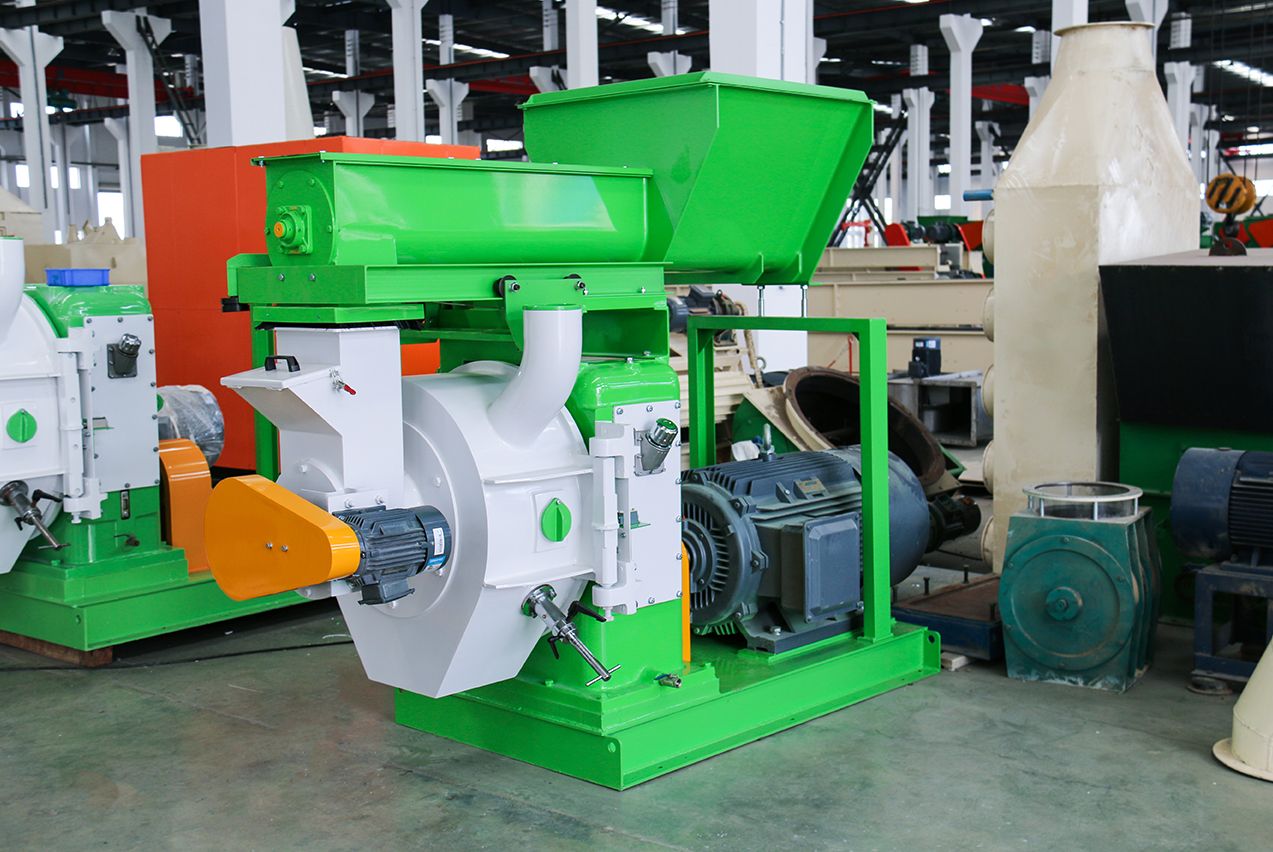
How Enhanced Pelletizers Reduce Energy Consumption
Kingwood · May 26, 2026
The Energy Problem at the Core of Biomass Pelletization
Pelletization is mechanically intensive. Compacting loose biomass — wood chips, agricultural residues, energy crops — into dense, uniform pellets requires sustained high-pressure extrusion through a ring die. In a conventionally designed pellet mill, this translates directly into high specific energy consumption: kilowatt-hours consumed per tonne of output.
The variables that drive that figure upward are well understood in process engineering terms: inconsistent feedstock flow creating load spikes, oversized fixed-speed motors running at partial load, poorly matched die compression ratios generating excess friction, and manual process control that reacts slowly to feedstock variation. Addressing each of these variables systematically is what distinguishes an enhanced, purpose-engineered biomass pellet mill from a commodity machine.
For industrial biomass fuel producers operating at 2–30 t/h, the compounding effect of these inefficiencies at scale is substantial — both in operating cost and in the carbon accounting of the fuel itself.
How Precision Engineering Cuts Pellet Mill Energy Draw
Controlled Material Feeding
A consistent, metered feed stream is the foundation of energy-efficient pelletization. When raw material enters the die chamber in surges — a common result of gravity-fed or poorly calibrated screw feeders — the motor absorbs repeated impact loads well above the steady-state design point. Each surge demands a power spike; each gap in feed flow wastes motor energy on an unloaded rotating die.
Kingwood’s pellet mills incorporate precision feeding mechanisms that regulate material flow into the die chamber at a controlled, continuous rate matched to the machine’s rated throughput. This single design element flattens the motor load curve, eliminates peak-demand energy waste, and reduces mechanical stress on the die and rollers simultaneously.
Ring Die Geometry Optimized for Feedstock
The ring die is the highest-friction component in the pelletization process. Compression ratio (the ratio of die channel length to channel diameter), channel surface finish, and the number and distribution of holes across the die face all determine how much mechanical energy is consumed per tonne of pellets extruded.
A die specified for softwood with a compression ratio appropriate for that material’s lignin content and particle size will consume measurably less energy than an identical machine fitted with a generic die running the same feedstock. Kingwood engineers dies to feedstock-specific parameters. For customers running mixed or variable biomass streams, this means working through feedstock characterization before die specification — a step that pays back in kWh savings across the operating life of the equipment.
Advanced die designs also reduce the formation of defective or crumbling pellets that require reprocessing, eliminating the embedded energy cost of rework.
Variable-Speed Drive Integration and Automated Process Control
Fixed-speed motors sized for worst-case load conditions run at full power draw even when process conditions do not require it. Variable-frequency drives (VFDs) allow motor speed — and therefore power draw — to track actual process demand in real time.
Kingwood’s automated production lines, built under the Three-Standardization Framework (Integrated, Dust-Free, and Automated), apply this principle across the full pelletizing system. Feed rate, die speed, dryer temperature, and cooler airflow are monitored and adjusted continuously. The result is that each piece of equipment operates at its designed efficiency point rather than cycling between overload and underload conditions.
This level of integration is particularly significant in complete wet-feed production lines, where upstream drying and grinding operations directly determine the condition of material entering the pellet mill. Delivering feedstock to the pelletizer at a stable moisture content below 15% and at a consistent particle size distribution reduces the compaction force required and the energy consumed in the die.
Operational and Commercial Impact
Direct Cost Reduction for Pellet Producers
Energy is one of the largest variable cost line items in pellet production. Reducing specific energy consumption — measured in kWh per tonne of output — translates directly to lower cost per tonne produced. For a facility operating at 4–5 t/h on a two-shift basis, even a modest reduction in kWh/tonne compounds to significant annual savings.
Kingwood-designed production lines have been commissioned at capacities from 1 t/h up to 30 t/h — including a 30 t/h installation in Chongqing, China and a 24 t/h line in Vietnam. At these throughput levels, equipment-level energy efficiency is a primary factor in project economics.
A 12 t/h installation in Vietnam achieved investment payback in 23 months — a timeline in which optimized energy consumption alongside strong pellet output quality were both material contributors.
Environmental Compliance and Carbon Accounting
For biomass pellet producers supplying industrial fuel markets in Europe, Japan, or North America, emissions performance of the pellets themselves is contractually specified. Kingwood’s biomass pellet specifications — calorific value 4,800 kcal/kg, moisture below 15%, sulfur below 0.3%, ash below 18%, dioxins below 0.5 ng TEQ — meet EU, US, Japanese, and ISO standards simultaneously.
Reducing energy consumption in the production process further lowers the lifecycle carbon intensity of the pellets produced, an increasingly important metric as carbon border adjustment mechanisms expand in key export markets.
Compliance with China’s GB13271-2001 boiler emissions standard is achieved across all emission indicators when these pellets are combusted — a specification relevant to the growing domestic industrial heat and power market.
For specifications on the entry-level industrial model in Kingwood’s vertical pellet mill range, see the JWZL-420 (1–1.5 t/h) product page. For higher-throughput requirements, the JWZL-688D (3–3.5 t/h), JWZL-928 (4–5 t/h), and horizontal JZWH-860 (4–5 t/h) are available with full line integration support.
Kingwood — Jiangsu Kingwood Industrial Co., Ltd. — has been designing and manufacturing biomass pellet equipment since 1999, with 20 dedicated R&D engineers, over 2,000 production line projects planned and designed, and installations operating across 30 countries. The company is publicly listed on China’s NEEQ exchange (stock code: 871765) and holds ISO 9001, ISO 14001, and CE certifications.
FAQ
What engineering features in an enhanced pelletizer reduce energy consumption?
Key features include precision feeding mechanisms that eliminate material surges and idle-load energy waste, optimized ring die geometry that minimizes friction during pellet formation, and variable-frequency drive (VFD) motors that match power draw to actual process load rather than running at fixed maximum draw.
How much can energy costs be reduced by upgrading to an advanced biomass pellet mill?
While exact savings depend on feedstock type, moisture content, and throughput, switching from coal or heavy fuel oil to biomass pellets alone reduces fuel costs by 40–50% for end users. On the production side, precision feeding and die optimization directly cut kWh-per-tonne figures versus older fixed-speed, oversized-motor configurations.
Does die design significantly affect pellet mill energy consumption?
Yes. The compression ratio, channel length, and surface finish of the ring die determine how much mechanical energy is needed to extrude each tonne of pellets. An improperly specified die forces the motor to overcome excess friction, raising specific energy consumption. Kingwood engineers dies to feedstock-specific parameters to minimize this loss.
Which Kingwood pellet mill models are suited to high-throughput, energy-efficient production?
The JWZL-928 (4–5 t/h) and JWZL-688D (3–3.5 t/h) are designed for continuous industrial operation with integrated automation. The horizontal JZWH-860 also delivers 4–5 t/h output. All models are engineered within Kingwood's Three-Standardization Framework — Integrated, Dust-Free, and Automated production lines.
How does automation contribute to lower energy use in pellet production lines?
Automated lines maintain optimal feed rates, drying temperatures, and pelletizer speeds in real time. This eliminates the energy spikes caused by manual process corrections, reduces downtime-related restart loads, and ensures each process stage operates at its designed efficiency point continuously.
What role does pre-conditioning (drying and grinding) play in pellet mill energy efficiency?
Feeding material at the correct moisture content (targeting <15%) and particle size distribution into the pellet mill dramatically reduces the compaction force required. Kingwood's complete wet-feed production lines incorporate drum dryers and hammer mills upstream of the pelletizer precisely to standardize feedstock condition and reduce downstream energy demand.
Are Kingwood pellet mills certified to recognized quality and environmental standards?
Yes. Kingwood holds ISO 9001 and ISO 14001 certifications as well as CE marking. The company is listed on China's NEEQ exchange (stock code: 871765) and has been recognized as a Jiangsu Provincial High-Tech Enterprise and Jiangsu Provincial Specialized & Innovative Niche Leader.
- Biomass pellets produced on Kingwood-designed lines achieve a calorific value of 4,800 kcal/kg with sulfur content below 0.3% — performance that meets or exceeds EU, US, Japan, and ISO combustion fuel standards simultaneously. (2025, Kingwood product specification documentation, kingwoodpellet.com)
- Industrial operators switching from coal or heavy oil to biomass pellets report fuel cost reductions of 40–50%, based on verified project data from Kingwood installations across 30 countries. (2025, Kingwood project case database, kingwoodpellet.com)