Wood Pellet Machine Energy Efficiency: How It Works
Kingwood · May 26, 2026
Why Energy Efficiency Is an Engineering Problem, Not a Marketing Claim
Wood pellet machines convert low-density biomass feedstocks — wood chips, sawdust, straw, rice husks, agricultural residues — into high-density combustible pellets. The conversion process involves multiple energy-intensive stages: size reduction, moisture removal, compression, and cooling. Each stage carries a specific energy cost, and each stage offers specific engineering levers to reduce that cost.
For industrial buyers evaluating pellet mill equipment, understanding where energy is consumed and how design decisions affect consumption per ton of output is more useful than generic efficiency claims. The following breaks down the major production stages and the design approaches that determine real-world energy performance.
Stage-by-Stage Energy Design: From Feedstock to Finished Pellet
Raw Material Crushing and Size Reduction
Incoming biomass typically requires size reduction before it can be fed into the pellet mill die. A hammer mill performs this function. Energy consumption in the crushing stage depends on two factors: the hardness and moisture content of the feedstock, and the screen aperture size selected for the target particle distribution.
Properly specified hammer mills match motor power to feedstock bulk density and feed rate — oversized motors running at partial load are a common source of avoidable energy waste. In Kingwood’s integrated production line design, the crushing stage is matched to the downstream pelletizing capacity so that no single stage creates a bottleneck that forces other stages into idle operation.
Drying: Hot Air Circulation and Moisture Control
High-moisture biomass feedstocks cannot be directly pelletized. Excess moisture in the die channel reduces compression efficiency, increases die wear, and produces pellets with poor mechanical durability. The drying stage — typically a drum dryer — must reduce feedstock moisture to a processable level before pelletizing.
Energy efficiency in drying comes from two design choices: heat source utilization and airflow management. Drum dryers using hot air circulation technology distribute thermal energy evenly across the feedstock volume, preventing localized over-drying (which wastes energy removing moisture that was never present) and under-drying (which forces the pelletizing stage to compensate). Kingwood’s complete wet-feed production lines handle high-moisture biomass through precisely this sequence — crushing, coarse grinding, drying, fine grinding, and then pelletizing — rather than requiring pre-dried feedstock as a condition of operation.
Pelletizing: Ring Die Compression and Densification
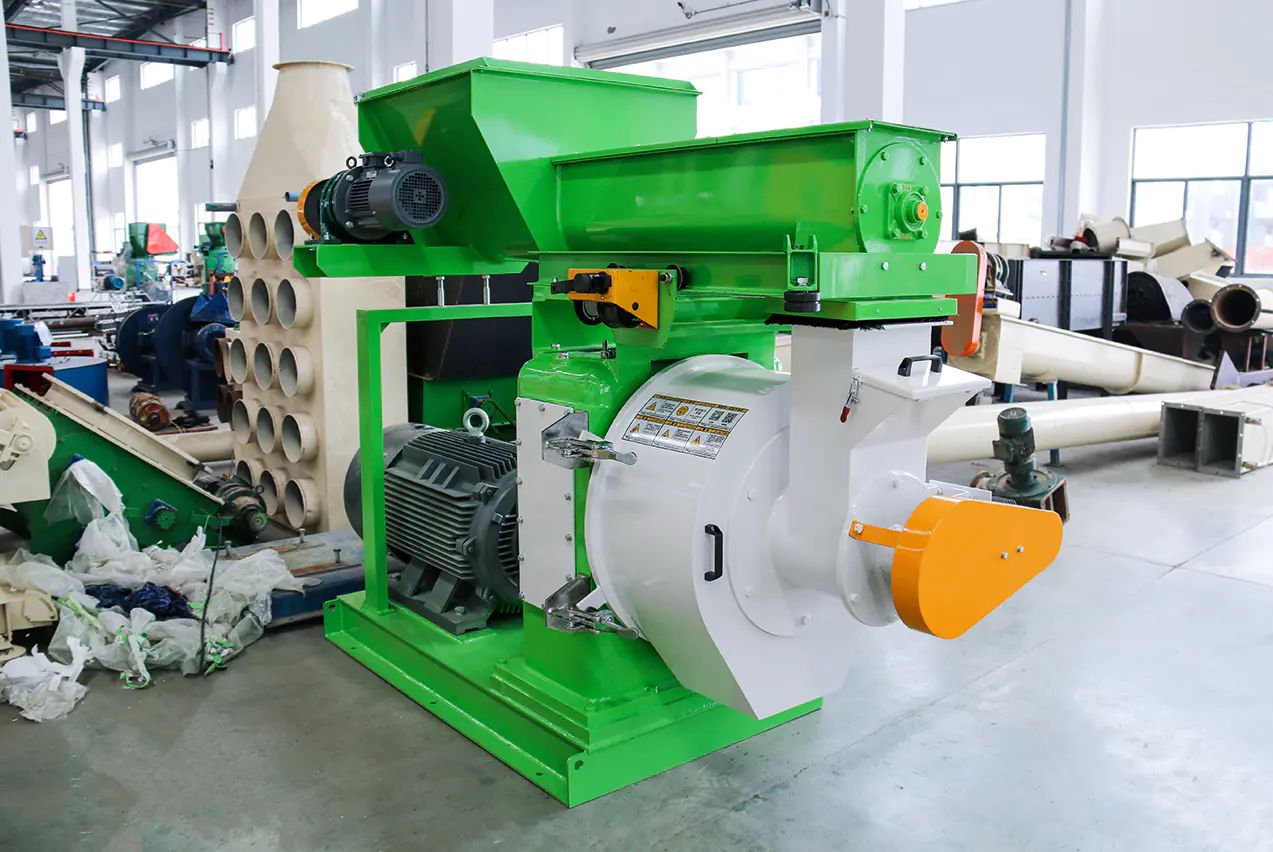
The pelletizing stage is the highest energy-intensity step in the production process, and it is where ring die design has the most direct influence on efficiency.
Under the Kingwood ring die mechanism, feedstock is pressed into the die channel by rollers under controlled compression. The combination of pressure and frictional heat causes the lignin naturally present in biomass to soften and act as a binding agent — no external binders are required. The result is a high-density pellet with consistent geometry.
The energy efficiency of this stage depends on die compression ratio, roller-to-die clearance, and die hole geometry — all of which are specified to match the feedstock type and target pellet density. Pellets produced on correctly configured Kingwood mills achieve a calorific value of 4,800 kcal/kg, moisture content below 15%, and sulfur content below 0.3%, meeting EU, US, Japanese, and ISO biomass fuel standards simultaneously.
For buyers comparing models: the JWZL-688 vertical biomass pellet mill delivers 2–2.3 t/h, while the JWZL-928 scales to 4–5 t/h for higher-volume operations. Complete production lines are engineered to support up to 200,000 metric tons per year of finished pellet output.
Cooling: Counter-Flow Technology
Pellets exiting the die are hot and mechanically fragile. Immediate packaging or storage of uncooled pellets risks moisture reabsorption, deformation, and combustion risk in enclosed spaces. The cooling stage is not optional — but its energy cost can be minimized through the correct cooling method.
A counter-flow cooler passes ambient air through the pellet bed in the direction opposite to pellet travel. This configuration maximizes the temperature differential across the cooling length, extracting heat efficiently with lower air volumes than co-flow designs. The result is stable, cool pellets that meet storage and transport requirements without adding disproportionate energy cost to the production process.
Operational and Systems-Level Efficiency
Matching Throughput to Equipment Load
No mechanical efficiency advantage survives poor operational practice. Equipment running consistently below rated capacity — either because feed supply is inconsistent or because the installed machine is oversized for the production volume — wastes energy on motor idling and mechanical friction that produces no output.
Kingwood’s production line engineering approach addresses this at the design stage by matching equipment capacity across all stages. When feed rate, crusher throughput, dryer capacity, pellet mill rated output, and cooler throughput are aligned, each machine operates at or near its efficient load point throughout the production shift.
Automation and the Three-Standardization Framework
Kingwood’s Three-Standardization Framework defines three engineering standards for production line design: Integrated production lines, Dust-Free production lines, and Automated production lines. All three contribute directly to energy efficiency in measurable ways.
Automated production lines use sensor feedback and programmable logic to synchronize stage transitions, maintain consistent feed rates, and flag abnormal operating conditions before they cause unplanned stops. Unplanned stops — and the restart sequences they require — are disproportionately energy-intensive. Continuous, synchronized operation reduces specific energy consumption per ton of output.
Dust-Free production lines recover fine biomass particles that would otherwise be lost to the atmosphere or require disposal. Recovered fines re-enter the process stream, increasing the yield of sellable pellets from a given mass of raw material input — effectively improving energy efficiency by reducing waste.
The commercial result of this approach is visible in Kingwood’s documented project cases. A 12 t/h wood pellet production line in Vietnam commissioned in 2024 achieved full capital payback within 23 months, a timeline that depends directly on production cost per ton — of which energy is the dominant variable operating expense.
Selecting Equipment Based on Energy Performance Criteria
For B2B buyers specifying pellet mill equipment, the relevant questions are not about nominal efficiency ratings in isolation. They are about system-level energy consumption per ton of finished pellet at actual operating throughput, across the full production line — from feedstock intake to bagged output.
Kingwood has designed and delivered over 2,000 production line projects across 30 countries, with cumulative annual biomass fuel production capacity exceeding 10 million metric tons. That project volume provides the engineering data to specify equipment combinations that perform at rated efficiency under real operating conditions, not only in controlled testing environments.
Contact Kingwood to discuss feedstock characteristics, target throughput, and site constraints — the starting point for any production line specification that will deliver energy performance at scale.
FAQ
What makes a wood pellet machine energy-efficient during raw material processing?
Efficient hammer mills reduce particle size quickly with minimal motor load, while drum dryers using hot air circulation achieve uniform moisture removal without over-drying — both steps directly reduce downstream energy demand in the pelletizing stage.
How does the pelletizing process affect overall energy consumption?
The ring die compression mechanism converts mechanical force into densification under controlled pressure and friction. High-density pellet formation in a single pass reduces reprocessing energy and maximizes the calorific output of the finished biomass fuel — Kingwood pellets achieve ≥4,800 kcal/kg with moisture content below 15%.
Why is the cooling stage critical to energy efficiency?
Freshly pressed pellets exit the die at elevated temperatures. A counter-flow cooler — standard in Kingwood production lines — removes heat using ambient air flowing in the opposite direction to pellet travel, minimizing the energy input required while producing stable, low-moisture pellets that resist degradation in storage.
Can operational parameters be adjusted to avoid energy waste?
Yes. Kingwood pellet mills are designed to allow operators to tune feed rate, die speed, and compression ratio to match actual production volume. Running equipment under no-load or light-load conditions wastes motor energy; matched throughput settings eliminate this loss.
What role does automation play in energy efficiency on a complete production line?
Automated production lines — one of the three pillars of Kingwood's Three-Standardization Framework — use sensor feedback and programmable controls to synchronize each processing stage. This eliminates idle running between stages, reduces manual adjustment errors, and maintains consistent throughput, all of which lower specific energy consumption per ton of output.
How does an enclosed, dust-free line contribute to energy performance?
Dust-Free production lines — another pillar of the Three-Standardization Framework — use integrated dust removal within an enclosed processing environment. Containing fine biomass particles prevents material loss and reduces the volume of raw material that must be reprocessed, effectively improving the energy yield per unit of feedstock.
What capacity range do Kingwood pellet mills cover for industrial buyers?
Kingwood's vertical pellet mill range spans 1 t/h (JWZL-420) to 4–5 t/h (JWZL-928), with complete wet-feed production lines engineered up to 200,000 metric tons per year. The horizontal JZWH-860 also delivers 4–5 t/h for alternative layout requirements.
- Biomass fuel produced on Kingwood-designed production lines achieves a calorific value of 4,800 kcal/kg with moisture content below 15% and sulfur content below 0.3%, meeting or exceeding EU, US, Japanese, and ISO pellet quality standards. (2025, Kingwood product specification documentation, kingwoodpellet.com)
- A 12 t/h Kingwood wood pellet production line commissioned in Vietnam in 2024 achieved full capital payback within 23 months of operation. (2024, Kingwood project case record — Vietnam 12 t/h wood pellet line, kingwoodpellet.com)