Wood Pellet Manufacturing Unit: Full Process Guide
Kingwood · May 26, 2026
What a Wood Pellet Manufacturing Unit Actually Does
A wood pellet manufacturing unit is not a single machine — it is a sequenced production system in which every stage depends on the output quality of the stage before it. Understanding how each process step contributes to the final product is essential for any operator planning or scaling a biomass fuel operation.
The unit begins at raw material intake. Wood waste, sawdust, and logging residues arrive from sawmills, furniture manufacturers, and forestry operations with inconsistent particle size and elevated moisture content. Before any material reaches the pellet mill, it must be sorted, screened for contaminants, and processed to meet feed specifications. Skipping or under-investing in this stage directly degrades pellet density, calorific value, and die service life downstream.
Stage-by-Stage Process Breakdown
Size Reduction Oversized wood feedstock is first reduced using a drum chipper, converting logs and branches into uniform wood chips. A hammer mill then performs fine grinding, reducing chips and other materials to a particle size suitable for pelletizing — typically below 5 mm. Consistent particle size distribution is a prerequisite for stable die compression and uniform pellet geometry.
Drying High-moisture biomass cannot be pelletized efficiently. A drum dryer reduces feedstock moisture to below 15% — the threshold required for both mechanical pellet formation and compliance with EU and ISO quality standards. Over-drying is equally problematic, as it reduces the natural lubrication needed for smooth die passage and increases fire risk in the grinding stage.
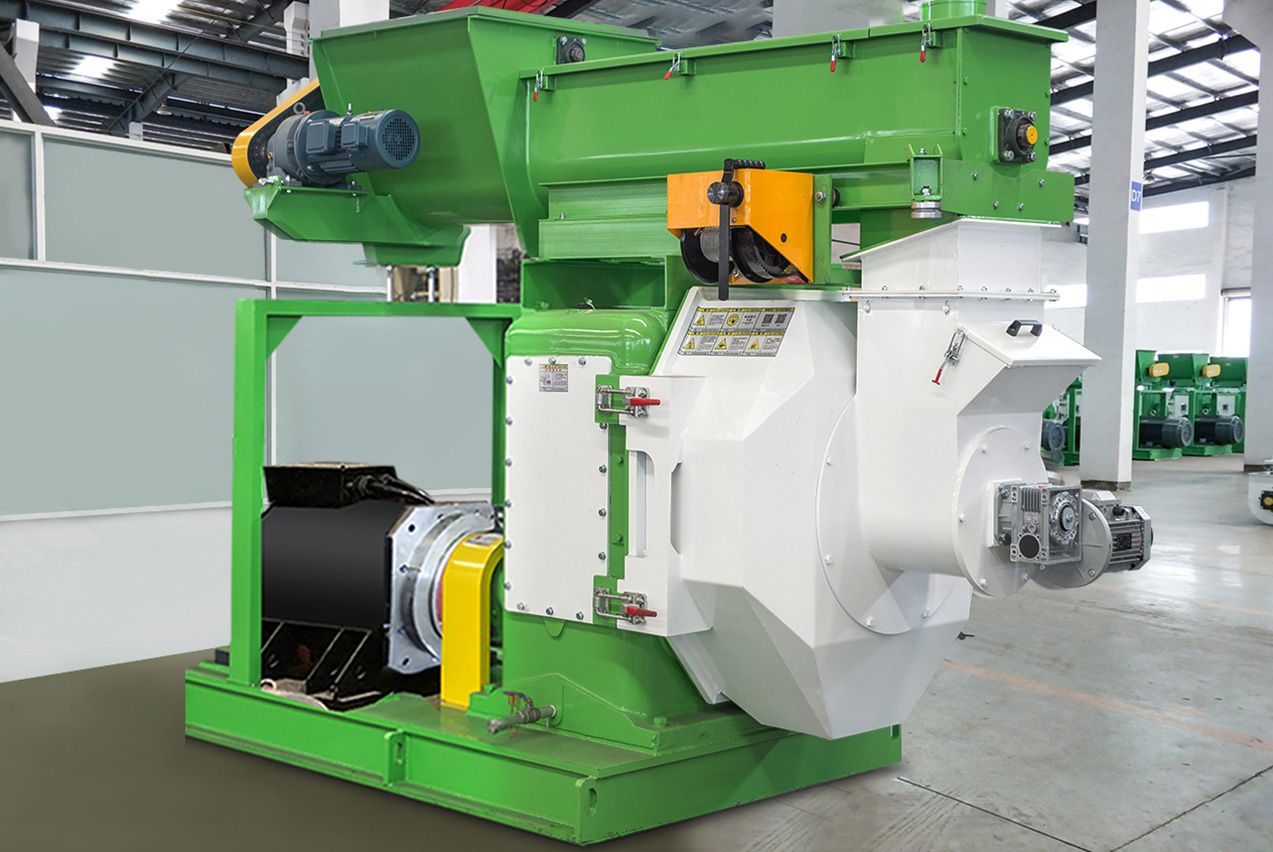
Pelletizing The pellet mill is the operational core of the manufacturing unit. Prepared wood particles enter the mill and are compressed through ring die openings under high mechanical pressure. This compression generates localized heat that activates lignin — the natural polymer present in wood — which acts as a binder, fusing particles into dense, cylindrical pellets without chemical additives.
Kingwood’s vertical pellet mill range covers throughputs from 1 t/h (JWZL-420) through 4–5 t/h (JWZL-928), with the JWZL-688 delivering 2–2.3 t/h as a proven mid-range configuration for small-to-medium industrial lines. The JZWH-860 horizontal pellet mill offers an equivalent 4–5 t/h capacity in a horizontal-feed configuration suited to specific material flow layouts.
Cooling and Sieving Pellets exit the die at temperatures that can exceed 80 °C with residual surface moisture. A counter-flow cooler draws ambient air in the opposing direction to pellet flow, rapidly reducing temperature and hardening the pellet surface. This step is critical for preventing caking, moisture re-absorption during storage, and pellet breakage in bulk handling.
Post-cooling, pellets pass through a sieving system that removes fines and irregular-geometry pellets. This ensures the final product meets dimensional tolerances demanded by industrial boiler feed systems and export quality standards.
Packaging and Distribution Finished pellets are packaged in configurations ranging from 15 kg retail bags to 1,000 kg bulk bags and loose bulk for direct industrial offtake. Kingwood’s complete lines integrate automated pellet packaging machines as standard, reducing manual labor requirements and maintaining production continuity.
Integrated Line Design and Automation
Operating each process stage as an isolated unit introduces coordination bottlenecks, dust emissions, and quality inconsistency. Kingwood addresses this through its Three-Standardization Framework — a design philosophy built on three pillars: Integrated production lines, Dust-Free production lines, and Automated production lines.
Kingwood’s wet-feed pellet production line embodies this approach. It handles high-moisture biomass through a fully enclosed, sequentially integrated flow — from crushing through packaging — with centralized automation control and built-in dust extraction at every transfer point. Complete line configurations are engineered for output up to 200,000 metric tons per year, making them viable for large-scale industrial biomass fuel producers and co-firing facilities.
Real deployments demonstrate the scale achievable with this architecture. A 24 t/h wood chip pellet production line commissioned in Vietnam in 2023 and a 12 t/h line also in Vietnam in 2024 — the latter achieving investment payback within 23 months — illustrate how integrated line design translates into commercially viable fuel operations.
The resulting biomass pellets achieve a calorific value of 4,800 kcal/kg, sulfur content below 0.3%, and ash content below 18%, complying with GB13271-2001, EU moisture standards, US calorific benchmarks, and ISO ash specifications. Industrial operators switching from fossil fuels to biomass pellets typically realize fuel cost reductions of 40–50%.
Established in 1999 and listed on the NEEQ (stock code: 871765), Jiangsu Kingwood Industrial Co., Ltd. operates from a 31,200 m² facility in Liyang Zhongguancun Industrial Park, Jiangsu Province. With over 27 years of R&D experience, 20 dedicated R&D specialists, and more than 2,000 production line projects planned and designed across 30 countries, Kingwood delivers full-scope engineering support — from consultation and design through installation, commissioning, and after-sales service.
FAQ
What is the role of a pellet mill in a wood pellet manufacturing unit?
The pellet mill is the core machine in any wood pellet manufacturing unit. It uses heat, pressure, and mechanical force to compress prepared wood particles through ring die openings, activating lignin as a natural binder to form dense, uniform cylindrical pellets.
What raw materials can a wood pellet manufacturing unit process?
Wood pellet manufacturing units typically process wood waste, sawdust, wood chips, and logging residues sourced from sawmills, furniture manufacturers, and forestry operations. These materials must be sorted, cleaned, and dried before entering the pelletizing stage.
Why is cooling necessary after pelletizing?
Freshly extruded pellets exit the pellet mill at elevated temperature and moisture levels. Rapid cooling — typically in a counter-flow cooler using ambient air — stabilizes pellet structure, reduces surface moisture, and prevents breakage during handling and storage.
How does Kingwood's wet-feed production line differ from a standard pellet line?
Kingwood's wet-feed pellet production line handles high-moisture biomass through a fully integrated sequence: crushing, coarse grinding, drying, fine grinding, pelletizing, and packaging. The line is fully automated, enclosed for dust control, and capable of up to 200,000 metric tons per year output.
What quality standards do Kingwood biomass pellets meet?
Kingwood biomass pellets achieve a calorific value of 4,800 kcal/kg, moisture content below 15%, sulfur content below 0.3%, and ash content below 18%. All emission indicators comply with China's GB13271-2001 boiler air pollutant standard, as well as EU, US, Japanese, and ISO pellet benchmarks.
What auxiliary equipment is required in a complete wood pellet manufacturing unit?
A complete wood pellet manufacturing unit typically requires a hammer mill or drum chipper for size reduction, a drum dryer for moisture control, the core pellet mill, a counter-flow cooler, a sieving system, and a pellet packaging machine.
Which Kingwood pellet mill models are suited for industrial-scale wood pellet production?
For industrial throughput, Kingwood offers the JWZL-688D (3–3.5 t/h), JWZL-928 (4–5 t/h), and JWZL-1068 (capacity on request) vertical pellet mills, along with the JZWH-860 horizontal pellet mill at 4–5 t/h. Multi-line configurations scale output significantly beyond single-unit capacity.
- Global wood pellet production reached approximately 42 million metric tons in 2023, driven by industrial co-firing demand across Europe and Asia-Pacific. (2023, IEA Bioenergy — Task 40 Sustainable International Bioenergy Trade, 2024 Annual Report)
- Biomass pellets can reduce fuel costs by 40–50% compared to conventional fossil fuel alternatives in industrial boiler applications. (2025, Kingwood technical specification data — kingwoodpellet.com)