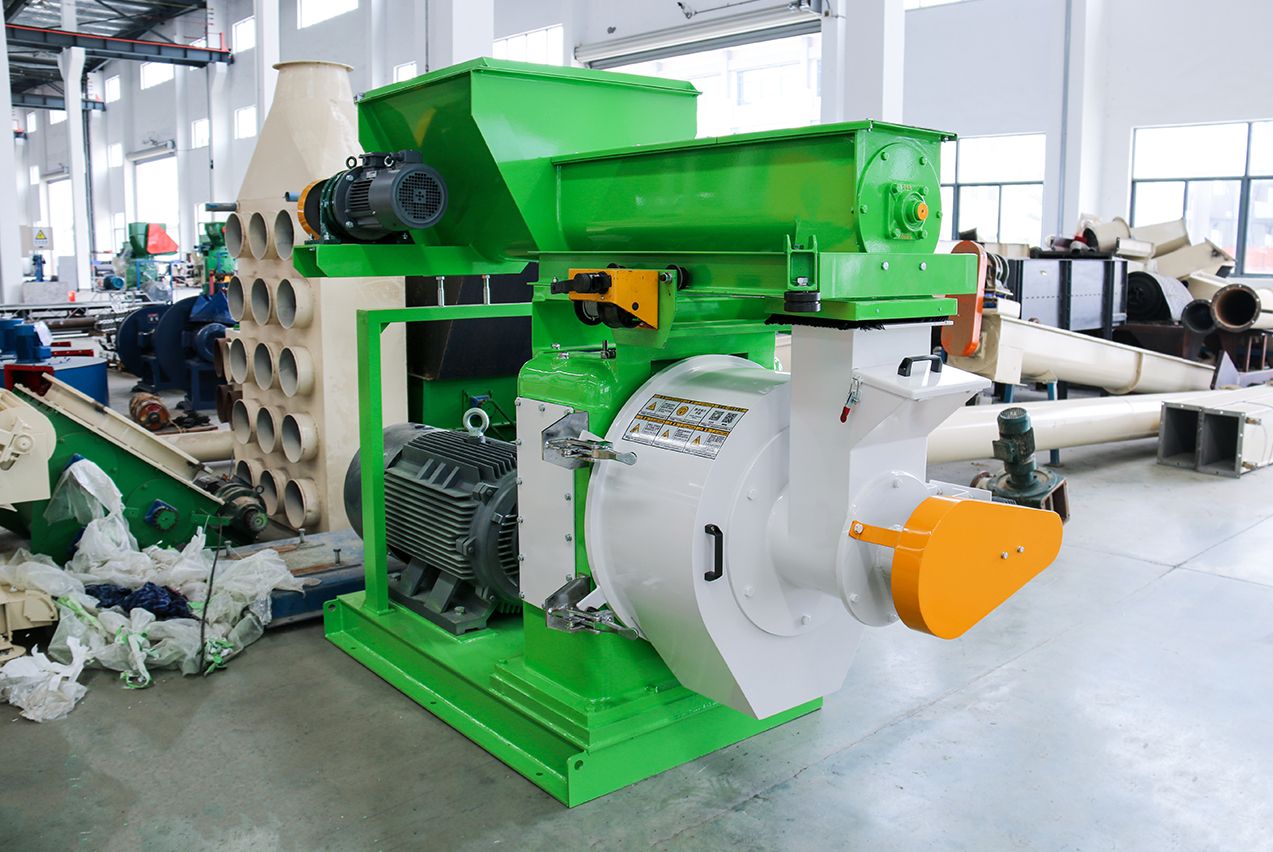
Growing Demand for Sawdust Pellet Mills Drives Industry Expansion
Kingwood · May 26, 2026
Why Sawdust Pellet Mill Demand Is Accelerating
Industrial energy consumers across Asia-Pacific, Europe, and North America are under mounting regulatory and commercial pressure to reduce coal and heavy fuel oil dependency. Sawdust pellets—produced by compressing wood residues through a ring die under controlled pressure and temperature—have emerged as a technically credible, cost-competitive substitute. With a calorific value of 4,800 kcal/kg, moisture content below 15%, sulfur content below 0.3%, and ash content below 18%, industrial-grade biomass pellets meet or exceed the fuel quality thresholds required for utility boilers, district heating networks, and industrial process heat applications.
The economics are equally compelling. Operators switching from coal or diesel to biomass pellets consistently report fuel cost reductions of 40–50%, while satisfying increasingly stringent air emissions requirements. In China, biomass pellets burned in compliant boiler systems produce emission indicators below GB13271-2001—the national Emission Standard of Air Pollutants for Boilers—without the capital investment required for flue gas desulfurization retrofits on coal units.
This combination of regulatory compliance, fuel cost savings, and feedstock availability from forestry and agricultural residues is the structural driver behind growing investment in sawdust pellet mill capacity worldwide.
Industrial Applications Extending Beyond Combustion
The commercial case for sawdust pellets extends well beyond direct combustion. B2B buyers across several verticals are integrating pellets into their supply chains for non-energy applications:
Wood composite manufacturing. Particleboard, MDF, and engineered wood panel producers use pelletized wood fiber as a controlled-moisture, standardized-density feedstock. Pelletized input reduces inbound logistics variability compared to bulk sawdust, improving process consistency on forming lines.
Livestock operations. Agricultural enterprises use sawdust pellets as animal bedding. The compressed, low-moisture format absorbs more moisture per kilogram than loose sawdust, reduces pathogen harboring, and lowers bedding change frequency—cutting both material and labor costs in large-scale poultry and swine facilities.
Co-firing and power generation. Industrial power plants operating coal-fired boilers are progressively substituting 10–30% of their fuel input with biomass pellets under co-firing programs, particularly in Vietnam, Japan, and South Korea where co-firing mandates provide financial incentives or compliance credits.
Each of these application sectors requires consistent pellet geometry, bulk density, and moisture specification—parameters that are determined by pellet mill design and process control, not simply feedstock quality.
Kingwood’s Engineering Response to Growing Market Demand
Founded in 1999 and operating from a 31,200 m² facility in Liyang Zhongguancun Industrial Park, Jiangsu Province, Kingwood has spent 27 years engineering pellet mill technology specifically for industrial-scale biomass processing. The company’s product range spans from the JWZL-420 vertical pellet mill at 1–1.5 t/h to the JWZL-928 at 4–5 t/h, with complete turnkey wet-feed production lines engineered for up to 200,000 metric tons per year output.
Kingwood’s wet-feed production line architecture is built for high-moisture biomass inputs—the feedstock reality in sawmill, agricultural residue, and forest harvesting contexts. The integrated sequence covers:
- Drum chipping — reducing oversize wood waste to processable chip dimensions
- Hammer milling — coarse size reduction to prepare material for drying
- Drum drying — controlled moisture reduction to target specification
- Fine grinding — particle size optimization for ring die compression
- Pelletizing — ring die compression forming 6–10 mm pellets at target bulk density
- Counter-flow cooling — stabilizing pellet temperature and hardness post-die
- Packaging — automated bagging or bulk loading for outbound logistics
This full-sequence capability eliminates the integration risk that arises when operators source individual machines from multiple suppliers. Process parameters are matched across stages at the engineering design phase, which reduces commissioning time and operating inefficiency once the line is running.
Kingwood’s proprietary Three-Standardization Framework structures every production line deployment around three non-negotiable operational pillars: integrated production flow, dust-free enclosed processing, and automated control. Dust-free design is particularly relevant for sawdust pellet plants, where combustible fine particle accumulation creates both fire risk and occupational health liability. The framework has been validated in documented projects including a dust-free biomass pellet workshop in Guizhou (2024) and Beijing’s first biomass pellet demonstration project (2024).
With over 2,000 production line projects planned and designed, equipment operating in 30 countries, and an annual biomass fuel production capacity of 10 million metric tons across its installed base, Kingwood’s engineering and after-sales infrastructure is scaled to support industrial operators through site assessment, process design, installation, commissioning, operator training, and long-term spare parts supply.
For operations requiring validation of ROI prior to full capital commitment, Kingwood’s Vietnam case studies provide reference data: a 12 t/h wood pellet production line delivered a 23-month payback period, and a 24 t/h installation was commissioned in 2023, demonstrating scalable deployment in the Southeast Asian co-firing market. A 30 t/h line in Chongqing, China further confirms large-scale domestic execution capability.
Industrial buyers evaluating sawdust pellet mill investment can contact Kingwood’s technical sales team directly for capacity modeling, feedstock assessment, and project-specific quotation.
FAQ
What is a sawdust pellet mill and how does it work?
A sawdust pellet mill compresses wood residues—sawdust, shavings, chips—under high mechanical pressure through a ring die, forming dense, uniform pellets typically 6–10 mm in diameter. The pelletizing process removes moisture and binds lignin naturally, producing a high-energy-density fuel suitable for industrial boilers, commercial furnaces, and power generation.
What are the primary industrial applications for sawdust pellets?
Sawdust pellets serve multiple B2B applications: biomass fuel for industrial boilers and co-firing power plants, animal bedding in livestock operations, raw material for wood composite boards (particleboard, MDF), and district heating systems. Their uniform size, low moisture content (<15%), and calorific value of 4,800 kcal/kg make them a reliable industrial feedstock.
How much can sawdust pellets reduce fuel costs compared to fossil fuels?
Kingwood's biomass pellets can reduce fuel costs by 40–50% compared to conventional fossil fuels, depending on local energy pricing and boiler efficiency. They also comply with China's GB13271-2001 boiler emissions standard, avoiding regulatory penalties associated with coal combustion.
What feedstocks can Kingwood pellet mills process beyond sawdust?
Kingwood's wet-feed pellet production lines handle a broad range of high-moisture biomass feedstocks: sawdust, wood chips, bark, agricultural straw, rice husks, and forest residues. The integrated crushing, drying, fine grinding, and pelletizing sequence is engineered to accommodate variable input moisture and particle sizes.
What production capacities are available for sawdust pellet production lines?
Kingwood offers vertical pellet mills from 1 t/h (JWZL-420) to 4–5 t/h (JWZL-928), as well as the horizontal JZWH-860 at 4–5 t/h. Complete turnkey production lines scale up to 200,000 metric tons per year. Custom engineering is available for projects exceeding standard configurations.
How does Kingwood's Three-Standardization Framework benefit industrial pellet plant operators?
The Three-Standardization Framework integrates three operational pillars: fully integrated production lines (eliminating inter-process material handling losses), dust-free enclosed processing (meeting occupational health and fire safety requirements), and automated control systems (reducing labor costs and ensuring consistent pellet quality). Together, these reduce downtime, improve output uniformity, and simplify compliance auditing.
What certifications does Kingwood hold for its pellet mill equipment?
Kingwood holds ISO 9001, ISO 14001, and CE certifications. The company is also recognized as a Jiangsu Provincial High-Tech Enterprise, Jiangsu Provincial Specialized & Innovative Niche Leader, and is listed on the NEEQ stock exchange under code 871765. Additional recognitions include Top 10 Brands in Biomass Molding Equipment and AAA Quality Trustworthy Brand Enterprise.
- Global wood pellet production reached approximately 44 million metric tons in 2023, with industrial-grade pellets accounting for the majority of demand in Europe and Asia-Pacific markets. (2024, IEA Bioenergy Task 40 — Sustainable Biomass Flows Report 2024)
- Asia-Pacific biomass pellet demand is projected to grow at a CAGR of over 9% through 2030, driven by coal-to-biomass co-firing mandates in Japan, South Korea, and Vietnam. (2024, IRENA Renewable Power Generation Costs and Biomass Outlook 2024)