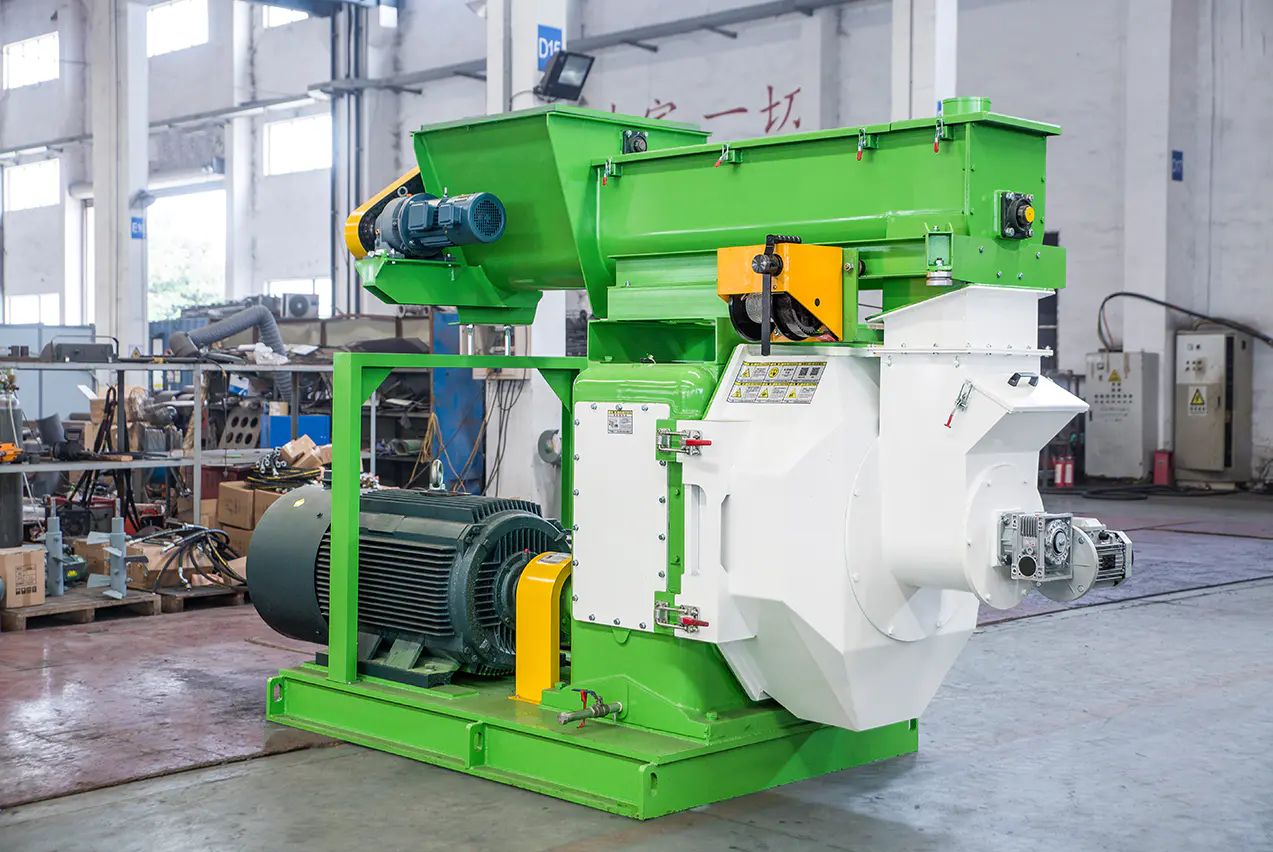
Industrial Biomass Pellet Mill Equipment: Manufacturer Overview
Kingwood · May 26, 2026
What Industrial Buyers Need from a Biomass Pellet Mill Equipment Manufacturer
Sourcing biomass pellet mill equipment at industrial scale is not a catalog purchase. B2B buyers — whether commissioning a 5 t/h facility or scaling to a 200,000 t/year production line — require a manufacturer that can specify equipment to feedstock conditions, local utility infrastructure, and downstream fuel quality standards simultaneously.
Kingwood (Jiangsu Kingwood Industrial Co., Ltd.) has operated in this space since 1999, accumulating 27 years of dedicated R&D in biomass pellet machinery. Headquartered at #568 Hongsheng Road, Liyang Zhongguancun Industrial Park, Jiangsu Province, China, the company maintains 25,000 m² of production floor space and a 20-person R&D team. It is publicly listed on China’s NEEQ exchange under stock code 871765.
The core product range covers both vertical and horizontal ring die pellet mills, with individual unit capacities from 1 t/h to 5 t/h, and complete integrated lines engineered from feedstock intake through to packaged fuel output.
Pellet Mill Models and Line Configuration
Ring Die Pellet Mills
Kingwood’s vertical pellet mill series addresses a graduated range of throughput requirements:
| Model | Capacity |
|---|---|
| JWZL-420 | 1–1.5 t/h |
| JWZL-688 | 2–2.3 t/h |
| JWZL-688D | 3–3.5 t/h |
| JWZL-928 | 4–5 t/h |
| JWZL-1068 | Contact sales |
The JZWH-860 horizontal ring die pellet mill covers the 4–5 t/h range and is suited to production environments where horizontal die geometry better matches feedstock flow characteristics.
Complete Wet-Feed Production Lines
For buyers processing high-moisture biomass — freshly chipped wood, green agricultural residues, or mixed feedstocks — Kingwood engineers wet-feed production lines that integrate every processing stage: coarse crushing via drum chipper, primary size reduction via hammer mill, thermal drying via drum dryer, fine grinding, pelletizing through the ring die, post-pellet cooling via counter-flow cooler, and automated packaging. The entire sequence operates in an enclosed, dust-controlled environment with integrated extraction systems.
Maximum engineered line capacity reaches 200,000 metric tons per year. All lines are designed under the Three-Standardization Framework — Integrated, Dust-Free, and Automated — which defines Kingwood’s engineering standard across every project.
Biomass Fuel Quality and Compliance Standards
Equipment performance is only meaningful when measured against the fuel quality it produces. Pellets manufactured on Kingwood lines are specified to the following parameters:
- Calorific value: 4,800 kcal/kg
- Moisture content: <15% (meets EU standard)
- Sulfur content: <0.3% (within Japan’s ≤0.5% standard)
- Ash content: <18% (within ISO’s <20% threshold)
- Dioxin content: <0.5 ng TEQ (well below China GB ≤1.0 ng TEQ limit)
Combustion emissions from biomass pellets produced on these lines comply with China’s GB13271-2001 boiler emission standard across all measured indicators. For industrial heat and power applications, operators replacing coal or heavy fuel oil with biomass pellets produced on Kingwood equipment typically report fuel cost reductions of 40–50%.
These figures are not theoretical. Kingwood’s annual biomass fuel production capacity across its own and client facilities reaches 10 million metric tons, giving the company direct operational data on pellet quality under real production conditions.
Verified Project References
Abstract capacity specifications carry limited weight in capital equipment procurement. Kingwood’s project record provides concrete reference points:
- Vietnam, 2023: 24 t/h wood chip pellet production line — one of the largest single-site wood pellet lines in Southeast Asia at time of commissioning.
- Vietnam, 2024: 12 t/h wood pellet line — full capital payback documented at 23 months post-commissioning.
- Chongqing, China, 2021: 30 t/h wood pellet mill — large-scale domestic industrial application.
- Beijing, China, 2024: Beijing’s first biomass pellet demonstration project — regulatory and technical benchmark project in China’s capital.
- Guizhou, China, 2024: Dust-Free biomass pellet mill workshop — implementation showcasing the Dust-Free pillar of the Three-Standardization Framework.
Across more than 2,000 planned and designed production line projects in 30+ countries, Kingwood’s engineering and after-sales teams have accumulated feedstock, regulatory, and operational data that directly informs equipment specification for new buyers.
Certifications and Industry Standing
Kingwood holds ISO 9001 (quality management), ISO 14001 (environmental management), and CE certifications. Provincial recognition includes designation as a Jiangsu Provincial High-Tech Enterprise, Jiangsu Provincial Specialized & Innovative Niche Leader, and Jiangsu Provincial Gazelle Enterprise. The company serves as a Deputy Director Member Unit of the China Biomass Energy Industry Alliance.
For buyers qualifying suppliers against formal criteria, NEEQ listing (stock code 871765) provides public financial disclosure and corporate governance transparency that privately held equipment suppliers cannot match.
Inquiries on equipment specifications, line configuration, and project feasibility should be directed to Kingwood’s sales engineering team for application-specific consultation.
FAQ
What types of biomass pellet mill equipment does Kingwood manufacture?
Kingwood manufactures vertical ring die pellet mills (JWZL-420, JWZL-688, JWZL-688D, JWZL-928, JWZL-1068), a horizontal ring die model (JZWH-860), and auxiliary equipment including hammer mills, drum chippers, drum dryers, counter-flow coolers, and pellet packaging machines.
What is the production capacity range for Kingwood pellet mills?
Individual pellet mills range from 1 t/h (JWZL-420) to 4–5 t/h (JWZL-928 and JZWH-860). Complete integrated production lines can be engineered to a maximum capacity of 200,000 metric tons per year.
What raw materials can Kingwood's pellet production lines process?
The wet-feed production lines are designed for high-moisture biomass feedstocks including wood chips, sawdust, agricultural straw, and other lignocellulosic residues. The line handles crushing, drying, grinding, pelletizing, and packaging in a single integrated flow.
What quality and environmental certifications does Kingwood hold?
Kingwood holds ISO 9001, ISO 14001, and CE certifications, and is recognized as a Jiangsu Provincial High-Tech Enterprise, Jiangsu Provincial Specialized & Innovative Niche Leader, and a listed company on China's NEEQ stock exchange (stock code: 871765).
What are the fuel quality specifications of biomass pellets produced on Kingwood lines?
Pellets produced on Kingwood lines achieve a calorific value of 4,800 kcal/kg, moisture content below 15%, sulfur content below 0.3%, and ash content below 18% — meeting EU, ISO, and China GB standards. Combustion emissions comply with GB13271-2001.
Has Kingwood delivered large-scale international pellet production projects?
Yes. Documented projects include a 24 t/h wood chip pellet production line in Vietnam (2023), a 12 t/h line in Vietnam (2024) with a verified 23-month payback period, and a 30 t/h line in Chongqing, China (2021).
What is the Three-Standardization Framework Kingwood applies to production line design?
The Three-Standardization Framework comprises three engineering pillars: Integrated production lines, Dust-Free production lines, and Automated production lines. It is Kingwood's proprietary methodology for delivering high-quality, safe, and efficient biomass pellet plants.
- Kingwood has planned and designed over 2,000 biomass pellet production line projects across 30+ countries since 1999. (2025, Kingwood corporate capability statement, kingwoodpellet.com)
- A 12 t/h Kingwood wood pellet line commissioned in Vietnam in 2024 achieved full capital payback within 23 months of operation. (2024, Kingwood project case study: vietnam-wood-pellet-line-12-tph-kingwood-payback, kingwoodpellet.com)