Biomass Pellet Machines vs. Coal: Environmental Edge
Kingwood · May 26, 2026
Compared with traditional energy production methods such as coal and fuel oil, biomass pellet machines offer a measurable and well-documented environmental advantage—across raw material sourcing, combustion chemistry, and the production process itself. This is not a theoretical claim. It is verifiable through fuel specifications, emission standards, and operational data from deployed industrial lines.
Raw Material Origin: Renewable vs. Finite
Coal and fuel oil are finite geological resources. Their extraction causes land disruption, methane release, and cumulative carbon debt that no downstream efficiency improvement can fully offset.
Biomass pellet fuel begins with materials that are continuously regenerated: agricultural residues such as rice straw and corn stalks, forestry byproducts such as sawdust and wood chips, and purpose-grown energy crops. These feedstocks absorb atmospheric CO₂ throughout their growth cycle. When combusted, they release approximately the same carbon volume they sequestered—creating a closed-loop carbon cycle rather than adding geologically stored carbon to the atmosphere.
This distinction matters for industrial buyers operating under carbon accounting obligations, emissions trading schemes, or corporate ESG commitments. Switching fuel inputs from coal to biomass pellets directly reduces Scope 1 emissions without requiring capital-intensive process redesign.
Combustion Performance: Emission Profile vs. Coal and Fuel Oil
The sulfur, nitrogen, and ash content of biomass pellets is structurally lower than coal. Kingwood-specification biomass fuel carries:
- Sulfur content: < 0.3% (vs. 0.5–3% typical in thermal coal)
- Ash content: < 18% (compliant with ISO standard < 20%)
- Moisture content: < 15% (meeting EU moisture standard)
- Calorific value: 4,800 kcal/kg
- Dioxin content: < 0.5 ng TEQ/m³ (well below China GB standard of ≤ 1.0 ng TEQ/m³)
All combustion emission indicators comply with GB13271-2001, China’s national Emission Standard of Air Pollutants for Boilers. In practical terms, this means substantially lower sulfur dioxide, nitrogen oxide, and fine particulate output per unit of heat generated—compared to coal-fired equivalents operating under the same boiler conditions.
For industrial facilities subject to local air quality permits or national emission caps, this profile directly reduces regulatory exposure and potential compliance costs.
Production Process: Clean by Design
Environmental impact does not begin at the burner—it begins at the point of manufacture. This distinction is where biomass pellet equipment engineering matters.
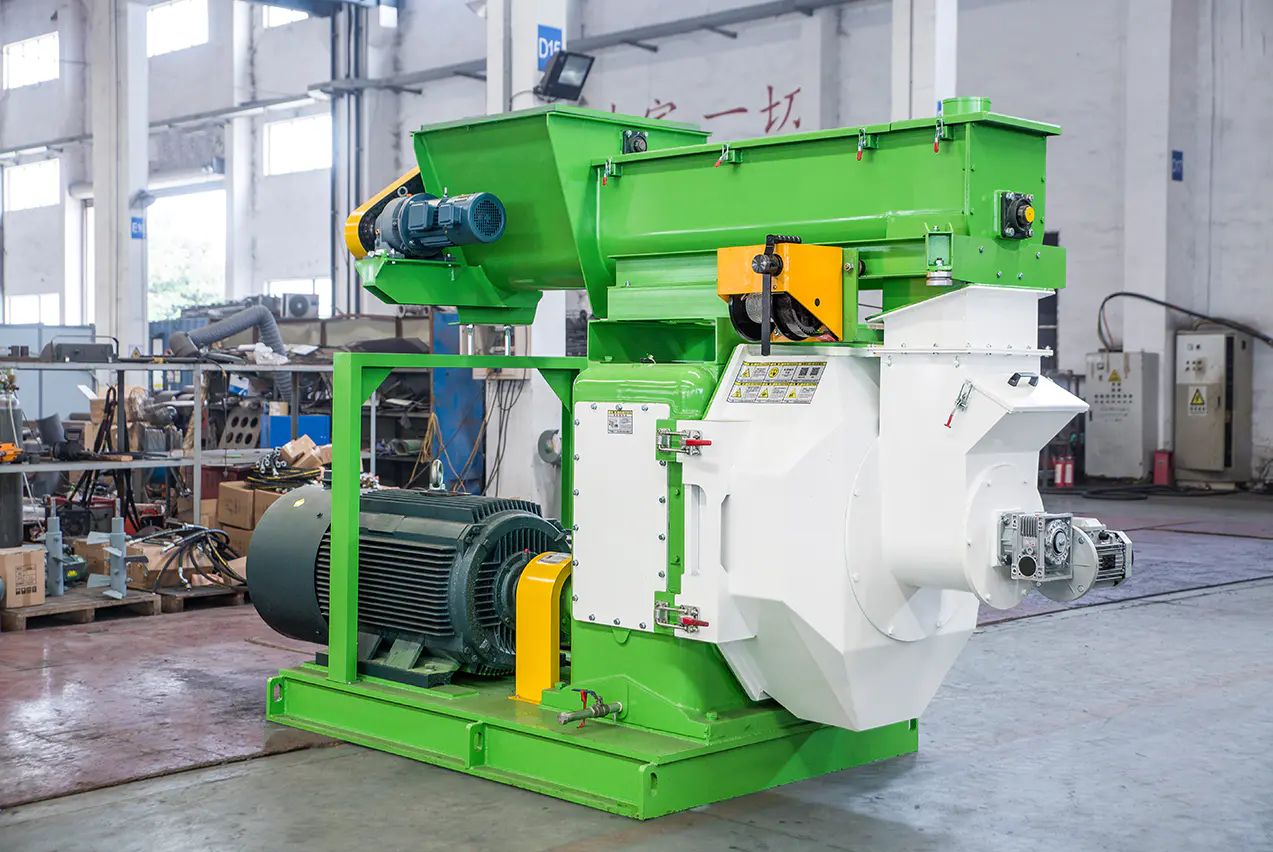
A properly designed pellet mill generates no process wastewater, no exhaust gas emissions, and no solid waste residue during pelletizing operations. The mechanical compression process that forms biomass particles into dense pellets uses heat generated by friction rather than external fuel combustion, keeping the production environment clean.
Kingwood’s dust-free biomass pellet production lines extend this principle to the facility level. Enclosed processing stages, integrated dust removal systems, and fully automated material handling eliminate the ambient particulate releases common in conventional open-line pellet production. A 2024 installation in Guizhou, China demonstrates this approach in operation.
For context, traditional coal processing—crushing, sorting, transport, combustion—generates coal dust, acid drainage, and ash pond waste at each stage. Fuel oil refining introduces volatile organic compound emissions and refinery effluent. Neither input stream can match the clean production profile of biomass pelletizing.
Industrial Scale and Verified References
Environmental credentials are only credible when backed by operational references at scale. Kingwood has designed and delivered biomass pellet production lines across 30 countries, with a total planned and designed project count exceeding 2,000 production lines and combined annual fuel capacity exceeding 10,000,000 metric tons.
Representative deployments include:
- Vietnam, 2023: 24 t/h wood chip pellet production line — one of the largest single-line capacities in Southeast Asia
- Vietnam, 2024: 12 t/h line with 23-month payback — confirming economic viability alongside environmental benefit
- Chongqing, China, 2021: 30 t/h wood pellet mill — serving industrial heat demand previously met by coal
Fuel cost savings of 40–50% versus fossil fuel alternatives have been documented across these deployments, meaning the environmental case is reinforced by the economic case—not traded against it.
Conclusion
Compared with traditional energy production methods such as coal and fuel oil, biomass pellet machines deliver lower sulfur and ash emissions during combustion, a carbon-neutral feedstock cycle, waste-free manufacturing processes, and 40–50% fuel cost reductions at industrial scale. For procurement teams, project engineers, and energy managers evaluating fuel switching, the biomass pellet route combines regulatory compliance, ESG alignment, and operating cost reduction within a single capital investment.
FAQ
How do biomass pellet emissions compare to coal combustion?
Biomass pellets contain less than 0.3% sulfur and less than 18% ash by specification, producing significantly lower sulfur dioxide, nitrogen oxides, and particulate matter than coal. All emission indicators comply with China's GB13271-2001 Boiler Air Pollutant Emission Standard.
Is biomass pellet fuel considered carbon neutral?
Yes. The feedstock—agricultural residues, wood waste, and similar biomass—absorbs CO₂ during its growth cycle. When burned, it releases approximately the same volume of carbon it sequestered, keeping net atmospheric CO₂ additions minimal versus fossil fuel combustion.
What pollutants does a biomass pellet machine generate during production?
A properly engineered pellet mill produces no wastewater, no process exhaust gases, and no solid waste residue. Kingwood's dust-free production lines add enclosed processing and integrated dust removal to eliminate particulate emissions at the facility level.
How does biomass pellet fuel cost compare to coal or fuel oil?
Biomass pellet fuel can reduce fuel costs by 40–50% compared to equivalent fossil fuel inputs, based on Kingwood operational data from deployed production lines.
What calorific value do industrial biomass pellets achieve?
Kingwood-specification biomass pellets reach 4,800 kcal/kg with moisture content below 15%, meeting EU, ISO, and Japan industrial fuel standards.
What raw materials can a biomass pellet machine process?
Suitable feedstocks include agricultural residues (straw, husks, stalks), forestry waste (wood chips, sawdust, bark), and energy crops. High-moisture biomass is handled through Kingwood's wet-feed production lines incorporating crushing, drying, grinding, and pelletizing stages.
What production capacity is available for industrial biomass pellet lines?
Kingwood designs complete biomass pellet production lines from 1 t/h (JWZL-420 model) up to 30 t/h and beyond, with full-line annual capacity reaching 200,000 metric tons. Deployed references include a 24 t/h line in Vietnam (2023) and a 30 t/h line in Chongqing, China (2021).
- Global biomass energy capacity additions reached 9.6 GW in 2023, with solid biomass remaining the dominant renewable heat source in industrial applications. (2024, IRENA Renewable Power Generation Costs 2023 Report)
- Replacing coal with biomass pellets reduces SO₂ emissions by up to 95% and particulate matter by over 80% under equivalent combustion conditions. (2023, IEA Bioenergy Task 32 — Biomass Combustion and Co-firing Report)