Brazilian Buyers Visit Kingwood's Biomass Pellet Mill Facility
Kingwood · May 26, 2026
Brazilian Buyers Conduct On-Site Equipment Evaluation at Kingwood
Industrial procurement at this scale is rarely finalized remotely. When Brazilian buyers set out to source biomass pellet mill equipment, they traveled directly to Kingwood’s manufacturing base at Liyang Zhongguancun Industrial Park in Jiangsu Province — a decision that reflects standard due diligence for operators investing in multi-year production infrastructure.
The visit provided direct access to Kingwood’s 25,000 m² production facility. The buyers walked through the full manufacturing sequence: raw material intake, CNC punching, component forging, heat treatment, precision welding, mechanical assembly, and finished-product testing. For procurement teams evaluating equipment that will anchor a commercial biomass fuel operation, this level of process visibility is difficult to replicate through documentation alone.
Technical discussions followed the floor tour. Kingwood’s team worked through the buyers’ feedstock profile, target throughput, and site constraints, then structured equipment recommendations around those specific parameters. No catalog pitch — applied engineering review.
JWZL-688 and Complete Wet-Feed Production Line Ordered
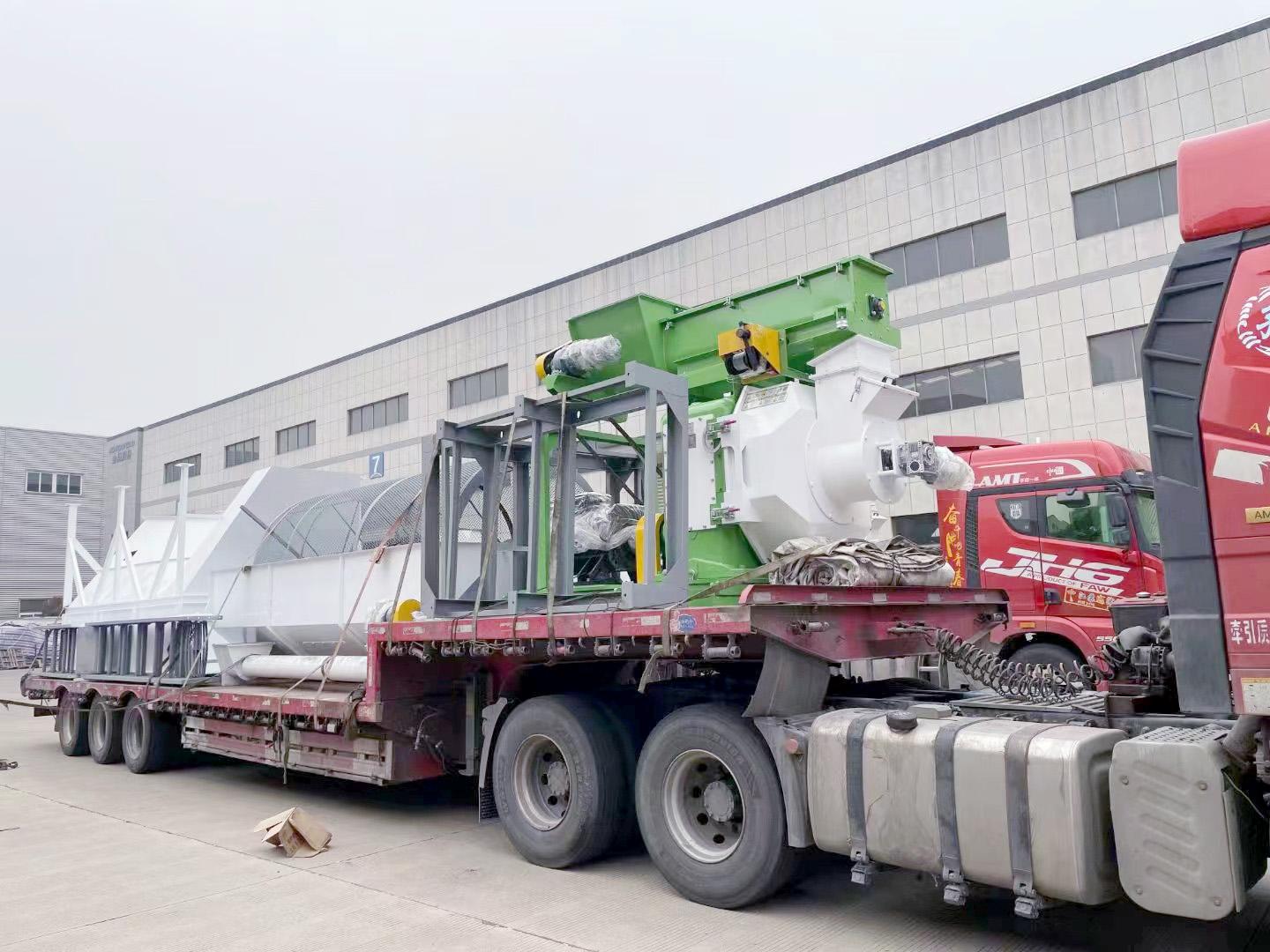
Following the factory walkthrough and technical review, the Brazilian customers placed an order for the JWZL-688 vertical biomass pellet mill and a complete pellet production line.
The JWZL-688 operates at 2–2.3 t/h and is engineered to process high-moisture biomass feedstocks — sawdust, wood chips, and agricultural residues — without requiring pre-dried inputs. Within Kingwood’s wet-feed production line architecture, it integrates with upstream crushing and drying stages and downstream counter-flow cooling and packaging, all within an enclosed, dust-controlled environment. This design reflects Kingwood’s Three-Standardization Framework: integrated, dust-free, and automated production lines.
For Brazilian operators processing wood waste or agricultural byproducts, the wet-feed configuration is operationally significant. Variable-moisture feedstocks enter the line without pre-drying, which lowers preprocessing costs, simplifies material handling logistics, and reduces the capital required for upstream conditioning equipment.
Pellets produced on this line meet industrial fuel specifications: calorific value of 4,800 kcal/kg, moisture content below 15%, sulfur content below 0.3%, and ash content below 18% — compliant with EU, ISO, and relevant national standards. Fuel cost savings versus fossil fuel alternatives typically reach 40–50%.
What On-Site Evaluation Surfaces That Specifications Cannot
A supplier’s facility visit surfaces operational realities that datasheets and brochures cannot convey: actual assembly tolerances, workforce depth, quality control discipline, spare parts inventory management, and the organizational capacity to support buyers through installation and long-term operation.
Kingwood has manufactured biomass pellet equipment since 1999 — 27 years of continuous R&D and production. The company holds ISO 9001, ISO 14001, and CE certifications, and its 20-person R&D team supports both product development and application engineering for new deployments. Recognition as a Jiangsu Provincial High-Tech Enterprise and a Top 10 Brand in Biomass Molding Equipment reflects standing within China’s regulated industrial certification framework, not self-reported marketing claims.
For international buyers, Kingwood’s deployment record across 30+ countries and more than 2,000 planned and designed production line projects provides verifiable reference points. Comparable installations — including a 24 t/h wood chip pellet production line in Vietnam and a 30 t/h line in Chongqing, China — document how Kingwood equipment performs under commercial operating conditions.
Following order confirmation, Kingwood managed manufacturing scheduling, quality inspection, export documentation, and outbound logistics. The company’s end-to-end service model — spanning consultation, engineering design, manufacture, freight coordination, installation, commissioning, operator training, and after-sales support — is structured specifically to reduce the project management burden on buyers coordinating cross-border capital equipment procurement.
FAQ
Why did Brazilian customers visit Kingwood's factory in person?
Evaluating industrial biomass pellet equipment at scale requires direct assessment of manufacturing quality, assembly processes, and testing capabilities. The Brazilian buyers needed to verify the JWZL-688 and complete production line against their specific feedstock conditions and output targets before committing capital.
Which Kingwood equipment did the Brazilian customers purchase?
The customers ordered the JWZL-688 vertical biomass pellet mill, rated at 2–2.3 t/h, together with a complete wet-feed pellet production line covering crushing, drying, pelletizing, cooling, and packaging.
Where is Kingwood's manufacturing facility located?
Kingwood operates from Liyang Zhongguancun Industrial Park, #568 Hongsheng Road, Liyang City, Jiangsu Province, China. The facility covers 25,000 m² of production space and 6,200 m² of office space.
What quality certifications does Kingwood hold?
Kingwood holds ISO 9001, ISO 14001, and CE certifications, and has been recognized as a Jiangsu Provincial High-Tech Enterprise and a Top 10 Brand in Biomass Molding Equipment, among other provincial and national designations.
What materials can the JWZL-688 process?
The JWZL-688 handles a range of biomass feedstocks including sawdust, wood chips, and agricultural residues. Its wet-feed design tolerates variable-moisture inputs without requiring pre-dried material, reducing preprocessing cost and site complexity.
How does Kingwood support international buyers after order confirmation?
Kingwood's full-service model covers consultation, design, manufacture, logistics, installation, commissioning, operator training, and ongoing after-sales support — structured to reduce the coordination burden on buyers managing cross-border equipment procurement.
How many countries does Kingwood serve?
Kingwood has supplied equipment and production line solutions to customers in over 30 countries, with more than 2,000 production line projects planned and designed since its founding in 1999.
- Global wood pellet production capacity exceeded 50 million metric tons per year as of 2023, with South America emerging as a growing export origin. (2023, Bioenergy Europe Statistical Report 2023)
- Brazil's biomass energy sector accounted for approximately 28% of the country's total energy supply in 2023, the highest share among G20 nations. (2023, International Energy Agency (IEA), World Energy Balances 2023)