Biomass Machinery Industry Poised for Remarkable Growth
Kingwood · May 26, 2026
Why the Biomass Machinery Industry Is Entering a High-Growth Phase
Renewable energy policy, fossil fuel economics, and industrial decarbonization targets are converging to create sustained demand for biomass pellet equipment across Asia, Europe, and the Americas. Governments in the EU, Japan, South Korea, and Vietnam have established mandatory renewable energy share targets that explicitly recognize solid biomass as a qualifying fuel—creating a durable, policy-backed demand floor for industrial pellet production capacity.
On the cost side, biomass pellets produced on efficient ring die pellet mills can reduce energy expenditure by 40–50% compared with coal or heavy fuel oil at equivalent thermal output. For industrial heat and power users operating at scale—cement plants, paper mills, district heating networks, co-firing power stations—that margin represents a structural cost advantage, not a marginal saving. The economics drive equipment investment independently of subsidy regimes.
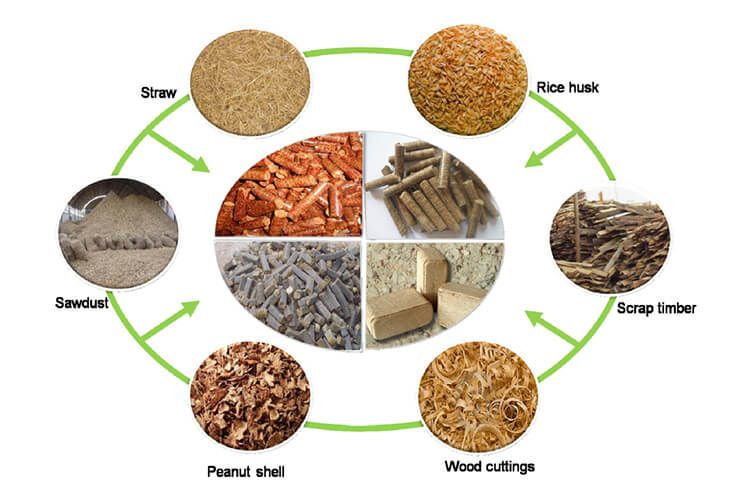
Feedstock availability reinforces the opportunity. Wood residues from sawmills, agricultural waste from rice, corn, and sugarcane processing, and purpose-grown energy crops collectively represent a global biomass resource base that remains substantially underutilized at the processing stage. The bottleneck is not raw material supply—it is pelletizing capacity and production line quality.
How Equipment Innovation Is Accelerating Market Adoption
The primary barrier to industrial biomass pellet production has historically been operational inconsistency: variable feedstock moisture, unplanned downtime on pellet mills, and dust management problems that create safety and regulatory exposure. The equipment generation now entering the market directly addresses these pain points.
Kingwood’s wet-feed biomass pellet production lines are engineered to handle high-moisture biomass through a fully integrated, enclosed processing sequence: drum chipping → coarse grinding → drum drying → fine grinding → ring die pelletizing → counter-flow cooling → packaging. Every stage is enclosed and connected to integrated dust removal systems, eliminating the open-transfer points where dust accumulation and moisture re-absorption previously degraded output quality.
The Three-Standardization Framework—Integrated production lines, Dust-Free production lines, and Automated production lines—structures every Kingwood project around three non-negotiable engineering outcomes. Integration means no process islands requiring manual transfer. Dust-free means enclosed conveying and negative-pressure dust extraction throughout. Automated means PLC-controlled sequencing with remote monitoring capability, reducing operator labor and enabling consistent shift-to-shift performance.
Across Kingwood’s vertical pellet mill range, capacities run from 1–1.5 t/h on the JWZL-420 through 4–5 t/h on the JWZL-928, with the JWZL-688D offering 3–3.5 t/h for mid-scale operations. The horizontal JZWH-860 delivers equivalent 4–5 t/h throughput in a layout suited to specific facility configurations. Complete integrated lines can be designed for annual outputs up to 200,000 metric tons.
Verified Performance: Industrial Case Evidence
Market growth projections carry more weight when grounded in documented installations. Kingwood has delivered over 2,000 production line projects across 30 countries, with recent deployments providing specific performance benchmarks.
A 24 t/h wood chip pellet production line in Vietnam commissioned in 2023 demonstrated large-scale throughput on mixed tropical hardwood feedstock. A separate 12 t/h installation in Vietnam in 2024 recorded full capital payback within 23 months—a return profile that positions biomass pellet equipment as a commercially defensible investment under current energy market conditions, not a speculative renewable energy bet.
In China, a 30 t/h installation in Chongqing (2021) established high-throughput operational benchmarks for domestic industrial users, while Beijing’s first biomass pellet demonstration project (2024) and a dust-free biomass pellet workshop in Guizhou (2024) illustrate both the policy-led urban deployment model and the Dust-Free production line standard in practice.
Quality and Compliance Infrastructure
Industrial buyers sourcing biomass machinery require supply chain confidence beyond equipment specifications. Kingwood, operating as Jiangsu Kingwood Industrial Co., Ltd. since 1999, is listed on China’s NEEQ exchange (stock code 871765), providing audited financial transparency. The company holds ISO 9001, ISO 14001, and CE certifications and is recognized as a Jiangsu Provincial High-Tech Enterprise and Jiangsu Provincial Specialized & Innovative Niche Leader.
Pellets produced on Kingwood equipment meet a verified emissions and fuel quality profile: 4,800 kcal/kg calorific value, moisture below 15%, sulfur below 0.3%, ash below 18%, and dioxin below 0.5 ng-TEQ/m³. These figures satisfy the EU moisture standard, the ISO ash standard, Japan’s sulfur threshold, and China’s GB13271-2001 boiler emission standard—supporting cross-border sales into the major regulated biomass fuel markets.
With 20 dedicated R&D experts, 27 years of continuous product development, and a 25,000 m² production facility in Liyang Zhongguancun Industrial Park, Kingwood’s manufacturing infrastructure is scaled for the project volumes that sustained market growth will demand. Contact Kingwood’s engineering team to discuss production line configuration for your specific feedstock, throughput target, and site conditions.
FAQ
What is driving growth in the biomass machinery industry?
Three converging forces are accelerating the market: (1) government renewable energy mandates and carbon-reduction targets across the EU, US, and Asia-Pacific that incentivize switching from coal to biomass fuel; (2) rising fossil fuel costs that make biomass pellets—which can reduce energy costs by 40–50% versus conventional fuels—economically compelling for industrial buyers; and (3) continuous equipment innovation, including automated ring die pellet mills and integrated wet-feed production lines, that lowers the operational barrier for large-scale biomass processing.
What types of biomass feedstock can industrial pellet mills process?
Industrial biomass pellet mills are designed to handle a broad range of organic feedstocks: hardwood and softwood chips, sawdust, bark, rice husk, corn stover, sugarcane bagasse, and other agricultural residues. Kingwood's wet-feed production lines manage high-moisture biomass through an integrated sequence of drum chipping, coarse grinding, drum drying, fine grinding, pelletizing, and packaging—enabling consistent output regardless of incoming moisture variation.
What emission and fuel-quality standards do industrial biomass pellets meet?
Biomass pellets produced on Kingwood equipment deliver a calorific value of 4,800 kcal/kg, moisture content below 15%, sulfur content below 0.3%, ash content below 18%, and dioxin content below 0.5 ng-TEQ/m³. These figures satisfy the EU moisture standard (<15%), the US calorific standard (>2,500 kcal/kg), Japan's sulfur standard (≤0.5%), the ISO ash standard (<20%), and China's GB13271-2001 boiler emission standard.
How does automation improve ROI for biomass pellet production lines?
Automation reduces labor headcount per shift, minimizes unplanned downtime through integrated process monitoring, and ensures consistent pellet density and durability. Kingwood's Three-Standardization Framework integrates Integrated, Dust-Free, and Automated production lines into a single project scope, shortening commissioning time and reducing per-tonne operating cost. A documented Vietnam installation delivering 12 t/h achieved full capital payback in 23 months.
What production capacities are available for industrial biomass pellet lines?
Kingwood's vertical pellet mill range covers 1–1.5 t/h (JWZL-420) through 4–5 t/h (JWZL-928), with the JWZL-688D delivering 3–3.5 t/h and the horizontal JZWH-860 also rated at 4–5 t/h. Complete integrated production lines can be engineered to a maximum annual output of 200,000 metric tons. Kingwood has designed and planned more than 2,000 production line projects across 30 countries.
What certifications should buyers require from a biomass machinery supplier?
Minimum credible certifications include ISO 9001, ISO 14001, and CE marking. Additional indicators of manufacturing maturity include high-tech enterprise designation, stock market listing for financial transparency, and verifiable installed-base case studies with documented throughput and payback data. Kingwood holds ISO 9001, ISO 14001, and CE, is listed on the NEEQ (stock code 871765), and is recognized as a Jiangsu Provincial High-Tech Enterprise.
What is a wet-feed biomass pellet production line and when is it required?
A wet-feed production line is an integrated processing sequence designed for biomass feedstock arriving with high and variable moisture content. The line sequences drum chipping, coarse grinding, drum drying, fine grinding, ring die pelletizing, cooling, and packaging within a fully enclosed, dust-suppressed environment. It is required for wood chip, bark, or agricultural residue inputs where field moisture exceeds safe pelletizing thresholds and continuous industrial-scale output is needed.
- Global biomass power generation capacity reached approximately 148 GW in 2023, with solid biofuels—including wood pellets—accounting for the largest share of bioenergy supply among renewable sources tracked by the IEA. (2023, International Energy Agency (IEA), Renewables 2023 Report)
- The global wood pellet market volume exceeded 40 million metric tons in 2023, with industrial-grade pellets destined for power and heat co-firing representing the dominant demand segment. (2023, Wood Pellet Association of Canada (WPAC), 2023 Market Overview)