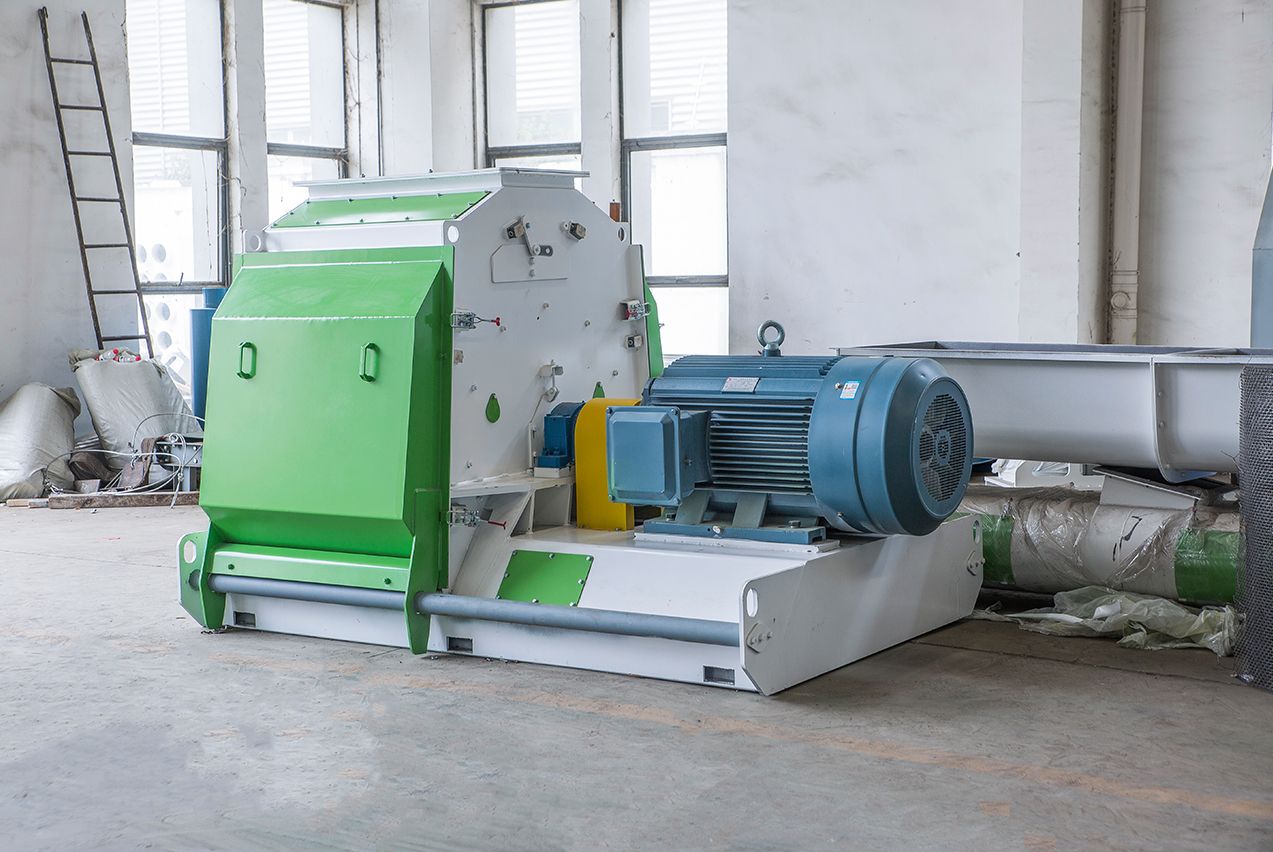
OEM Biomass Wood Chip Hammer Mill Machine | Kingwood
Industrial Role of the Hammer Mill in Biomass Pellet Production
Consistent particle size at the grinding stage is the single most controllable variable in pellet quality. Raw biomass feedstocks — branches, bark, wood chips, plant roots, demolition timber, and mixed fibrous waste — arrive at widely varying dimensions and moisture levels. A biomass wood chip hammer mill reduces this heterogeneous input to a controlled particle size that the downstream pellet mill die can compress uniformly and efficiently.
Kingwood integrates the hammer mill as a primary or secondary grinding stage depending on feedstock characterization. For large-dimension input such as whole logs or thick branches, a drum chipper performs initial breakdown before material enters the hammer mill chamber. Inside the chamber, a high-speed rotor carrying hardened hammer elements strikes and fractures material against a breaker plate and cylindrical screen. Particle size at discharge is governed by screen mesh aperture, which Kingwood’s engineering team specifies during line design to match the die diameter and throughput target of the downstream pellet mill.
This grinding stage directly determines pellet density, combustion uniformity, and die wear rate. Oversized particles cause inconsistent compression in the ring die, increasing mechanical stress and reducing pellet durability. Undersized or over-milled particles increase energy consumption in the drying stage. Correct hammer mill configuration — rotor speed, hammer count, screen aperture, and feed rate — is therefore an engineering decision with measurable downstream cost consequences, not a commodity selection.
OEM Manufacturing and Configuration for Industrial Buyers
Kingwood (Jiangsu Kingwood Industrial Co., Ltd., NEEQ: 871765) has operated as an industrial biomass equipment manufacturer since 1999, accumulating 27 years of R&D experience in biomass size reduction and pelletizing systems. The hammer mill product line is manufactured within a 25,000 m² production facility in the Liyang Zhongguancun Industrial Park, Jiangsu Province, under an ISO 9001-certified quality management system. CE certification covers equipment supplied to European and export markets. ISO 14001 environmental management system certification applies across manufacturing operations.
For OEM buyers and EPC contractors, Kingwood offers hammer mill supply on two bases:
Standalone OEM units — configured to the buyer’s feedstock specification, with documentation packages supporting integration into existing processing lines. Kingwood’s technical team conducts feedstock analysis review and provides screen, rotor, and motor sizing recommendations prior to manufacture.
Integrated line components — hammer mills specified and supplied as part of Kingwood’s complete wet-feed pellet production line, covering the full processing sequence from raw biomass intake through crushing, drying, fine grinding, pelletizing, cooling, and packaging. These lines are fully enclosed with integrated dust removal systems, meeting the Kingwood Three-Standardization Framework requirements for Integrated, Dust-Free, and Automated production.
The company has designed and delivered over 2,000 production line projects across 30 countries. A 20-strong R&D team maintains continuous development on rotor geometry, hammer alloy selection, and screen wear resistance — all of which directly affect operating cost per metric ton of output.
Matching Hammer Mill Throughput to Pellet Line Capacity
Hammer mill selection cannot be made independently of the complete line mass balance. The crushing stage must sustain throughput equal to or greater than the pellet mill’s rated output, accounting for moisture-related mass reduction through the drying stage and any recirculation from screening.
Kingwood’s pellet mill range covers the following rated capacities:
| Model | Type | Rated Capacity |
|---|---|---|
| JWZL-420 | Vertical | 1–1.5 t/h |
| JWZL-688 | Vertical | 2–2.3 t/h |
| JWZL-688D | Vertical | 3–3.5 t/h |
| JWZL-928 | Vertical | 4–5 t/h |
| JWZL-1068 | Vertical | Contact sales |
| JZWH-860 | Horizontal | 4–5 t/h |
For each pellet mill model, Kingwood specifies a matched hammer mill configuration during line engineering. Multi-mill installations — such as the 24 t/h wood chip pellet production line delivered in Vietnam in 2023 — require coordinated hammer mill staging to sustain feed consistency across parallel pelletizing trains without surge or starvation at any stage.
Complete line designs from Kingwood scale to 200,000 metric tons per year of biomass fuel output. At this scale, hammer mill reliability and screen change intervals become significant operational cost variables. Kingwood addresses this through hardened wear components and standardized screen formats that allow rapid maintenance turnaround without full line shutdown.
Finished pellets produced on Kingwood lines meet the following fuel quality benchmarks: calorific value 4,800 kcal/kg, moisture content below 15%, sulfur content below 0.3%, and ash content below 18% — compliant with EU moisture standards, US calorific standards, and Japan sulfur standards. These specifications are achievable only when the hammer mill grinding stage delivers consistent particle size, making correct hammer mill selection and maintenance a direct quality assurance factor for every metric ton shipped.
For feedstock analysis, line capacity requirements, or OEM supply inquiries, contact Kingwood’s technical sales team through the product inquiry form.
FAQ
What materials can a Kingwood biomass wood chip hammer mill process?
Kingwood hammer mills are engineered to handle coarse fibrous and lumpy biomass feedstocks including branches, bark, plant roots, wood blocks, wood chips, sawdust, pallets, furniture scraps, demolition debris, household waste, and certain chemical waste streams. The rotor and screen configuration can be adjusted to match the hardness and moisture profile of the target feedstock.
How does the hammer mill fit into a complete Kingwood wet-feed pellet production line?
In Kingwood's wet-feed pellet production line architecture, the hammer mill operates as the primary size-reduction stage. High-moisture biomass first passes through a drum chipper for coarse reduction, then enters the hammer mill for fine grinding to the particle size required for pelletizing. Material then moves to the drum dryer, secondary fine grinder if specified, pellet mill, counter-flow cooler, and finally the packaging system. The entire sequence is enclosed and integrated with dust removal per the Three-Standardization Framework.
What output particle size does the hammer mill deliver before pelletizing?
Target particle size is determined by the screen mesh installed in the hammer mill chamber. For standard biomass pellet production, screens are selected to produce particles consistent with the die specification of the downstream pellet mill — typically in the range required to achieve uniform density and combustion quality in the finished pellet. Kingwood's engineering team specifies the correct screen size during production line design based on feedstock and pellet die diameter.
Can Kingwood supply the hammer mill as a standalone OEM unit or only as part of a complete line?
Kingwood supplies hammer mills both as standalone OEM units and as integrated components within complete production lines. OEM clients receive equipment manufactured under Kingwood's ISO 9001 and CE-certified quality system. For standalone supply, Kingwood's technical team provides feedstock-specific configuration guidance to ensure the unit performs to rated capacity within the buyer's existing process.
What certifications cover Kingwood hammer mill manufacturing?
Kingwood hammer mills are produced under an ISO 9001-certified quality management system and ISO 14001 environmental management system. Equipment supplied for export markets carries CE certification. The company holds Jiangsu Provincial High-Tech Enterprise status and is listed on China's NEEQ stock exchange under code 871765, providing an additional level of corporate transparency for international buyers conducting supplier qualification.
How does hammer mill capacity affect the sizing of a complete pellet production line?
Hammer mill throughput capacity is the governing constraint for the upstream crushing stage and must be matched to the pellet mill's rated output. For example, Kingwood's JWZL-928 pellet mill operates at 4–5 t/h, so the hammer mill feeding it must sustain at least equivalent throughput with adequate buffer. Kingwood's complete line designs — which scale up to 200,000 metric tons per year — specify hammer mill capacity as part of an integrated mass-balance calculation, ensuring no bottleneck exists between the crushing, drying, and pelletizing stages.
What is the typical payback period for a Kingwood pellet production line that includes a hammer mill?
Payback depends on feedstock cost, local energy prices, and line throughput. In a documented 2024 Vietnam deployment, a Kingwood 12 t/h wood pellet line achieved full payback in 23 months. Biomass pellets produced on Kingwood lines carry a calorific value of 4,800 kcal/kg at moisture content below 15% and sulfur below 0.3%, qualifying them for premium fuel markets and supporting faster revenue recovery versus lower-spec output.