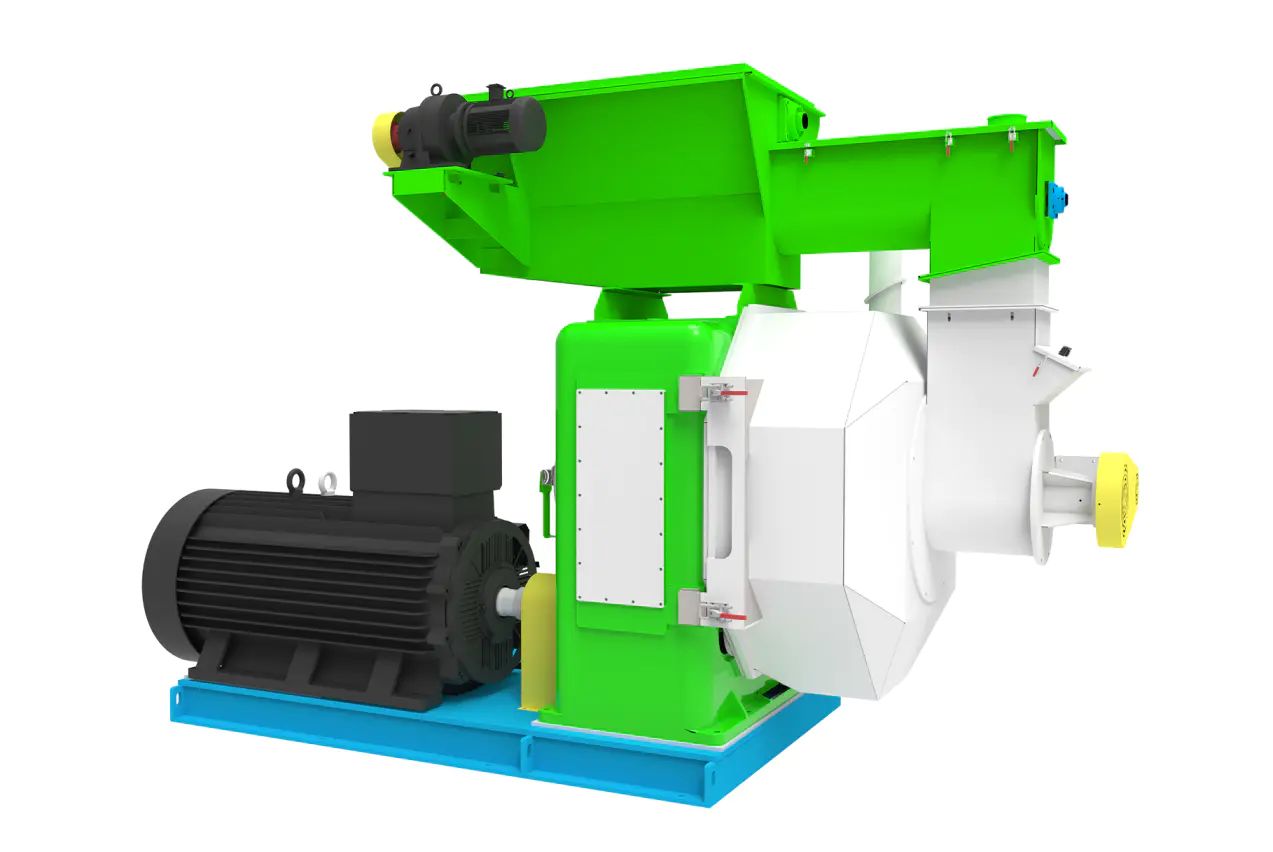
JWZL-998 Biomass Pellet Mill — 5–6 T/h Industrial
JWZL-998 Ring Die Biomass Pellet Mill — Technical Overview
The Kingwood JWZL-998 is a large-format ring die biomass pellet mill engineered for continuous, high-throughput production at industrial scale. With a rated capacity of 5–6 metric tons per hour and a 400 KW main drive motor, the JWZL-998 addresses the operational requirements of facilities running multi-shift schedules where sustained output, minimal downtime, and consistent pellet quality are non-negotiable.
The compression assembly centers on a 998 mm × 145 mm ring die with 2,800 precision-drilled holes. Combined with dual 480 mm × 151 mm roller shells, this geometry distributes compression force evenly across the die surface — the mechanical basis for the machine’s ≥90% pellet formation rate and ≤10% pulverization rate. Both figures are critical quality thresholds for biomass fuel supplied to commercial boiler operators or exported under ISO or ENplus specifications.
The JWZL-998 is designed and manufactured by Jiangsu Kingwood Industrial Co., Ltd., a NEEQ-listed company (stock code: 871765) founded in 1999, with 27 years of focused R&D in biomass pellet equipment. The machine is built to Kingwood’s Three-Standardization Framework, delivering integrated, dust-free, and automated production line compatibility as standard design requirements — not optional add-ons.
Full Technical Specifications
| Parameter | Specification |
|---|---|
| Main Motor Power | 400 KW – 8P |
| Screw Conveyor Reducer / VFD Motor | BWD4-59-Y4-4P |
| Forced Feeding Motor | 3 KW – 6P |
| Cooling Oil Pump | 1.5 KW |
| Plate Heat Exchanger | HU50-40-3.0-H |
| Pneumatic Grease Injector | YGP-A |
| Gearbox Model | WJ-998 |
| Gear Oil Grade | L-CKC220 |
| Ring Die Dimensions | 998 mm × 145 mm |
| Number of Die Holes | 2,800 |
| Roller Shell Dimensions | 480 mm × 151 mm × 2 |
| Rated Capacity | 5–6 T/h |
| Machine Dimensions (L×W×H) | 5,080 mm × 1,965 mm × 3,460 mm |
| Machine Weight | 18 metric tons |
| Pellet Formation Rate | ≥90% |
| Pellet Pulverization Rate | ≤10% |
| Noise Level | ≤93 dB(A) |
The forced feeding system operates via a dedicated 3 KW motor, maintaining consistent material flow into the compression chamber and preventing bridging — a recurring failure mode in high-moisture biomass feedstocks such as fresh wood chips or agricultural residue. The HU50-40-3.0-H plate heat exchanger and YGP-A pneumatic grease injector work in tandem to hold stable gearbox and bearing temperatures under continuous load, extending service intervals and reducing unplanned stoppages.
At 18 metric tons machine weight, the JWZL-998 provides structural mass that dampens operational vibration — a practical advantage when processing abrasive feedstock blends that would accelerate die wear in lighter-frame machines.
Integration Into Complete Biomass Pellet Production Lines
The JWZL-998 functions as the pelletizing core within Kingwood’s fully automated wet-feed biomass pellet production lines. These lines process raw biomass at elevated moisture content through a defined sequence: coarse crushing → drying → fine grinding → pelletizing → cooling → packaging. All processing stages run within an enclosed architecture with integrated dust removal, satisfying Kingwood’s dust-free production standard and the tightening environmental compliance requirements applicable in China and major export markets.
Complete line configurations engineered by Kingwood scale to 200,000 metric tons per year in design capacity. At throughput targets above single-machine output, the JWZL-998 is typically deployed in parallel multi-mill arrangements within a unified control architecture. The Vietnam 24 T/h wood chip pellet production line is a documented reference for how Kingwood integrates multiple ring die pellet mills into a coordinated high-capacity system commissioned in 2023.
Procurement teams and plant engineers specifying the JWZL-998 for new builds or capacity expansions should engage Kingwood’s engineering team at the project design stage. Feedstock species, initial moisture content, target pellet diameter, and downstream application — industrial boiler firing, co-firing, or export — directly determine ring die hole geometry, compression ratio selection, and upstream dryer sizing. These variables are application-specific and require feedstock data to configure correctly.
Operational Considerations for the 5–6 T/h Category
For buyers evaluating ring die pellet mills at the 5–6 T/h output tier, several JWZL-998 design parameters carry direct operational significance:
- 2,800 die holes: Maximizes active compression area per production cycle, supporting throughput consistency across varying feedstock moisture and particle size distributions.
- Standardized auxiliary components: The WJ-998 gearbox, L-CKC220 gear oil specification, and HU50-40-3.0-H heat exchanger are documented service components with defined maintenance intervals, simplifying spare parts inventory planning for remote or high-utilization facilities.
- ≤93 dB(A) noise rating: Meets standard industrial noise thresholds, reducing acoustic enclosure engineering requirements in new facility designs.
- 400 KW 8-pole motor: The 8-pole configuration delivers higher torque at lower rotational speed relative to 4-pole alternatives, which is mechanically favorable for dense or fibrous feedstocks that impose variable compression loads.
- NEEQ-listed manufacturer (871765): Public listing on China’s National Equities Exchange and Quotations provides audited financial disclosure — a relevant factor for buyers making multi-year equipment and spare parts supply commitments.
Kingwood has delivered biomass pellet equipment and complete production lines across 30 countries, with a project engineering portfolio covering more than 2,000 production lines and aggregate biomass fuel production capacity exceeding 10 million metric tons annually. The company operates from a 31,200 m² facility in Liyang Zhongguancun Industrial Park, Jiangsu Province, supported by a 20-person dedicated R&D team.
For JWZL-998 pricing, delivery schedules, ring die configuration options, or complete line project quotations, contact Kingwood’s technical sales team. Application-specific recommendations require feedstock characterization data and defined production targets.
FAQ
What is the output capacity of the JWZL-998 biomass pellet mill?
The JWZL-998 delivers a rated capacity of 5–6 metric tons per hour under standard operating conditions, making it suitable for large-scale biomass fuel production facilities.
What ring die specification does the JWZL-998 use?
The JWZL-998 uses a 998 mm × 145 mm ring die with 2,800 die holes, paired with 480 mm × 151 mm roller shells (×2) for consistent pellet formation across the full die surface.
What is the pellet formation rate and pulverization rate of the JWZL-998?
The JWZL-998 achieves a pellet formation rate of ≥90% and a pellet pulverization rate of ≤10%, meeting industrial biomass fuel quality requirements.
What motor powers the JWZL-998 main drive?
The main motor is rated at 400 KW (8-pole). Auxiliary drives include a BWD4-59-Y4-4P screw conveyor reducer/variable frequency motor, a 3 KW forced feeding motor, and a 1.5 KW cooling oil pump.
How does the JWZL-998 integrate into a complete biomass pellet production line?
The JWZL-998 is engineered to serve as the pelletizing core within Kingwood's fully automated wet-feed production lines, which handle crushing, drying, fine grinding, pelletizing, and packaging in an enclosed, dust-managed environment.
What lubrication and cooling systems are used in the JWZL-998?
The JWZL-998 incorporates a HU50-40-3.0-H plate heat exchanger, a pneumatic grease injector (YGP-A), and a WJ-998 gearbox lubricated with L-CKC220 gear oil for sustained high-load operation.
What noise level does the JWZL-998 operate at?
Noise output is rated at ≤93 dB(A), consistent with industrial pellet mill operating standards for enclosed production facilities.