Vietnam 24 t/h Wood Chip Pellet Production Line — Kingwood Case
Vietnam · 2023
Background and Project Context
Vietnam has emerged as one of the world’s most significant wood pellet exporters, with industrial output directed primarily toward power generation and boiler fuel markets in South Korea, Japan, and other East Asian economies. According to IEA Bioenergy, Southeast Asia accounted for a substantial and growing share of globally traded wood pellets through 2022–2023, with Vietnam consistently ranking among the top three supplying nations by volume.
Against this export-driven backdrop, a Vietnamese industrial client engaged Kingwood in late 2022 to engineer, manufacture, and commission a high-throughput biomass pellet production line capable of meeting export-grade quality standards. The feedstock base — rubber wood, acacia wood, and mixed hardwood logs — reflects the locally abundant plantation species that underpin Vietnam’s wood pellet supply chain. Both rubber wood and acacia are dense, high-calorific hardwoods that, when correctly processed, yield pellets compliant with ISO 17225-2 Class A1 quality parameters for net calorific value, moisture content, and mechanical durability.
The project was formally commissioned in April 2023, making it one of Kingwood’s largest single-line installations in Southeast Asia at the time of delivery. The facility was designed from the outset as an export-oriented production asset, requiring consistent 24 t/h throughput, low downtime, and pellet quality stable enough to satisfy industrial end-user specifications across multiple international markets.
Equipment Configuration
The 24 t/h line is built on Kingwood’s wet-feed production architecture — an integrated process sequence engineered specifically for high-moisture hardwood feedstocks that require staged size reduction and thermal drying before pelletization can proceed.
Incoming Material Preparation
Debarking is the first stage of the process. Incoming rubber wood and acacia logs are debarked prior to chipping, reducing the ash content of the finished pellet and protecting downstream wear components from abrasive bark particles. A Kingwood drum chipper then reduces the debarked logs into uniform wood chips, establishing the particle geometry and bulk density profile required for efficient hammer mill throughput.
Grinding and Drying
A coarse-pass hammer mill reduces the chips to a particle size suitable for the drum dryer. The drum dryer reduces feedstock moisture to below 15% — the threshold specified under ISO 17225-2 for industrial-grade wood pellets and a prerequisite for stable ring die pellet mill operation. Moisture control at this stage is critical: feedstock above 15% moisture causes inconsistent pellet hardness and elevated fines generation, both of which degrade bulk durability ratings. A second-pass hammer mill then refines the dried material to the optimal particle size for ring die pressing.
Pelletizing
The core of the line is a parallel configuration of two 12 t/h pellet mills, each operating independently to deliver the combined 24 t/h nameplate capacity. The ring die design used in Kingwood pellet mills distributes radial compression evenly across the die face, producing dense, geometrically uniform pellets with low fines content. Running two units in parallel rather than a single large-frame machine also provides operational resilience: if one mill requires a die change or routine maintenance, the line can continue at 12 t/h without a full production halt.
Post-Press Handling
Immediately after pressing, pellets pass through a counter-flow cooler. Counter-flow cooling draws ambient air upward through the pellet bed in the opposite direction to product travel, achieving uniform temperature reduction and residual moisture removal without surface cracking. Hardened, cooled pellets then proceed to packaging for bagged dispatch.
Buffer Silo
A key engineering feature of this installation is the intelligent bottom-discharge buffer silo positioned at the raw material intake stage. This low-fault design prevents the bridging and blockage failures common with fibrous hardwood biomass, ensuring a continuous, metered feed rate into both pellet mills. Stable feed rate is a direct enabler of consistent 24 t/h output and reduces the frequency of operator intervention during extended production runs.
For further detail on Kingwood’s ring die pellet mill range used in large-scale installations, see the JWZL series pellet mill product page.
Commissioning and Performance Results
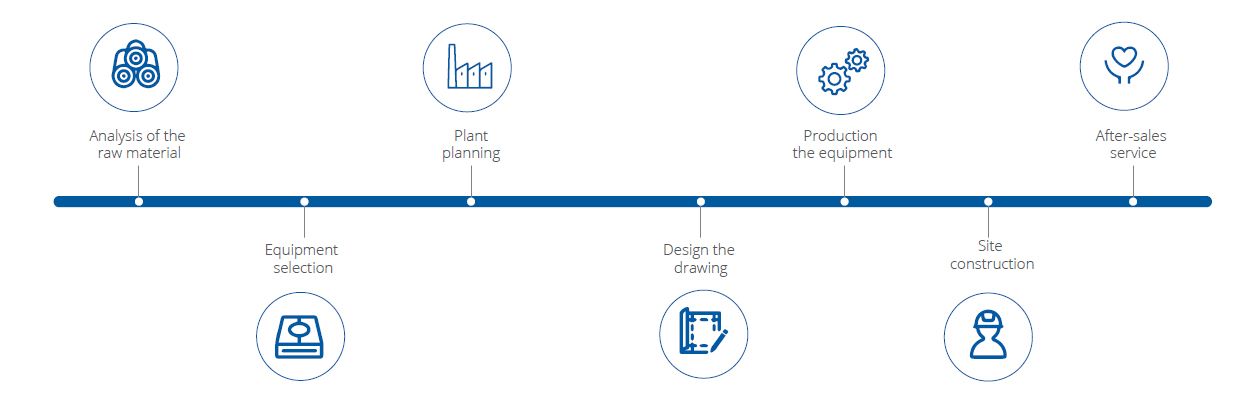
Commissioning took place in April 2023, following Kingwood’s full-service project delivery model. The service scope for this Vietnam installation included raw material analysis and feedstock characterization, layout and civil engineering coordination, equipment manufacturing, site erection supervision, commissioning, and operator training. This end-to-end delivery approach — consistent with Kingwood’s Three-Standardization Framework for project execution — reduces integration risk on large-throughput lines where multiple process stages must be balanced to achieve nameplate capacity.
Throughput and Quality
The line achieved its 24 t/h nameplate capacity during commissioning trials, operating across both pellet mills in parallel configuration. Feedstock comprised the client’s standard blend of rubber wood, acacia, and mixed hardwood, processed through the full wet-feed sequence from debarking to packaging. Finished pellet quality was assessed against ISO 17225-2 parameters, with moisture content confirmed below 15% post-cooling — a necessary condition for both export compliance and safe bulk storage.
Operational Resilience
The parallel two-mill configuration provides a practical availability advantage: routine maintenance or die replacement on one ring die pellet mill does not require a line shutdown. The intelligent buffer silo at raw material intake further supports uninterrupted operation by decoupling log delivery cycles from the continuous demands of the grinding and drying stages. Together, these design choices support sustained high-utilization operation across extended production shifts.
Export Readiness
Vietnam’s primary wood pellet export markets — South Korea and Japan — require pellet specifications that align with ISO 17225-2 industrial-grade standards, including defined limits on moisture, ash content, and mechanical durability. The debarking stage at the front of the process directly addresses the ash content requirement, which ISO 17225-2 Class A1 caps at 1.5% on a dry basis for premium industrial pellets.
Lessons and Takeaways
Several engineering and procurement insights are transferable from this Vietnam installation to other large-scale biomass pellet projects.
Wet-Feed Architecture Is Essential for Plantation Hardwoods
Rubber wood and acacia arrive at the mill gate with moisture contents that make direct pelletization impossible. Investing in a complete wet-feed sequence — drum chipper, coarse hammer mill, drum dryer, fine hammer mill — is not optional for these feedstocks. Attempting to short-cut the drying or grinding stages results in pellet quality inconsistency that undermines export compliance and customer retention.
Parallel Mill Configuration Reduces Production Risk
For facilities targeting 20 t/h and above, a parallel configuration of two or more pellet mills offers significant operational advantages over a single large-frame machine. Die wear, unexpected downtime, and scheduled maintenance events become manageable production interruptions rather than full line stoppages.
Buffer Silo Design Matters at Scale
At 24 t/h throughput, even short interruptions in raw material feed translate to meaningful output losses. The intelligent bottom-discharge buffer silo specified for this line demonstrates that upstream material handling deserves the same engineering attention as the pellet mills themselves.
Full-Service Delivery Compresses Commissioning Time
Kingwood’s involvement from feedstock analysis through operator training reduced the risk of integration failures at commissioning. Procurement engineers specifying large-throughput lines should evaluate whether a supplier’s project scope covers the full process chain or only the pellet mill units in isolation.
Kingwood’s NEEQ Listing (Stock Code: 871765)
Kingwood is listed on China’s National Equities Exchange and Quotations (NEEQ) under stock code 871765. For procurement teams conducting supplier due diligence, NEEQ listing provides a layer of financial transparency and corporate governance verification not universally available among biomass equipment manufacturers.
Sources
- IEA Bioenergy — Global Wood Pellet Industry and Trade Study, Task 40, 2022 update. Referenced for Southeast Asia pellet export volume data.
- ISO 17225-2:2021 — Solid biofuels — Fuel specifications and classes — Part 2: Graded wood pellets. Referenced for moisture content (≤15%), ash content (Class A1 ≤1.5% d.b.), and mechanical durability specifications applied to finished pellet quality assessment.