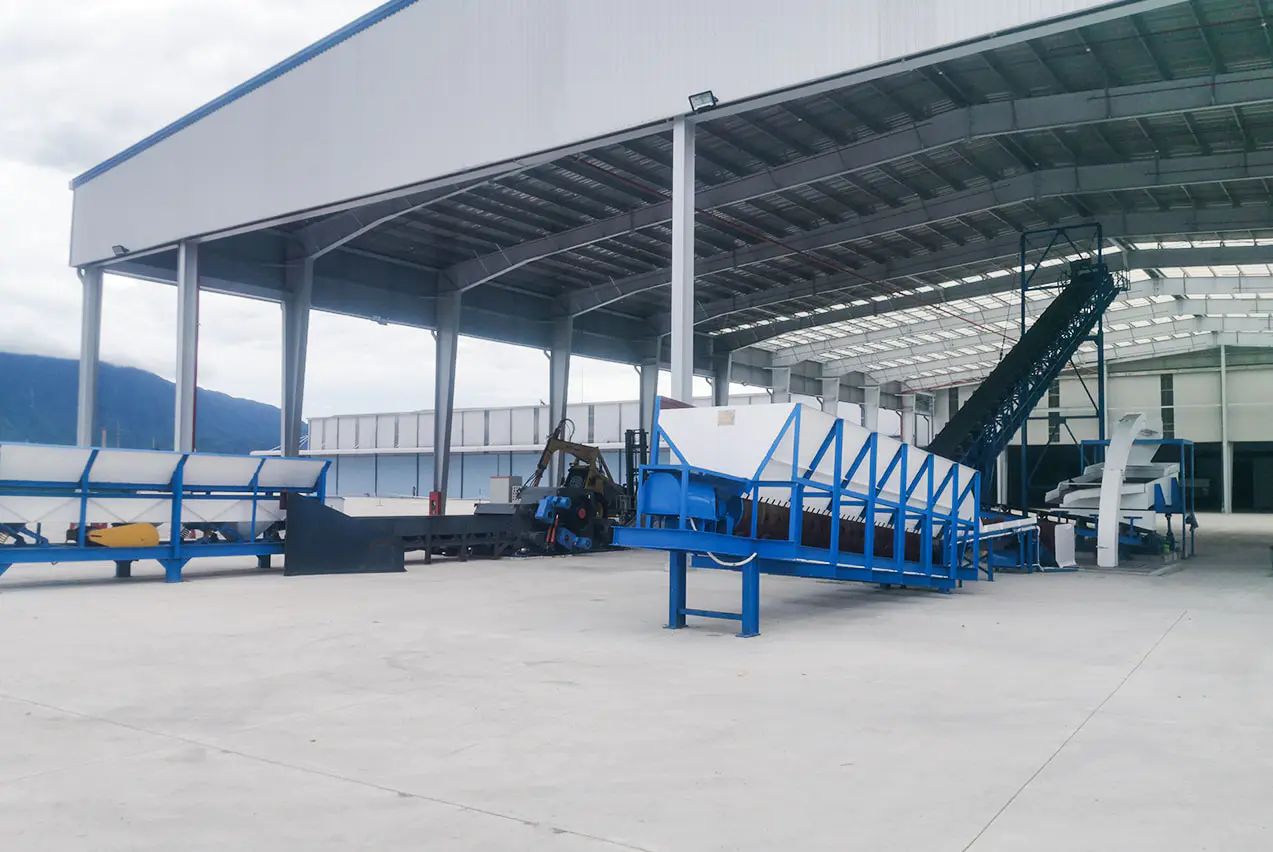
Dust-Free Biomass Pellet Mill Workshop Built in Guizhou
China · 2024
A Dust-Free Standard Applied at Industrial Scale in Guizhou
In 2024, Kingwood — formally Jiangsu Kingwood Industrial Co., Ltd. — completed the construction and commissioning of a fully enclosed, dust-free biomass pellet mill workshop in Guizhou Province, China. The project stands as one of the most technically complete implementations of Kingwood’s proprietary Three-Standardization Framework: a manufacturing philosophy built on Integrated, Dust-Free, and Automated production lines.
Guizhou’s abundant forestry and agricultural residue base made it a strategically sound location for a large-format biomass pellet facility. The client required a production environment that would satisfy increasingly strict regional environmental compliance requirements while maintaining consistent output quality and operator safety standards. Kingwood’s engineering team designed and delivered a workshop that addresses all three demands within a single unified infrastructure.
What a Dust-Free Pellet Mill Workshop Actually Involves
The term “dust-free” carries specific technical meaning in industrial biomass pellet manufacturing. It is not limited to housekeeping or filtration add-ons. In the Guizhou project, dust-free design was built into the process architecture from the ground up.
Enclosed material handling. Raw biomass — including wood chips and agricultural residues — enters a fully sealed intake and conveying system. Open belt transfers and exposed chutes, common sources of fugitive dust in conventional plants, are eliminated. Material moves through enclosed augers and pneumatic circuits from pre-processing through to pelletizing.
Integrated dust extraction. Each processing station — hammer mill grinding, drum drying, ring die pelletizing, and counter-flow cooling — connects to a centralized dust removal network. Pulse-jet bag filters and cyclone separators capture particulate at source. This architecture ensures that dust concentrations in the working environment remain below occupational health thresholds and that no visible emissions exit the building envelope.
Sealed pelletizing and packaging. The ring die pellet mills at the core of the line operate within enclosed housing. Finished pellets transfer via sealed conveyors to the counter-flow cooler and then to automated packaging, completing a closed loop from raw material intake to bagged or bulk-dispatched product.
The result is a production floor where personnel can work without respiratory protective equipment under normal operating conditions — a meaningful shift from the dust-laden environments typical of earlier-generation pellet plants.
Engineering Specifications and Line Architecture
The Guizhou workshop operates as a wet-feed biomass pellet production line, Kingwood’s established format for processing high-moisture raw materials including fresh wood chips and green agricultural residues. The sequence runs: primary size reduction via drum chipper → coarse grinding in hammer mill → moisture reduction through drum dryer → fine grinding → pelletizing via ring die pellet mills → cooling in counter-flow cooler → packaging.
The line is fully automated. Process parameters — feed rate, dryer outlet temperature, pellet mill roller gap, cooler residence time — are monitored and adjusted through a centralized control interface. Automation reduces operator headcount requirements and eliminates the variability introduced by manual process intervention, which is a core objective of the Three-Standardization Framework’s Automated pillar.
Pellet quality output on this line targets the following performance parameters, consistent across Kingwood’s complete line designs:
- Moisture content: <15% (meeting EU biomass fuel standard)
- Calorific value: 4,800 kcal/kg
- Sulfur content: <0.3%
- Ash content: <18%
- Dioxin content: <0.5 ng TEQ/m³
All emission indicators comply with China’s GB13271-2001 Standard for Air Pollutant Emissions from Boilers.
For clients evaluating Kingwood’s pellet mill equipment independently of a complete line, the JWZL-928 vertical biomass pellet mill — rated at 4–5 tonnes per hour — represents the core pelletizing unit deployed in mid-to-large scale projects of this type.
Guizhou in the Context of Kingwood’s China Project Portfolio
The Guizhou dust-free workshop is one of several landmark domestic projects Kingwood has completed in recent years. In 2024, Kingwood also delivered Beijing’s first biomass pellet demonstration project, a high-visibility installation that established a municipal-level reference point for clean biomass fuel adoption in China’s capital. A 30 tph wood pellet line in Chongqing, completed in 2021, demonstrated Kingwood’s capacity to engineer high-throughput solutions for major urban-industrial markets.
Internationally, Kingwood has delivered projects across 30 countries. The company has planned and designed more than 2,000 production line projects, with a combined annual biomass fuel capacity across installed lines exceeding 10 million metric tons.
Founded in 1999 and backed by 27 years of R&D in biomass pellet equipment, Kingwood holds ISO 9001, ISO 14001, and CE certifications and is recognized as a Jiangsu Provincial High-Tech Enterprise. The company is listed on China’s NEEQ exchange under stock code 871765.
The Guizhou project demonstrates that dust-free industrial pellet production is achievable at scale without compromising throughput, automation, or fuel quality — and that the Three-Standardization Framework provides a replicable engineering template for the next generation of biomass pellet facilities in China and beyond.