China 10 t/h Construction Waste & Furniture Offcuts Pellet Line
China · 2023
Project Overview: 10 t/h Construction Waste & Furniture Offcuts Pellet Line
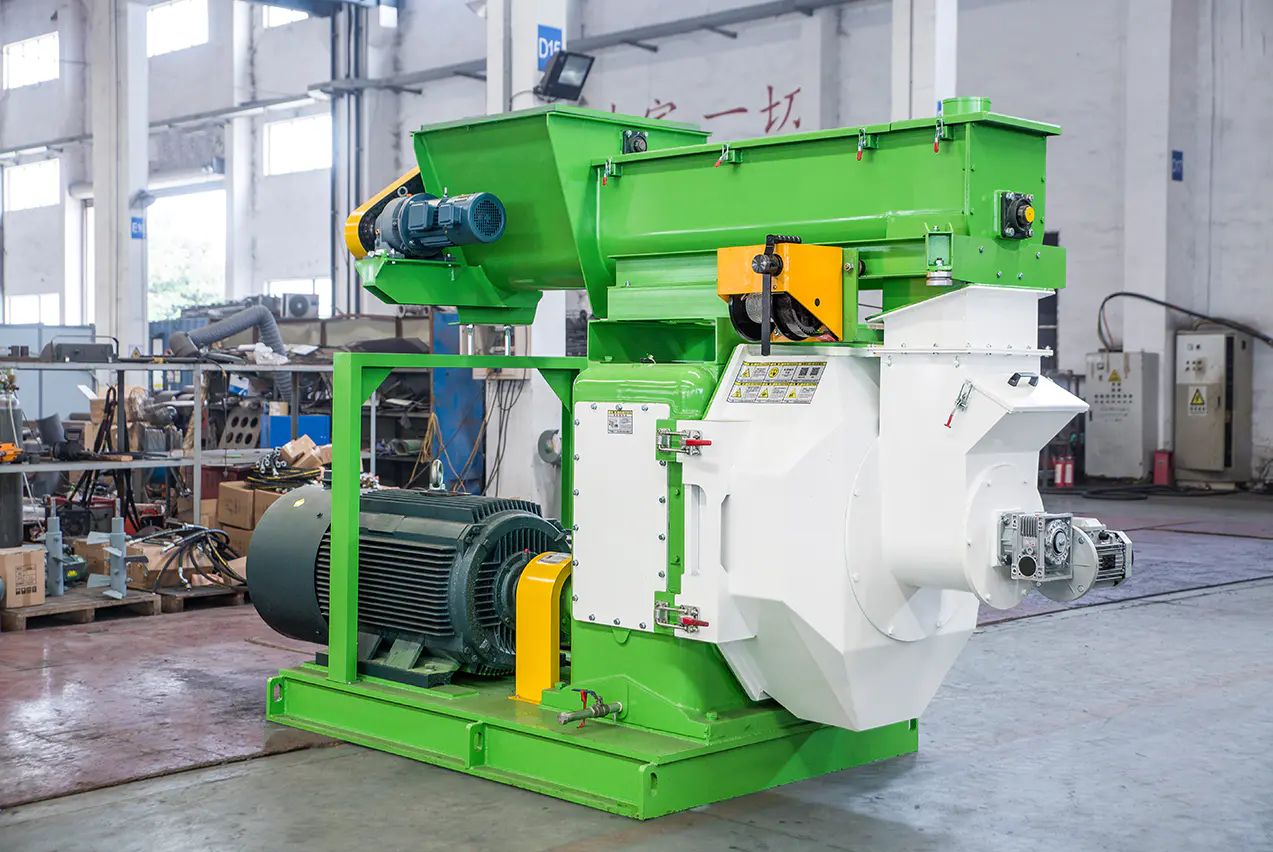
Country: China Commissioned: March 2023 Line capacity: 10 t/h Total installed power: 1,980 kW Pellet mills: 4 × JWZL-688 vertical biomass pellet mills
This project presented a specific industrial challenge: two distinct waste streams — construction site wood offcuts and furniture factory trim — were generating significant volumes of mixed, high-moisture wood residue with no viable local disposal route other than landfill. The client required a production line capable of converting this variable feedstock into specification-grade biomass fuel pellets at commercial throughput.
Kingwood engineered and supplied a complete 10 t/h wet-feed biomass pellet production line. The line processes raw wood residue through a full sequence of size reduction, moisture management, pelletizing, cooling, and packaging — operating as a single integrated, enclosed system in line with Kingwood’s Three-Standardization Framework for integrated, dust-free, and automated production.
Feedstock Profile and Processing Logic
Construction waste offcuts and furniture factory residues are not uniform feedstocks. Particle size varies from bulk wood slabs to fine shavings; moisture content fluctuates depending on source and season. A single-stage dry-feed line cannot handle this variability reliably at 10 t/h scale.
The Kingwood wet-feed line architecture is specifically designed for this scenario. The processing sequence is:
- Coarse size reduction — drum chipper and hammer mill reduce bulk offcuts and panel waste to a uniform chip and particle fraction suitable for drying.
- Drum drying — a rotary drum dryer removes excess moisture, targeting a consistent pre-pelletizing moisture level appropriate for ring die compression.
- Fine grinding — a secondary hammer mill stage reduces dried material to the particle distribution required for dense pellet formation.
- Pelletizing — four JWZL-688 vertical pellet mills compress the prepared material into 6–10 mm diameter biomass pellets. Each JWZL-688 delivers 2–2.3 t/h, giving a combined line output of 10 t/h at continuous operation.
- Counter-flow cooling — a counter-flow cooler reduces pellet temperature and finalizes moisture stabilization before handling.
- Packaging — automated pellet packaging closes the line.
The entire line operates under enclosed, negative-pressure dust extraction, meeting the dust-free production standard critical for wood dust environments subject to occupational health and fire-safety regulations.
Equipment Specification: JWZL-688 Pellet Mill
The JWZL-688 is Kingwood’s mid-range vertical biomass pellet mill, purpose-built for continuous industrial-scale pellet production from wood and agricultural residue feedstocks.
| Parameter | Specification |
|---|---|
| Model | JWZL-688 |
| Type | Vertical ring die pellet mill |
| Capacity | 2–2.3 t/h per unit |
| Units installed | 4 |
| Combined output | ~10 t/h |
Running four parallel JWZL-688 units rather than a single large machine provides operational redundancy: scheduled maintenance or an unplanned stoppage on one mill does not take the entire line offline. This architecture is standard Kingwood practice on lines above 8 t/h where continuous production uptime is a commercial requirement.
For projects requiring higher per-unit throughput, the JWZL-928 (4–5 t/h) or the horizontal JZWH-860 (4–5 t/h) are available. Line capacity can be scaled to meet annual production requirements up to 200,000 metric tons.
Fuel Output Quality and Environmental Impact
Pellets produced on this line meet the following specification benchmarks, verified against Kingwood’s standard fuel quality parameters:
- Calorific value: ≥ 4,800 kcal/kg
- Moisture content: < 15% (EU EN ISO 17225 compliant)
- Sulfur content: < 0.3%
- Ash content: < 18%
- Dioxin content: < 0.5 ng TEQ/m³
These parameters qualify the pellets for direct use as fuel in industrial biomass boilers and biomass-fired power generation. Combustion emissions from compliant biomass pellets fall below the thresholds set in China’s GB13271-2001 national Emission Standard of Air Pollutants for Boilers.
From a resource management perspective, this line eliminates two problematic waste streams entirely. Construction wood offcuts and furniture factory trim — both previously classified as solid waste requiring disposal cost — are reclassified as production inputs. The client replaces a disposal liability with a revenue-generating fuel product, while substituting biomass for coal or heavy oil at an energy cost saving of 40–50% on equivalent thermal output.
Why This Project Architecture Is Relevant to Industrial Buyers
For procurement and engineering teams evaluating biomass pellet line investments based on mixed industrial wood waste:
- Feedstock flexibility is the primary engineering requirement. The wet-feed line handles moisture variation that dry-feed systems cannot.
- Four-mill redundancy at 10 t/h protects production continuity without requiring a backup line investment.
- Dust-free enclosed processing is not optional for wood dust environments — it is a regulatory and insurance requirement in most jurisdictions.
- Pellet quality at specification enables the product to be sold into commodity biomass fuel markets or consumed captively in on-site boilers.
For comparable project references, see the 12 t/h Vietnam wood pellet line (commissioned 2024, 23-month payback) and the 24 t/h Vietnam wood chip pellet production line (commissioned 2023).
Kingwood has planned and designed over 2,000 production line projects across 30 countries since its founding in 1999. Engineering inquiries for construction waste and furniture offcut pellet lines at any capacity are handled directly by the Kingwood technical sales team.