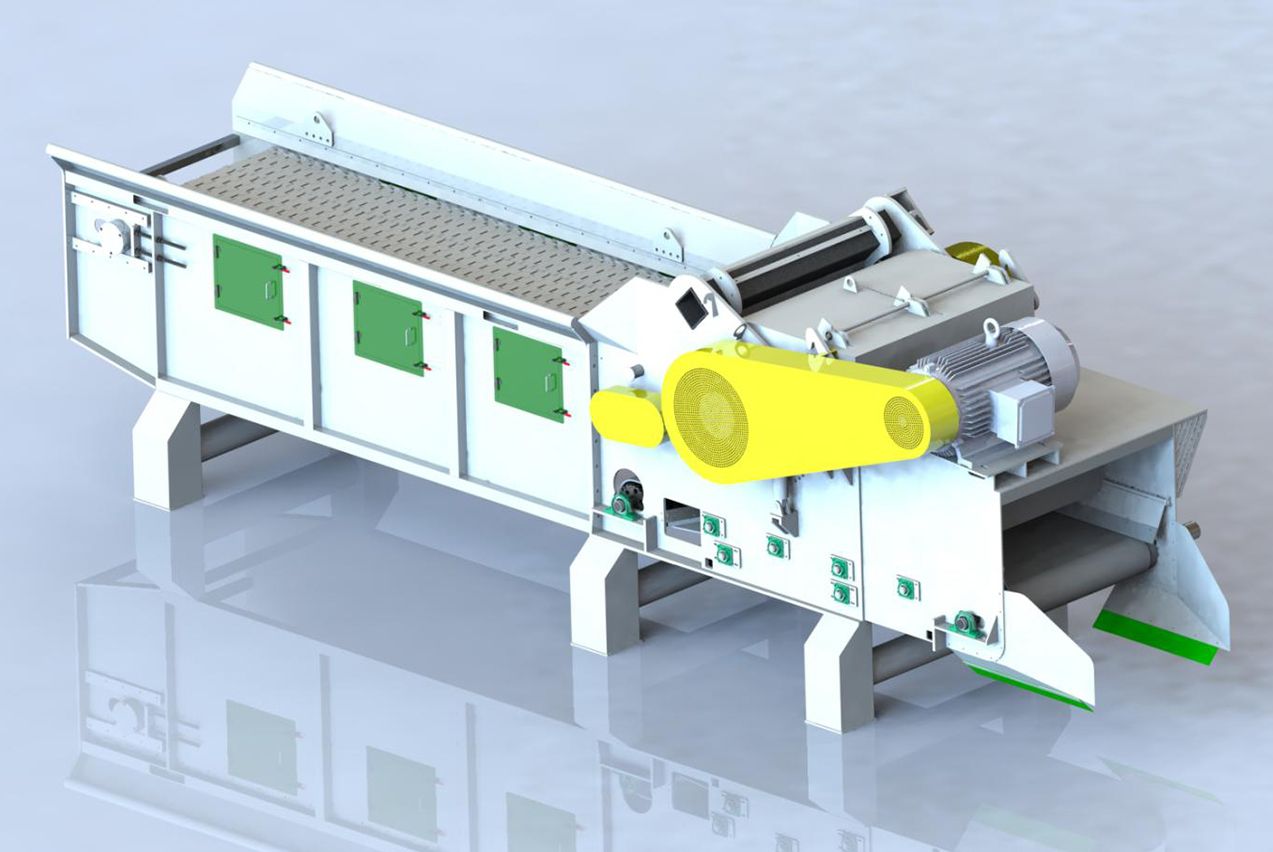
Drum Wood Crusher: Industrial Wood Size Reduction Guide
Kingwood · May 26, 2026
Why Wood Size Reduction Is the Foundation of Efficient Processing
Wood is among the highest-volume raw materials in global industry, fundamental to construction, furniture manufacturing, paper and pulp production, and increasingly, biomass energy generation. In each of these sectors, the ability to reduce raw or waste wood to a controlled, uniform particle size is not a secondary concern — it is the first engineering constraint that determines downstream throughput, energy consumption, and end-product quality.
For biomass pellet producers specifically, raw wood arrives in highly variable forms: full logs, slabs, harvesting residues, sawmill offcuts, and demolition timber. Before any of this material can enter a pellet mill, it must be reduced to a manageable chip size. That is the specific function of the drum wood crusher — and getting it right has measurable consequences for every subsequent stage of production.
How a Drum Wood Crusher Works in an Industrial Setting
A drum wood crusher — also referred to as a drum chipper in processing line documentation — operates on a rotating cylindrical rotor fitted with hardened blades or knives. As the rotor turns at high speed, wood fed into the machine is shredded against a fixed counter-blade, producing chips of a size determined by the screen or gap setting selected for the application.
In industrial-scale operation, the key performance variables are:
- Blade material and geometry — determines cut quality, energy draw, and maintenance interval
- Rotor speed and diameter — governs throughput capacity and chip size distribution
- Screen aperture — sets the maximum output particle size passed to the next processing stage
- Feed system design — controls material flow rate and prevents bridging or blockage on high-density feeds
Uniform output chip size is not merely a quality metric. It directly controls the performance of the drum dryer stage that follows: irregular chip sizes create uneven moisture evaporation, leaving oversized pieces underdried and fines overdried. Both conditions increase energy cost and degrade pellet mill efficiency downstream.
Integration into a Complete Biomass Pellet Production Line
The drum wood crusher does not operate in isolation. In Kingwood’s wet-feed pellet production line architecture, it is the first mechanical stage in a fully sequenced, automated process:
- Primary size reduction — drum wood crusher reduces raw logs or wood waste to chip-scale material
- Coarse grinding — hammer mill refines chips to the particle size range required for drying
- Drying — drum dryer reduces moisture content to the level required for pelletizing (target: below 15%)
- Fine grinding — second-pass hammer mill achieves the final particle fineness for ring die pellet mill feed
- Pelletizing — ring die pellet mill compresses dried, ground material into dense pellets
- Cooling — counter-flow cooler brings pellet temperature and surface moisture to specification
- Packaging — automated pellet packaging closes the production loop
This sequence is enclosed and dust-controlled throughout, consistent with Kingwood’s Three-Standardization Framework — integrated, dust-free, and automated production lines. The drum wood crusher is sized specifically to match the throughput demand of the line it feeds: a line targeting 30 TPH output, as deployed in Chongqing, China, requires a crushing stage with sufficient capacity to prevent any upstream bottleneck.
Kingwood has planned and designed more than 2,000 production line projects across 30+ countries, with complete lines capable of reaching 200,000 metric tons of annual pellet output. Each line specification begins with feedstock characterization — species, moisture content, bulk density, and form factor — which in turn defines the drum wood crusher specification.
Operational Advantages and Maintenance Considerations
In high-utilization industrial environments, equipment selection criteria extend well beyond initial throughput figures. Operators evaluate total cost of ownership, which is heavily influenced by:
Throughput consistency. A well-engineered drum wood crusher maintains rated capacity across varied feedstock types without requiring operator intervention for routine feed variations. This matters in production facilities where downtime directly translates to missed shipment volume.
Blade service intervals. Blade wear is the primary consumable cost in drum wood crushing. Kingwood designs for blade accessibility — reducing the labor time associated with planned blade changes and allowing maintenance crews to complete the work within standard shift windows rather than requiring extended production halts.
Integration with line control. In automated production lines, the crushing stage must communicate with upstream feed conveyors and downstream process equipment. Speed variation, jam detection, and feed rate modulation are standard requirements in modern line designs.
Dust and emissions management. Wood crushing generates fine particulate. In a dust-free production line design, the crushing stage is enclosed and connected to the integrated dust removal system — protecting both operator health and finished pellet cleanliness.
For operations considering how to structure their wood processing investment, Kingwood’s auxiliary equipment range — including the drum wood crusher, hammer mill, drum dryer, and counter-flow cooler — is available both as individual units and as components of a complete engineered production line. Review Kingwood’s complete pellet production line specifications for capacity models and configuration options, or explore the Vietnam 24 TPH wood chip pellet production line case for a documented example of full-line integration at industrial scale.
Jiangsu Kingwood Industrial Co., Ltd. is headquartered at #568 Hongsheng Road, Liyang Zhongguancun Industrial Park, Jiangsu Province, China. Founded in 1999 and listed on NEEQ (stock code: 871765), Kingwood delivers complete biomass pellet production line engineering — from equipment supply through commissioning and after-sales support — to industrial clients across 30+ countries.
FAQ
What is a drum wood crusher and how does it work?
A drum wood crusher is a high-throughput size-reduction machine consisting of a cylindrical drum fitted with hardened blades. The drum rotates at high speed, shredding incoming wood logs, slabs, or scrap into uniform small chips. Output size is controlled by screen selection, making it suitable for downstream grinding, drying, and pelletizing stages.
What industries use drum wood crushers?
Drum wood crushers are used in biomass energy production, paper and pulp manufacturing, sawmill scrap recovery, furniture waste processing, and construction wood recycling. In biomass pellet production lines, they typically serve as the primary size-reduction step before hammer milling and drying.
How does a drum wood crusher fit into a biomass pellet production line?
In a wet-feed biomass pellet production line, the drum wood crusher is the first mechanical stage. It reduces bulky logs or wood waste to chip-sized material, which then passes through coarse grinding, drum drying, fine grinding, pelletizing via a ring die pellet mill, and finally cooling and packaging — all in an enclosed, automated process.
What are the maintenance requirements for an industrial drum wood crusher?
Key maintenance tasks include periodic blade inspection and replacement, bearing lubrication, screen integrity checks, and clearing of the discharge system. Kingwood designs its equipment for straightforward blade access, reducing planned downtime and supporting high-availability production schedules.
Why is output uniformity important when crushing wood for pellets?
Uniform chip size ensures consistent moisture evaporation during drum drying and even particle distribution entering the hammer mill. Inconsistent particle size leads to uneven pellet density, increased die wear, and reduced pellet mill throughput — directly affecting production cost and pellet quality.
What raw materials can a drum wood crusher process?
Industrial drum wood crushers handle a wide range of lignocellulosic feedstocks: hardwood and softwood logs, slabs, branches, pallet scrap, sawdust blocks, and agricultural residue-based wood composites. Feed moisture content and hardness determine blade specification and rotor speed selection.
How does Kingwood support customers integrating a drum wood crusher into a complete line?
Kingwood provides full-line engineering from consultation and process design through manufacture, logistics, installation, commissioning, operator training, and after-sales support. The drum wood crusher is specified and sized as part of the overall line balance — matched to downstream pellet mill capacity targets ranging up to 200,000 metric tons per year.
- Kingwood has planned and designed over 2,000 biomass pellet production line projects for clients across more than 30 countries. (2025, Jiangsu Kingwood Industrial Co., Ltd. — Company Profile)
- Kingwood's complete wet-feed pellet production lines support annual output capacities up to 200,000 metric tons per year, with single-line pellet mill models ranging from 1 TPH to 5+ TPH. (2025, Jiangsu Kingwood Industrial Co., Ltd. — Product Specification Documentation)