Vertical Biomass Pellet Machine for Agricultural Residue Processing
Kingwood · May 26, 2026
Why Vertical Biomass Pellet Mills Are Gaining Ground in Agricultural Residue Processing
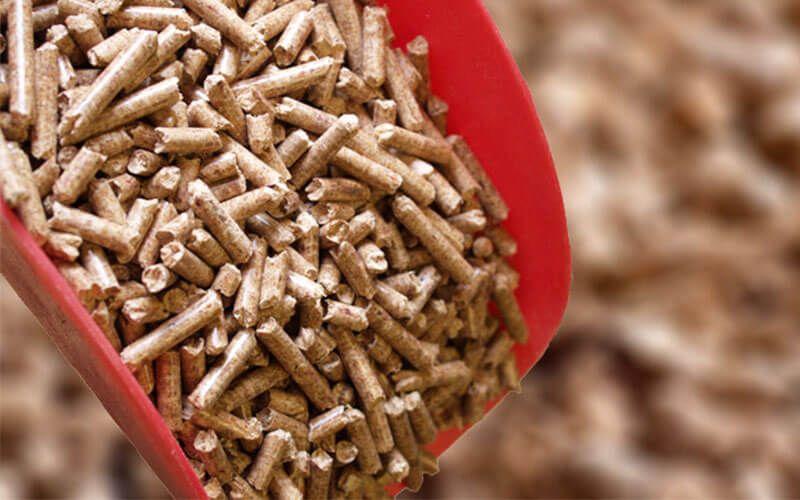
Agricultural operations generate substantial volumes of low-value residues — wheat straw, rice husks, corn stalks, sawdust, and forestry offcuts — that most facilities either landfill or open-burn. Both disposal routes carry rising regulatory and cost exposure. Vertical biomass pellet mills offer a technically credible alternative: converting those residues into standardized, tradeable biomass fuel pellets that meet international specifications and command a market price.
This article examines the engineering and commercial case for vertical pellet mill technology in agricultural and agro-industrial settings, with reference to Kingwood’s current product range and documented project data.
Vertical vs. Horizontal Ring Die: Engineering Differences That Matter
The core distinction between vertical and horizontal pellet mill configurations is the orientation of the die and roller assembly. In a horizontal ring die pellet mill — such as Kingwood’s JZWH-860 — the die rotates on a horizontal axis, making it well-suited for high-throughput, consistent-density feedstocks at industrial scale (4–5 t/h).
Vertical pellet mills orient the die on a vertical axis. This has two practical consequences for agricultural residue processing:
- Gravity-assisted material distribution. Fibrous, low-bulk-density feedstocks — rice husks, chopped straw — distribute more evenly across the die face under gravity, reducing uneven wear and inconsistent pellet density.
- Reduced installation footprint. The vertical column profile requires significantly less floor area than an equivalent horizontal machine, which matters in retrofitted farm buildings or constrained workshop layouts.
Kingwood’s vertical pellet mill range spans five models — JWZL-420 (1–1.5 t/h), JWZL-688 (2–2.3 t/h), JWZL-688D (3–3.5 t/h), JWZL-928 (4–5 t/h), and JWZL-1068 (capacity on request) — allowing capacity to be matched precisely to feedstock availability rather than over-specifying capital expenditure.
Complete Wet-Feed Production Lines for High-Moisture Biomass
A standalone pellet mill solves only part of the processing challenge. Agricultural residues arriving directly from harvest or storage typically carry moisture content well above the ≤15% threshold required for pellet production. Sending undried material directly to a pellet mill accelerates die wear and produces out-of-specification product.
Kingwood’s complete wet-feed biomass pellet production lines address the full process sequence:
- Drum chipper — primary size reduction of large woody or crop material
- Hammer mill — coarse grinding to homogenize particle size distribution
- Drum dryer — controlled moisture reduction to target specification
- Secondary hammer mill — fine grinding prior to pelletizing
- Vertical or horizontal pellet mill — compression and forming
- Counter-flow cooler — pellet temperature and final moisture conditioning
- Pellet packaging machine — automated bagging for product dispatch
The entire sequence operates as an enclosed, automated system under Kingwood’s Three-Standardization Framework — Integrated, Dust-Free, and Automated — eliminating manual transfer points that generate dust and process inconsistency. Complete line design capacity reaches up to 200,000 metric tons per year.
For a detailed example of this configuration at industrial scale, see the 24 t/h Vietnam wood chip pellet production line case study.
Fuel Quality, Cost Economics, and Market Access
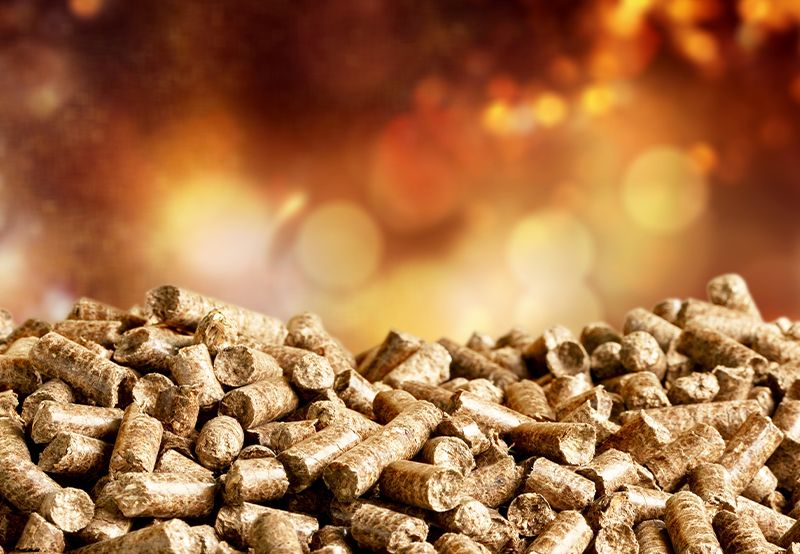
Pellets produced on Kingwood lines are engineered to the following specification: calorific value ≥ 4,800 kcal/kg, moisture < 15%, sulfur < 0.3%, ash < 18%, dioxin < 0.5 ng TEQ. These figures satisfy China’s GB13271-2001 boiler emission standard and align with EU moisture thresholds, USA calorific value requirements (>2,500 kcal/kg), and ISO ash limits (<20%).
The commercial case for on-site pelletization of agricultural residues rests on three levers:
- Input cost near zero. Crop residues and sawdust that would otherwise require disposal fees become a free or low-cost feedstock.
- Fuel cost displacement. Biomass pellets displace coal, HFO, or gas in on-site boilers, reducing fuel costs by 40–50% versus fossil alternatives.
- Pellet sales revenue. Surplus production can be sold into growing domestic and export markets for industrial heating and power generation.
A Kingwood 12 t/h production line commissioned in Vietnam in 2024 achieved full investment payback in 23 months under these combined economics. That project detail is documented in the Vietnam 12 t/h wood pellet line payback case.
OEM Supply Capability and Quality Credentials
Kingwood — formally Jiangsu Kingwood Industrial Co., Ltd. — has manufactured biomass pellet equipment since 1999 from its 31,200 m² facility at Liyang Zhongguancun Industrial Park, Jiangsu Province, China. The company holds ISO 9001, ISO 14001, and CE certifications, is listed on China’s NEEQ exchange (stock code: 871765), and employs 20 dedicated R&D specialists.
The company has planned and designed more than 2,000 production line projects across 30 countries. OEM supply agreements are supported by documented quality management systems, CE-compliant equipment design, and full export documentation capability — requirements that procurement teams in regulated markets increasingly treat as baseline qualifications.
For buyers evaluating vertical biomass pellet machine production line suppliers, Kingwood’s combination of model range depth (five vertical mill capacities), complete line engineering capability, and verified international project track record represents a substantive qualification base. Contact the Kingwood sales team to discuss feedstock analysis, line sizing, and OEM commercial terms.
FAQ
What distinguishes a vertical pellet mill from a horizontal ring die pellet mill?
A vertical pellet mill positions the die and rollers on a vertical axis, which reduces the footprint significantly and allows gravity-assisted material flow. This makes the vertical configuration better suited for agricultural residue feedstocks — including sawdust, rice husks, and crop stalks — that have variable bulk density. Kingwood's horizontal ring die model JZWH-860 is designed for higher-throughput industrial applications at 4–5 t/h, while vertical models such as the JWZL-928 cover 4–5 t/h in a more compact envelope.
Which Kingwood vertical pellet mill models are available and what are their capacities?
Kingwood currently offers five vertical biomass pellet mill models: JWZL-420 (1–1.5 t/h), JWZL-688 (2–2.3 t/h), JWZL-688D (3–3.5 t/h), JWZL-928 (4–5 t/h), and JWZL-1068 (contact sales for capacity). All models process agricultural and woody biomass residues into pellets meeting international fuel specifications.
What agricultural residues can be processed into biomass pellets?
Kingwood's vertical pellet mills and complete wet-feed production lines handle a wide range of agricultural residues: wheat straw, corn stalks, rice husks, sawdust, wood chips, and forestry trim. The complete line — covering crushing, coarse grinding, drying, fine grinding, pelletizing, and packaging — is engineered for high-moisture feedstocks, removing the need for pre-drying before infeed.
What fuel quality do Kingwood biomass pellets achieve?
Pellets produced on Kingwood lines meet the following specifications: calorific value ≥ 4,800 kcal/kg, moisture content < 15%, sulfur content < 0.3%, ash content < 18%, and dioxin content < 0.5 ng TEQ. All emission indicators comply with China's GB13271-2001 national boiler air pollutant standard and align with EU, USA, Japan, and ISO benchmarks.
How quickly can a biomass pellet production line investment pay back?
A documented Kingwood 12 t/h wood pellet line commissioned in Vietnam in 2024 achieved full investment payback within 23 months. Biomass pellets typically reduce fuel costs 40–50% versus fossil fuel alternatives, accelerating return on capital across most market conditions.
What does Kingwood's Three-Standardization Framework mean for an OEM buyer?
Kingwood's Three-Standardization Framework structures every production line around three engineering pillars: Integrated production lines (end-to-end process continuity), Dust-Free production lines (fully enclosed processing with integrated dust removal), and Automated production lines (minimal manual intervention). For OEM buyers, this means consistent equipment specification, predictable commissioning timelines, and compliance with increasingly strict environmental regulations in export markets.
Does Kingwood supply OEM production lines for export markets?
Yes. Kingwood has planned and designed over 2,000 production line projects and serves clients in more than 30 countries. The company is publicly listed on China's NEEQ exchange (stock code: 871765) and holds ISO 9001, ISO 14001, and CE certifications — supporting OEM supply agreements that require auditable quality management and export documentation.
- Global wood pellet production reached approximately 44 million metric tons in 2023, with industrial-grade pellets for power generation representing the largest demand segment. (2023, International Energy Agency (IEA), Renewables 2024 report)
- The global biomass pellet market was valued at USD 12.1 billion in 2023 and is projected to grow at a CAGR of 8.3% through 2030, driven by renewable energy mandates in the EU, Japan, and South Korea. (2023, Grand View Research, Biomass Pellets Market Size & Trends Report, 2024)