Why Vertical Ring Die Pellet Mills Are Gaining Ground
Kingwood · May 26, 2026
The Engineering Case for Vertical Ring Die Pellet Mills
Industrial biomass pellet producers evaluating equipment configurations face a clear set of performance requirements: maximizing throughput per installed kilowatt, maintaining consistent pellet density across diverse feedstocks, and minimizing unplanned downtime. The vertical ring die pellet mill addresses each of these requirements through its core mechanical design.
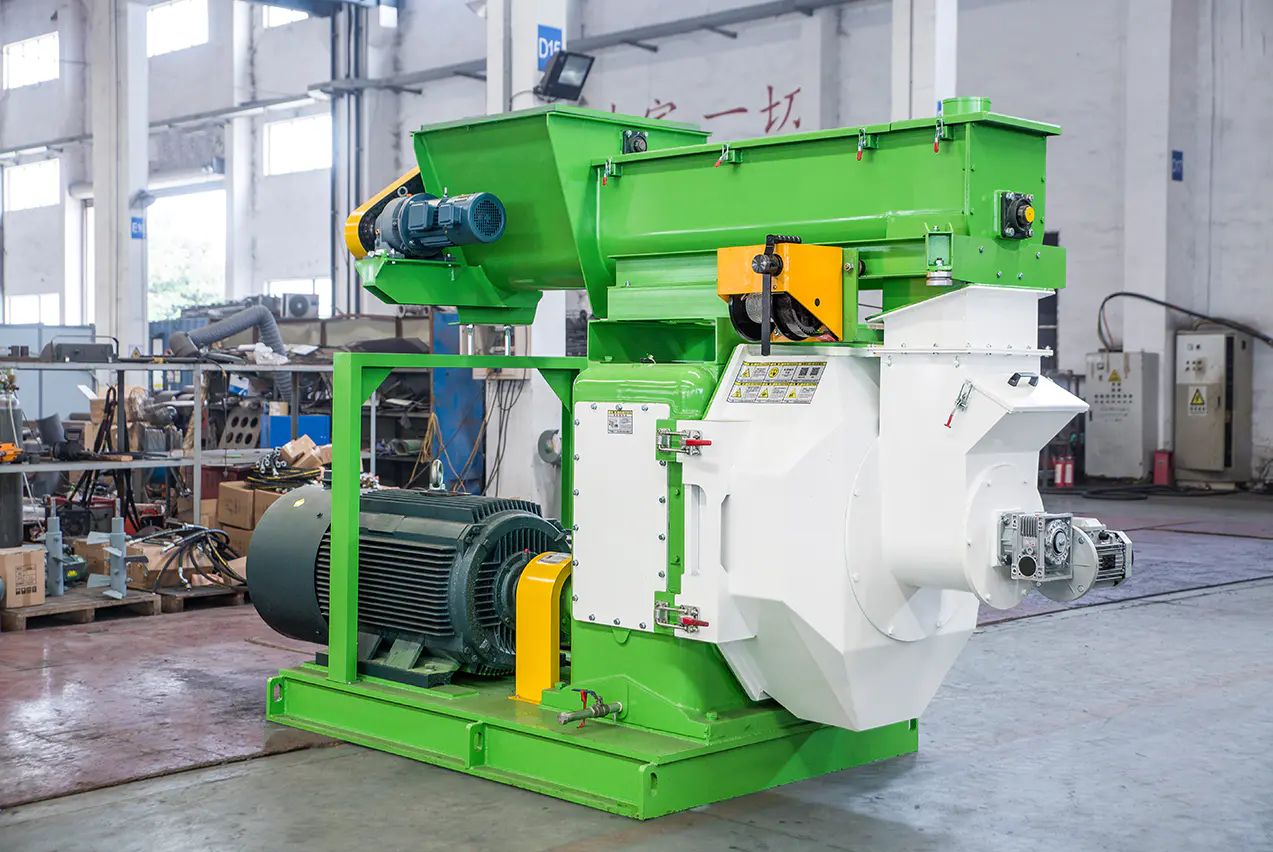
In a vertical ring die configuration, the die rotates around a fixed central axis while rollers compress biomass material against the inner die channel. The rotational movement generates centrifugal force that assists in drawing material into compression zones continuously—unlike flat die designs, where material must be mechanically fed across a stationary die surface. The result is a genuinely continuous production cycle rather than a semi-batch process, which is why ring die configurations dominate industrial-scale pellet manufacturing worldwide.
The compression mechanics also affect energy draw directly. Because centrifugal force contributes to material compaction, the main drive motor operates against lower resistance per unit of output. For large-scale operations running 20 or more hours per day, this difference translates into significant reductions in electricity cost per metric ton of pellets produced—one of the most controllable line items in a pellet plant’s operating budget.
Kingwood’s vertical pellet mill lineup—spanning the JWZL-420 at 1–1.5 t/h through the JWZL-928 at 4–5 t/h and the larger JWZL-1068—is designed around this principle. Each model uses a ring die matched to the throughput class, with roller geometry and die channel dimensions engineered for the biomass feedstocks most common in industrial operations: sawdust, wood shavings, wood chips processed through a hammer mill or drum chipper, and agricultural residues.
Pellet Quality: What the Ring Die Design Delivers
Pellet quality in an industrial context means consistent diameter, density, and durability across a production run. Buyers in the EU, Japan, and South Korea specify pellet fuel to published standards, and inconsistent product leads to rejected shipments or pricing penalties.
The ring die design contributes to quality consistency in two ways. First, the uniform radial compression applied by the rollers against a machined die channel produces pellets with predictable density. Second, because the die wears evenly around its circumference rather than in localized flat zones, pellet geometry remains stable over longer production intervals before die replacement is required.
Biomass pellets produced on Kingwood lines are specified to achieve 4,800 kcal/kg calorific value, below 15% moisture content, below 0.3% sulfur, and below 18% ash content. These figures meet the EU moisture threshold, comply with Japan’s ≤0.5% sulfur standard, and fall below China’s GB13271-2001 boiler emission limits—enabling Kingwood customers to sell into multiple export markets from a single production configuration.
For operations handling high-moisture feedstocks such as fresh wood chips or green agricultural residues, pellet quality at the die depends heavily on upstream preparation. Kingwood’s complete wet-feed production lines integrate a drum chipper for size reduction, a drum dryer to bring moisture into the optimal range, fine grinding via hammer mill, and pelletizing—all within an enclosed, automated sequence governed by a single control system. This integration prevents moisture variability from reaching the die, which is the most common cause of pellet quality inconsistency in field operations.
Operational Reliability and the Three-Standardization Framework
Procurement decisions in industrial biomass are rarely made on equipment specifications alone. Plant operators weight total cost of ownership heavily—and that calculation includes maintenance frequency, spare parts availability, and the cost of unplanned stops.
Vertical ring die pellet mills have fewer reciprocating components than equivalent flat die configurations, which reduces wear-point count. Kingwood’s models incorporate automatic lubrication systems and digital monitoring across critical bearing and roller assemblies, allowing maintenance teams to schedule interventions based on condition data rather than fixed intervals.
Every complete production line Kingwood designs and builds is delivered under its Three-Standardization Framework: Integrated (all process stages connected in a single material flow), Dust-Free (enclosed handling and integrated dust removal throughout), and Automated (PLC-controlled sequencing from feedstock intake to packaged output). The Dust-Free specification in particular addresses a compliance requirement that is becoming non-negotiable in China and in a growing number of export markets—particulate exposure limits for workers and community air quality standards around industrial facilities. A documented Dust-Free implementation completed in Guizhou, China in 2024 demonstrates this capability at operating scale.
Kingwood has designed and executed over 2,000 production line projects across 30 countries since the company was founded in 1999. The 2023 installation of a 24 t/h wood chip pellet production line in Vietnam and a 12 t/h line in Vietnam in 2024 that reached full payback in 23 months are representative of the operational outcomes Kingwood production lines deliver in export-oriented pellet manufacturing contexts.
For buyers evaluating a custom vertical flat ring die wood pellet mill machine sourced from China, the relevant questions are: what feedstock variability does the line need to handle, what quality specification does the target market require, and what level of process integration will minimize operating cost over a 10-year plant life. Kingwood’s engineering team—backed by 20 R&D specialists and 27 years of biomass equipment development—structures proposals around those parameters rather than catalog specifications. Contact Kingwood to discuss production line configurations matched to your feedstock and output requirements.
FAQ
What is the difference between a vertical ring die pellet mill and a flat die pellet mill?
A vertical ring die pellet mill uses a rotating ring die that enables continuous, high-throughput pellet production. A flat die mill operates on a fixed horizontal surface and is generally suited to smaller-scale or lower-capacity operations. The ring die design allows centrifugal force to assist compression, reducing the energy required per ton of output.
What biomass feedstocks can a vertical ring die pellet mill process?
Vertical ring die pellet mills can handle a broad range of biomass materials including sawdust, wood shavings, wood chips, agricultural crop residues, and forestry by-products. Kingwood's wet-feed production lines extend this capability to high-moisture feedstocks by integrating crushing, drying, and pelletizing in a single automated sequence.
How does a vertical ring die pellet mill reduce energy consumption?
The rotating ring die generates centrifugal force that assists in compressing biomass material against the die channel. This mechanical advantage reduces the motor load required to achieve the same compaction output compared to flat die designs, resulting in measurable reductions in kilowatt-hours per ton of pellets produced.
What pellet quality standards can Kingwood's vertical pellet mills meet?
Biomass pellets produced on Kingwood lines achieve a calorific value of 4,800 kcal/kg, moisture content below 15%, sulfur content below 0.3%, and ash content below 18%—meeting EU moisture standards, ISO ash standards, and complying with China's GB13271-2001 boiler emission standard.
What is Kingwood's available model range for vertical ring die pellet mills?
Kingwood manufactures five vertical pellet mill models: JWZL-420 (1–1.5 t/h), JWZL-688 (2–2.3 t/h), JWZL-688D (3–3.5 t/h), JWZL-928 (4–5 t/h), and JWZL-1068 (capacity on request). A horizontal ring die model, the JZWH-860, is also available at 4–5 t/h.
How does Kingwood's Three-Standardization Framework apply to pellet mill production lines?
Kingwood's Three-Standardization Framework specifies that all complete production lines must be Integrated, Dust-Free, and Automated. This means enclosed material handling, zero-dust processing environments, and PLC-controlled sequencing throughout—from raw feedstock intake to finished pellet packaging.
What is a realistic return on investment timeline for a Kingwood pellet production line?
A documented 12 t/h Kingwood production line installed in Vietnam in 2024 achieved full capital payback within 23 months of commissioning. Actual ROI will vary based on feedstock cost, local energy prices, and line utilization rate.
- Global industrial wood pellet demand reached approximately 34 million metric tons in 2023, driven by coal-to-biomass fuel switching mandates across the EU and East Asia. (2023, IEA Bioenergy Task 40 — Global Wood Pellet Industry Market and Trade Study 2023)
- Biomass pellets produced within EU ENplus and ISO 17225 specifications must meet moisture content below 15% and ash content below 1% (A1 grade) to qualify for premium heating fuel markets. (2023, ISO 17225-2:2021 — Solid Biofuels: Fuel Specifications and Classes for Graded Wood Pellets)