Mini Wood Pellet Mill: OEM Supplier Guide for Small-Scale Producers
Kingwood · May 26, 2026
Why Small-Scale Producers Are Investing in Mini Wood Pellet Mills
The case for installing a compact wood pellet mill does not rest on marketing claims — it rests on measurable economics. Biomass pellets produced from locally sourced sawdust, wood shavings, or agricultural residues consistently deliver fuel cost savings of 40–50% versus fossil fuel alternatives, based on Kingwood’s operational data from client installations across more than 30 countries. For small commercial producers, farm operators, and OEM distributors evaluating entry-level equipment, those margins matter.
A mini wood pellet mill occupies a distinct position in the pellet equipment market: it provides industrially relevant output — structured, standardized biomass pellets meeting fuel specifications used in residential boilers and small industrial applications — at a capital cost and footprint accessible to non-industrial buyers. The key engineering constraint is feedstock preparation. Incoming biomass must be below 15% moisture content and reduced to consistent particle size before pressing. Without controlled pre-processing, ring die wear accelerates and pellet durability suffers.
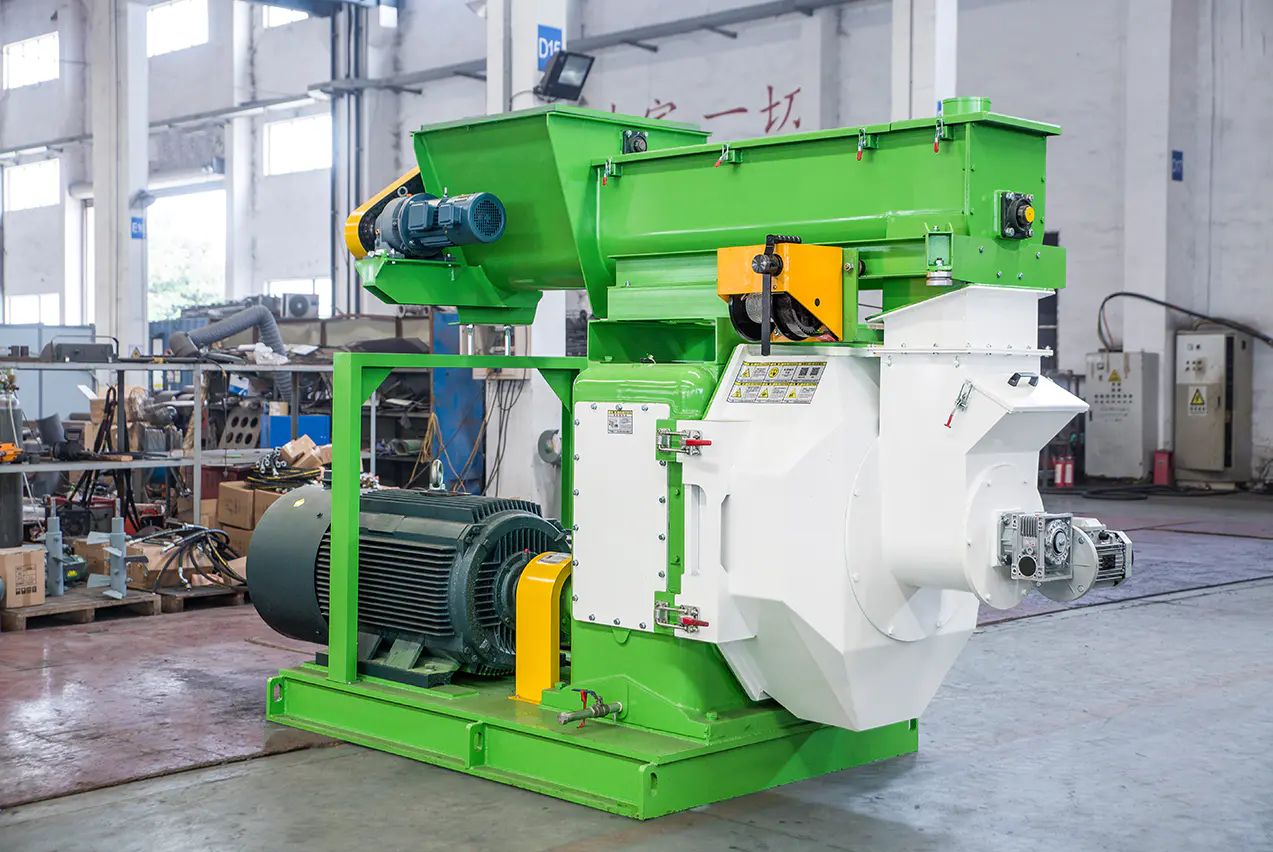
Kingwood’s entry-level vertical pellet mill, the JWZL-420, produces 1–1.5 tonnes per hour and is built around the same ring die pelletizing principle as the company’s larger industrial models. This consistency in core engineering means that operating logic, maintenance procedures, and spare parts supply chains transfer directly as producers scale up.
Technical Parameters That Define Pellet Mill Investment Value
When evaluating a mini wood pellet mill as an OEM product or direct investment, three technical parameters determine long-term return: throughput reliability, die service life, and pellet quality consistency.
Throughput reliability depends on matched feeding systems and motor sizing. Undersized feed systems create uneven die loading; oversized motors waste energy on intermittent small-batch runs. Kingwood’s JWZL-series vertical pellet mills use a vertical ring die configuration that distributes radial pressing force evenly across the die surface, reducing localized wear and maintaining throughput consistency across varied feedstock densities — sawdust, rice husk, and chopped straw each behave differently under compression.
Die service life is largely determined by raw material abrasiveness and moisture control upstream. A well-sized hammer mill upstream reduces particle size to 3–5 mm before the pelletizing stage, which extends die life and improves pellet density. For higher-moisture feedstocks — green wood chips at 30–50% moisture are common in tropical markets — integrating a drum dryer before the pellet mill is not optional; it is a process requirement.
Pellet quality consistency is what determines market access. Kingwood biomass pellets produced on JWZL-series equipment achieve:
- Calorific value: 4,800 kcal/kg
- Moisture content: <15%
- Sulfur content: <0.3%
- Ash content: <18%
- Dioxin content: <0.5 ng TEQ
These values satisfy EU moisture standards, exceed the US calorific threshold of >2,500 kcal/kg, comply with Japan’s sulfur limit of ≤0.5%, and fall within ISO ash content limits of <20%. For OEM customers supplying to regulated markets in Europe or Northeast Asia, this specification range is not a differentiator — it is a baseline requirement.
OEM Supply Model: What Kingwood Provides
Jiangsu Kingwood Industrial Co., Ltd. has operated as an equipment manufacturer since 1999, accumulating 27 years of focused R&D in biomass pellet machinery. The company is publicly listed on the NEEQ (National Equities Exchange and Quotations) under stock code 871765, with facilities spanning 31,200 m² in Liyang Zhongguancun Industrial Park, Jiangsu Province.
For OEM clients — distributors, system integrators, and regional machinery dealers — Kingwood supports custom configurations across its JWZL product line. Customization parameters include ring die diameter and compression ratio, feeder type, motor specification for local grid voltage standards, enclosure design for dust control, and automation integration level.
The company’s Three-Standardization Framework — covering integrated production lines, dust-free production lines, and automated production lines — is applied as a design philosophy across OEM builds, not only flagship installations. This means that even an entry-level JWZL-420 delivered under an OEM arrangement is built to the same enclosed processing and integrated dust removal standards as a full-scale production line.
Kingwood holds ISO 9001, ISO 14001, and CE certifications, and carries designation as a Jiangsu Provincial High-Tech Enterprise and a Jiangsu Provincial Specialized and Innovative Niche Leader. These credentials support OEM clients seeking to meet procurement qualification requirements in European and Japanese markets.
For reference, a 12 TPH wood pellet line delivered by Kingwood to a Vietnamese client in 2024 achieved investment payback within 23 months — a documented case that illustrates realistic ROI expectations for well-designed small-to-mid-scale pellet operations. See the full Vietnam 12 TPH wood pellet line case study for detailed cost and output data.
Feedstock Flexibility and Market Positioning for Small Producers
One operationally significant advantage of a ring die pellet mill at small scale is feedstock flexibility. Unlike some fixed-configuration systems, the JWZL-series accepts varied biomass inputs without mechanical reconfiguration — switching between sawdust and agricultural straw requires adjusting die compression ratio and feed rate, not replacing mechanical assemblies.
This matters commercially because small producers rarely have access to single-source feedstock at consistent volume. A farm-based operator may process rice husks post-harvest, switch to wood shavings from a nearby furniture workshop during the off-season, and supplement with tree pruning waste as available. A mini wood pellet mill that cannot handle this variation in bulk density and moisture profile creates operational bottlenecks that erode the economic case.
By processing diverse local biomass into standardized pellets meeting verified fuel specifications, small producers can supply local industrial boiler operators, district heating systems, or export brokers purchasing to EN Plus or equivalent grading standards. The wood pellet market’s continued expansion in Europe and Northeast Asia — driven by coal displacement mandates and industrial decarbonization targets — creates durable demand for verified-quality pellets from new supply regions.
For buyers evaluating OEM home mini wood pellet mill grinding machine supplier options, the relevant differentiators are not marketing claims about simplicity or affordability. They are die engineering, feedstock range, achievable pellet specification, and the supplier’s documented track record across international installations. Kingwood’s 2,000-plus planned and designed production line projects across 30 countries provide the reference base to assess those factors directly.
FAQ
What raw materials can a mini wood pellet mill process?
Mini wood pellet mills are designed to handle a broad range of biomass feedstocks, including sawdust, wood shavings, wood chips, rice husks, straw, and other agricultural residues. Feedstock moisture content should be kept below 15% for optimal pellet quality and machine longevity.
What pellet quality standards do Kingwood biomass pellets meet?
Kingwood biomass pellets achieve a calorific value of 4,800 kcal/kg, moisture content below 15%, sulfur content below 0.3%, and ash content below 18%. These specifications comply with EU, US, Japanese, and ISO biomass fuel standards.
Does Kingwood offer OEM manufacturing for mini wood pellet mills?
Yes. Kingwood operates as an OEM supplier for small and home-scale wood pellet mills, with 27 years of R&D experience and ISO 9001 and CE certifications. Custom configurations are available based on feedstock type, output capacity, and automation requirements.
How does pellet diameter customization work on a mini pellet mill?
The ring die on a mini wood pellet mill can be swapped to produce pellets of different diameters, typically 6 mm, 8 mm, or 10 mm. This allows producers to target specific end markets, including residential heating, industrial boilers, or export grading standards.
What is the entry-level capacity for Kingwood's pellet mill range?
Kingwood's entry-level vertical biomass pellet mill, the JWZL-420, delivers a throughput of 1–1.5 tonnes per hour, making it a suitable starting point for small commercial or pilot-scale biomass pellet production operations.
How does a mini wood pellet mill contribute to cost savings versus fossil fuels?
Biomass pellets produced by a wood pellet mill can reduce fuel costs by 40–50% compared to equivalent fossil fuel inputs, based on Kingwood's documented operational data. This saving is driven by lower feedstock cost and higher combustion efficiency of standardized pellets.
What after-sales support does Kingwood provide for OEM clients?
Kingwood provides technical commissioning support, spare parts supply, and remote diagnostics for OEM and direct clients across more than 30 countries. The company's 20-strong R&D team also supports equipment customization and process optimization post-delivery.
- Global wood pellet production reached approximately 42 million metric tons in 2023, with demand concentrated in Europe, Japan, and South Korea. (2023, IEA Bioenergy Task 40 — Sustainable Biomass Supply Chains)
- Biomass energy accounts for roughly 55% of total renewable energy consumption in the EU, with pellet imports growing year-on-year to meet industrial and residential heating demand. (2024, European Biomass Association (AEBIOM) — European Biomass Statistics Report)