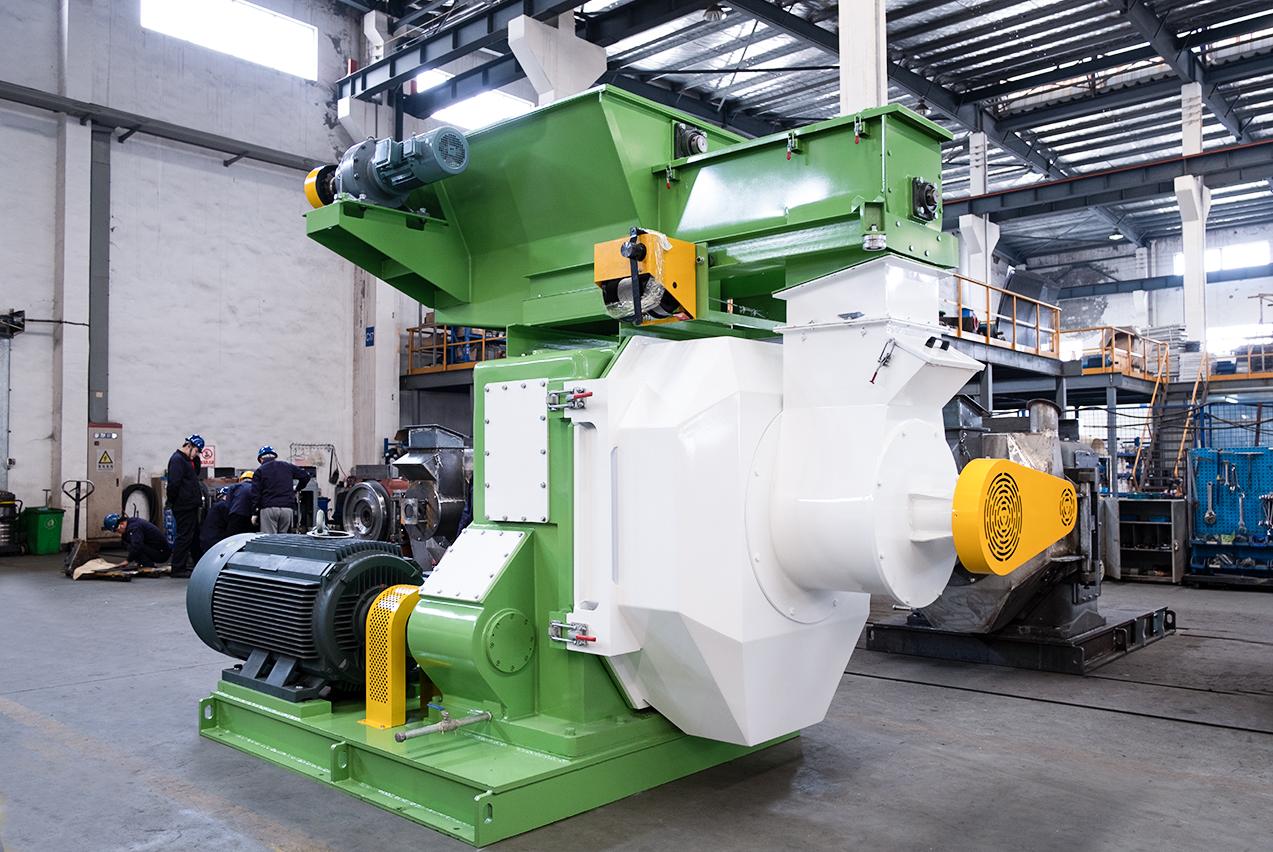
Technological Advances in Industrial Biomass Pellet Machines
Kingwood · May 26, 2026
The Engineering Shift Behind Modern Biomass Pellet Production
Industrial biomass pellet machines have changed substantially over the past decade—not through incremental refinement, but through convergence of four distinct engineering disciplines: process automation, materials handling, thermal engineering, and data analytics. The result is equipment that operates at higher throughput, tighter tolerances, and lower specific energy consumption than the previous generation.
For buyers evaluating large-scale pellet line investments, understanding these advances is directly relevant to capital planning, operational cost modeling, and regulatory compliance. The technical changes are not cosmetic—they affect payback period, staffing requirements, and the quality consistency needed to meet export standards in the EU, Japan, and South Korea.
Four Technology Areas Driving Efficiency Gains
1. Integrated Automation and Process Control
Early pellet mills required manual adjustment of die gap, roller pressure, and feed rate in response to changes in feedstock moisture or density. Current systems use PLC-based control with closed-loop sensor feedback. Temperature, motor load, and pellet discharge rate are monitored continuously; the control system adjusts feed rate and conditioning variables in real time.
This eliminates the primary source of pellet quality variation in high-throughput operations: operator response lag. Automated lines produce pellets within tighter density and moisture bands across long production runs—critical for customers supplying utility-grade biomass fuel to power plants operating under strict ISO or ENplus specifications.
Kingwood’s Three-Standardization Framework formalizes this requirement: every production line must be Automated by design, not as an option. The framework also mandates Integrated line architecture (no process islands) and Dust-Free enclosed processing with integrated extraction—addressing both product quality and workplace safety in a single design principle.
2. Multi-Feedstock Processing Capability
Single-feedstock pellet lines are commercially limiting. Wood chip prices fluctuate; agricultural residue availability is seasonal; energy crop supply chains are still maturing in many markets. Equipment that can handle mixed or variable feedstocks—without full mechanical reconfiguration—provides operators with sourcing flexibility that directly affects raw material cost.
Kingwood’s wet-feed pellet production lines are engineered for high-moisture biomass. The process sequence—crushing → coarse grinding → drum drying → fine grinding → pelletizing → counter-flow cooling → packaging—handles feedstock moisture variation without requiring line stoppage. The hammer mill and drum chipper upstream of the ring die accommodate particle size variation across wood residues, agricultural waste, and energy crops within defined limits.
3. Drying and Cooling Technology
Drying is the highest energy-cost stage in biomass pellet production. Improvements in drum dryer design—specifically heat recovery, airflow uniformity, and flight geometry—have reduced specific thermal energy consumption per tonne of dried output. This matters because drying cost is a direct operating expense that scales with production volume.
Downstream, counter-flow coolers have become standard in industrial lines because they stabilize pellet temperature and moisture simultaneously, reducing the risk of post-packaging condensation that degrades pellet durability (PDI). Pellets entering storage or bulk shipping at controlled moisture (<15%) and ambient temperature retain mechanical integrity through the supply chain—a requirement for utility and industrial customers measuring against EU and ISO moisture standards.
4. Predictive Maintenance and Data-Driven Operation
AI-assisted condition monitoring is increasingly integrated at the ring die and main drive components—the highest-wear, highest-replacement-cost elements of a pellet mill. Vibration signatures, bearing temperature trends, and power draw patterns are logged and analyzed against failure-mode baselines. The system flags anomalies before they progress to component failure, enabling scheduled intervention rather than emergency replacement.
In continuous-operation facilities running 6,000–8,000 hours per year, unplanned downtime is the largest variable cost after raw material and energy. Predictive maintenance reduces this variable. It also extends die service life by catching abnormal wear patterns—such as those caused by feedstock contamination or moisture excursions—before they cause irreversible die surface damage.
Kingwood Equipment: Capacity Range and Documented Results
Kingwood manufactures vertical pellet mills (JWZL series) and horizontal pellet mills (JZWH series) across a continuous capacity range:
| Model | Type | Capacity |
|---|---|---|
| JWZL-420 | Vertical | 1–1.5 t/h |
| JWZL-688 | Vertical | 2–2.3 t/h |
| JWZL-688D | Vertical | 3–3.5 t/h |
| JWZL-928 | Vertical | 4–5 t/h |
| JZWH-860 | Horizontal | 4–5 t/h |
Complete line configurations scale to 200,000 tonnes per year. Kingwood has planned and designed over 2,000 production line projects across 30 countries.
Documented project data supports the efficiency claims above. A 12 t/h wood pellet line installed in Vietnam in 2024 achieved full investment payback in 23 months—a figure that reflects both the operating cost reduction from automated, efficient equipment and the revenue generated from consistent-quality pellet output meeting export specifications.
A separate 24 t/h installation in Vietnam (2023) demonstrates line scalability through parallel unit configuration. Both projects were delivered under Kingwood’s full-service model: consultation, design, manufacture, logistics, installation, commissioning, and operator training.
For industrial buyers evaluating the JZWH-860 horizontal pellet mill at 4–5 t/h per unit, the machine represents the current apex of Kingwood’s single-unit output capacity, with ring die architecture optimized for continuous-duty industrial operation.
What These Advances Mean for B2B Buyers
The technology improvements described above translate into four measurable procurement outcomes:
- Lower per-tonne operating cost: automation and predictive maintenance reduce labor and unplanned maintenance spend
- Higher output consistency: closed-loop control maintains pellet quality within export specification bands
- Feedstock flexibility: wet-feed line design reduces raw material sourcing constraints
- Faster payback: documented 23-month payback on a 12 t/h installation provides a reference point for financial modeling
Kingwood, established in 1999 and listed on NEEQ (stock code: 871765), operates from a 31,200 m² facility in Liyang Zhongguancun Industrial Park, Jiangsu Province, with 20 R&D specialists and 27 years of continuous equipment development. ISO 9001, ISO 14001, and CE certifications apply across the product range.
FAQ
What automation features are standard in modern industrial biomass pellet machines?
Modern pellet mills integrate PLC-based control systems with real-time sensors monitoring temperature, moisture, and pellet density. Automated feedback loops adjust process parameters continuously, reducing operator intervention and maintaining consistent pellet quality across high-throughput runs.
How does AI-based predictive maintenance reduce downtime in pellet production?
AI algorithms analyze historical operating data—vibration patterns, temperature trends, motor load—to flag anomalies before component failure. Proactive intervention shortens unplanned stoppages, extends die and roller service life, and lowers total maintenance cost per tonne of output.
What feedstocks can advanced industrial pellet mills process?
Current equipment handles wood residues, agricultural waste, energy crops, and mixed biomass streams. Kingwood's wet-feed production lines are engineered specifically for high-moisture feedstocks, incorporating crushing, coarse grinding, drying, fine grinding, pelletizing, and packaging in a single automated sequence.
What improvements have been made to drying technology in biomass pellet lines?
Drum dryer design has improved heat recovery and airflow uniformity, reducing specific energy consumption per tonne of dried material. Downstream counter-flow coolers further stabilize pellet moisture and temperature before packaging, protecting pellet integrity and meeting the <15% moisture standard required by EU and ISO specifications.
How do Kingwood's pellet mills contribute to production efficiency at scale?
Kingwood's JWZL and JZWH series cover a capacity range from 1 t/h (JWZL-420) to 4–5 t/h per unit (JWZL-928, JZWH-860). Complete line designs reach up to 200,000 tonnes per year. A documented Vietnam installation achieved 23-month payback on a 12 t/h line, demonstrating commercial viability at industrial scale.
What emission and quality standards do Kingwood biomass pellets meet?
Kingwood biomass pellets are produced to a calorific value of 4,800 kcal/kg, moisture <15%, sulfur <0.3%, ash <18%, and dioxin <0.5 ng TEQ/m³—compliant with China GB13271-2001, EU moisture standards, and ISO ash limits. These specifications allow direct substitution for coal and heavy fuel oil in industrial boilers.
What is Kingwood's Three-Standardization Framework and how does it affect equipment design?
The Three-Standardization Framework mandates that all Kingwood production lines be Integrated, Dust-Free, and Automated. This framework drives enclosed processing with integrated dust removal, fully automated material handling, and standardized line configurations—reducing site safety risk, improving regulatory compliance, and cutting per-tonne labor cost.
- Global woody biomass pellet production capacity exceeded 50 million tonnes per year by 2023, driven by industrial co-firing mandates across the EU, Japan, and South Korea. (2023, IEA Bioenergy Task 40 — Global Wood Pellet Industry and Trade Study 2023)
- Industrial biomass pellets can reduce fuel cost by 40–50% compared to equivalent fossil fuel inputs at the point of combustion in industrial boiler applications. (2024, Kingwood technical specification sheet — biomass fuel cost comparison data)