Wood Pellet Press Machines in the Circular Economy
Kingwood · May 26, 2026
The Industrial Case for Wood Pellet Press Machines in Waste Valorization
Global industrial waste streams generate billions of tonnes of biomass annually — sawmill residues, agricultural stalks, forestry thinnings, and urban green waste — the majority of which is either landfilled, burned in the open, or left to decompose. Each disposal route carries measurable costs: landfill tipping fees, greenhouse gas liabilities, and foregone energy value.
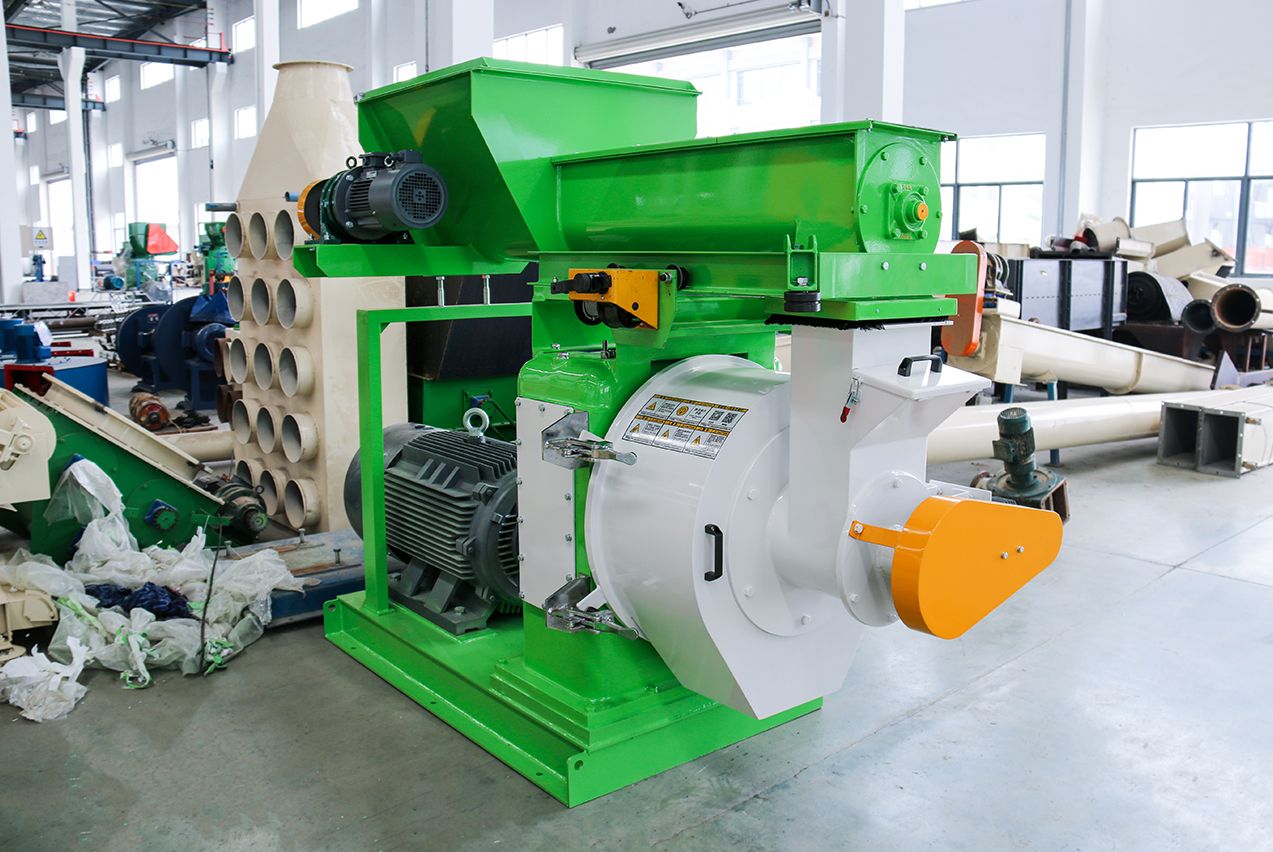
A wood pellet press machine resolves this by converting low-density, high-moisture biomass into standardized, energy-dense pellets. The transformation is physical rather than chemical: mechanical compression forces lignin — naturally present in woody biomass — to act as a binder, producing a pellet that is stable, transportable, and combustible with consistent thermal output.
At industrial throughput, this is not a marginal improvement. Kingwood’s complete wet-feed biomass pellet production lines — covering crushing, coarse grinding, drying, fine grinding, pelletizing, and automated packaging — handle feedstocks that would otherwise represent a disposal liability and convert them into a fuel product delivering 4,800 kcal/kg calorific value at moisture content below 15%.
How Pellet Press Machines Function Within a Circular Economy System
The circular economy framework demands that waste outputs from one process become resource inputs for another. Wood pellet press machines operationalize this principle at scale across three primary sectors.
Energy sector: Biomass pellets displace coal and heavy fuel oil in industrial boilers and combined heat-and-power (CHP) plants. Kingwood pellets contain less than 0.3% sulfur and less than 18% ash, with dioxin levels below 0.5 ng TEQ/m³ — meeting or exceeding the requirements of EU, US, Japanese, and ISO international fuel standards. Fuel cost savings versus fossil fuel equivalents reach 40–50% in documented operational deployments.
Agricultural sector: Crop residues — rice straw, corn stalks, sugarcane bagasse — represent one of the largest untreated biomass volumes globally. Pelletizing these materials at farm-gate or regional processing hubs generates a tradeable commodity from a waste stream that, if burned in the field, contributes directly to particulate air pollution and CO₂ loading. A pellet press machine with an integrated hammer mill and drum dryer can process high-moisture agricultural residues continuously without manual intervention.
Manufacturing and construction: Wood-based composite products — particleboard, MDF, and engineered lumber — draw on compressed biomass feedstock. By channeling sawmill offcuts and wood waste through a pellet press prior to composite board manufacturing, producers reduce virgin timber consumption and improve material yield per log. This is particularly relevant for facilities operating under extended producer responsibility (EPR) regulations or sustainability procurement requirements.
A 24 t/h wood chip pellet production line deployed in Vietnam in 2023 demonstrates this model at commercial scale: regionally sourced wood processing residues, previously treated as waste, now feed a continuous pellet line supplying export-grade biomass fuel.
Equipment Selection and Process Integration
Effective waste-to-pellet conversion requires more than a pellet mill in isolation. Feedstock variability — in moisture content, particle size, bulk density, and ash composition — demands a configured process line rather than a standalone machine.
Kingwood’s vertical ring die pellet mills cover throughput requirements from 1 t/h (JWZL-420) through 2–2.3 t/h (JWZL-688), 3–3.5 t/h (JWZL-688D), and 4–5 t/h (JWZL-928). For facilities requiring horizontal configuration, the JZWH-860 delivers equivalent 4–5 t/h output. Full production lines are engineered to annual capacities up to 200,000 metric tons, with integrated dust removal, enclosed material handling, and automated packaging — all aligned with Kingwood’s Three-Standardization Framework: Integrated, Dust-Free, and Automated production lines.
Key auxiliary equipment in a complete waste valorization line:
- Drum chipper: Reduces oversized woody feedstock to a uniform chip size suitable for further grinding
- Hammer mill: Secondary size reduction to achieve consistent particle distribution ahead of the pellet mill
- Drum dryer: Reduces feedstock moisture from field-level (30–60%) to the sub-15% threshold required for pellet formation
- Counter-flow cooler: Brings freshly extruded pellets from ~80°C to ambient temperature, stabilizing the pellet and preventing condensation during storage
- Pellet packaging machine: Automates bagging for commercial distribution or bulk loading for export
This integrated configuration ensures process continuity, reduces manual handling, and supports the dust-free operational environment that regulatory authorities increasingly require for biomass processing facilities. Kingwood’s dust-free biomass pellet mill workshop implementation in Guizhou (2024) provides a documented reference for facilities pursuing enclosed-process certification.
Regulatory Alignment and Investment Justification
Governments across Asia, Europe, and North America have introduced carbon pricing mechanisms, renewable energy mandates, and waste diversion targets that structurally increase the economic value of biomass pellet production. Facilities converting waste biomass to fuel pellets may qualify for renewable energy certificates, carbon credits, and preferential feed-in tariff arrangements depending on jurisdiction.
From a capital investment standpoint, the payback profile for industrial pellet lines has improved significantly as fossil fuel prices have risen. A 12 t/h Kingwood line commissioned in Vietnam in 2024 recorded full capital recovery within 23 months — a benchmark consistent with the 40–50% cost advantage biomass pellets hold over fossil fuel alternatives at current energy prices.
Kingwood has been designing and deploying biomass pellet production lines since 1999 — 27 years of process engineering experience now reflected in over 2,000 production line projects across more than 30 countries. The company operates from a 31,200 m² facility in Liyang Zhongguancun Industrial Park, Jiangsu Province, and maintains a 20-member R&D team focused on pellet mill performance, feedstock adaptability, and process automation.
For project developers, waste processors, and energy companies evaluating biomass pellet equipment, the combination of verified emission compliance, documented payback data, and configurable line capacity makes the wood pellet press machine one of the most commercially defensible investments available within the circular economy infrastructure.
FAQ
What is the role of a wood pellet press machine in the circular economy?
A wood pellet press machine converts waste biomass — including sawdust, crop residues, and wood chips — into dense, combustible pellets. This closes the resource loop by redirecting materials away from landfills and incineration, back into productive energy or material use.
What feedstocks can a wood pellet press machine process?
Industrial pellet mills handle a wide range of feedstocks: wood chips, sawdust, bark, agricultural straw, rice husks, and other lignocellulosic waste streams. High-moisture feedstocks require pre-drying — typically via a drum dryer — before pelletizing.
How do biomass pellets compare to coal in terms of emissions?
Biomass pellets produced by Kingwood equipment contain less than 0.3% sulfur and less than 18% ash, with dioxin emissions below 0.5 ng TEQ/m³. All emission indicators comply below China's GB13271-2001 boiler air pollutant standard, making pellets a significantly cleaner alternative to coal.
What capacity range do Kingwood pellet mills cover?
Kingwood's vertical pellet mill range spans from 1 t/h (JWZL-420) to 4–5 t/h (JWZL-928), with horizontal models such as the JZWH-860 also rated at 4–5 t/h. Complete production lines can be engineered to handle up to 200,000 metric tons per year.
How does pellet production reduce agricultural waste pollution?
By pelletizing crop residues such as straw and husks, farmers convert low-value waste into marketable biomass fuel or feedstock for composite materials. This reduces field burning, cuts particulate emissions, and generates additional revenue per harvest cycle.
What certifications validate Kingwood's pellet equipment quality?
Kingwood holds ISO 9001, ISO 14001, and CE certifications, and is recognized as a Jiangsu Provincial High-Tech Enterprise. The company is also a Deputy Director Member Unit of the China Biomass Energy Industry Alliance and is publicly listed on the NEEQ (stock code: 871765).
What cost advantage do biomass pellets offer over fossil fuels?
Biomass pellets produced on Kingwood lines deliver a calorific value of 4,800 kcal/kg at a fuel cost 40–50% lower than equivalent fossil fuel sources, based on operational data from deployed production lines.
- Kingwood has planned and designed over 2,000 biomass pellet production line projects across more than 30 countries since 1999. (2025, Kingwood corporate profile, kingwoodpellet.com)
- A 12 t/h wood pellet production line deployed by Kingwood in Vietnam in 2024 achieved full investment payback within 23 months. (2024, Kingwood case study: vietnam-wood-pellet-line-12-tph-kingwood-payback, kingwoodpellet.com)