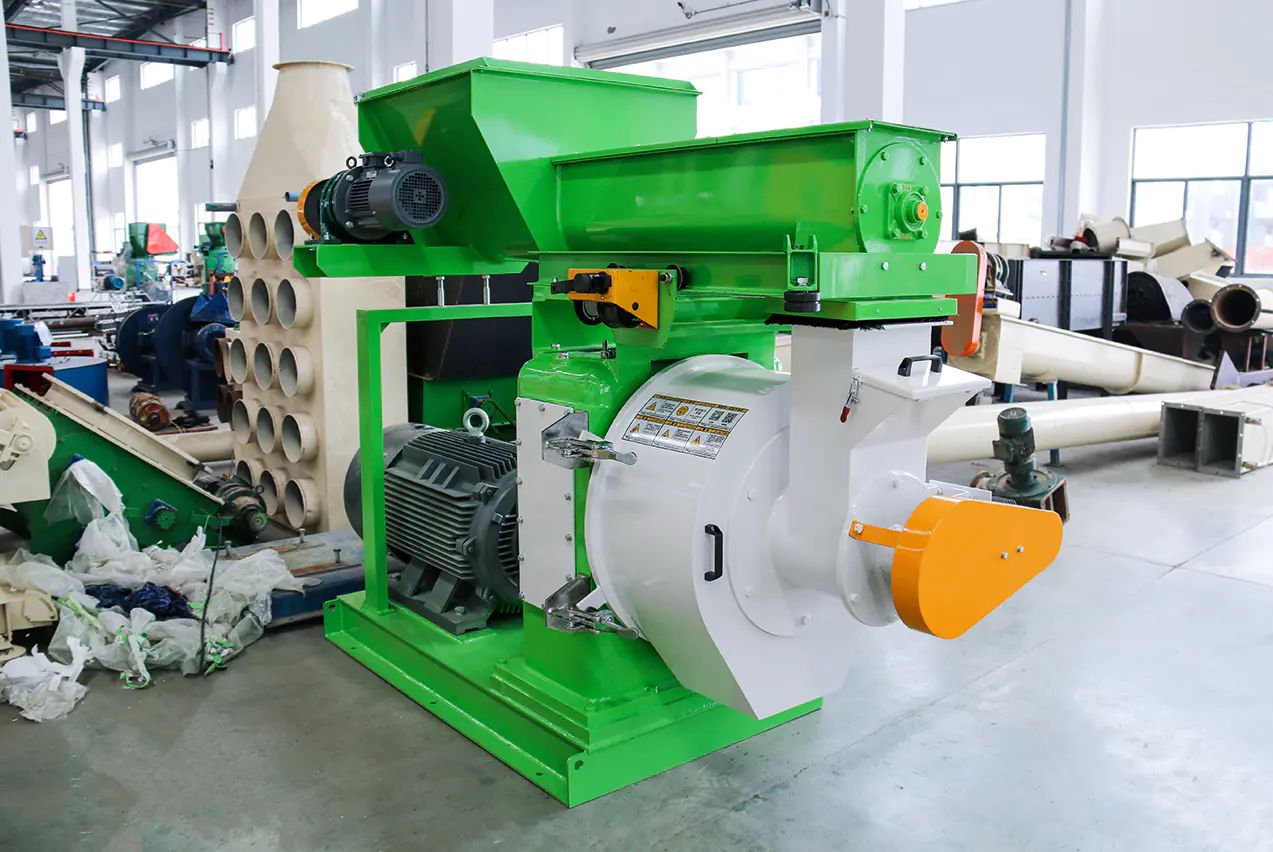
How a Hardwood Pellet Mill Works: OEM Manufacturing Guide
Kingwood · May 26, 2026
The conversion of wood waste into dense, combustible biomass pellets is one of the most technically mature and commercially viable pathways in industrial renewable energy. At the center of this process is the hardwood pellet mill — a precision machine that transforms low-value forestry residues and wood processing waste into standardized biomass fuel ready for heating systems, co-firing power plants, and industrial boilers.
This guide covers how industrial pellet mills function, what differentiates high-performance OEM equipment, and how Kingwood engineers complete production lines for commercial and export markets.
How a Hardwood Pellet Mill Converts Wood Waste into Fuel
The pellet production process begins well before material enters the pellet mill itself. Raw hardwood feedstocks — including sawdust, wood chips, bark, and shavings — arrive at variable moisture levels and particle sizes. Both must be controlled before pelletizing.
Size reduction is handled upstream by a drum chipper (for bulk timber and branch wood) and a hammer mill for fine grinding to the 3–5 mm particle size range required by the pellet mill die. Moisture control is managed by a drum dryer, which brings feedstock to below 15% moisture content — the threshold required to produce mechanically stable pellets and meet international biomass fuel standards.
Once conditioned, material is fed into the pellet mill. The core compression mechanism is the ring die: a rotating cylindrical die with precision-bored radial holes. Rollers press the wood particles against the inner surface of the ring die, forcing material through the die holes under pressures that generate sufficient frictional heat to activate the lignin naturally present in wood fiber. This lignin acts as a binder, eliminating the need for chemical additives in most hardwood pellet applications.
Pellets exit the die at elevated temperature and are conveyed to a counter-flow cooler, which reduces pellet temperature and residual moisture while hardening the outer surface. The result is a dense, durable cylindrical pellet — typically 6–8 mm in diameter — with a calorific value of 4,800 kcal/kg, sulfur content below 0.3%, and ash content below 18%.
OEM Pellet Mill Equipment: What to Specify for Industrial Production
For buyers sourcing OEM hardwood pellet mill equipment, three variables determine production line viability: feedstock characteristics, target throughput, and operational environment.
Feedstock moisture and density govern upstream equipment selection. High-moisture hardwood chips common in tropical forestry operations require longer dryer residence time and larger drum dryer capacity relative to dry sawmill residues. Kingwood’s wet-feed production line design accounts for this variability and handles the full sequence — crushing, coarse grinding, drying, fine grinding, pelletizing, and packaging — in an integrated, enclosed system.
Throughput requirements map directly to pellet mill model selection:
| Model | Type | Capacity |
|---|---|---|
| JWZL-420 | Vertical pellet mill | 1–1.5 t/h |
| JWZL-688 | Vertical pellet mill | 2–2.3 t/h |
| JWZL-688D | Vertical pellet mill | 3–3.5 t/h |
| JWZL-928 | Vertical pellet mill | 4–5 t/h |
| JZWH-860 | Horizontal pellet mill | 4–5 t/h |
Complete integrated production lines can be engineered to 200,000 metric tons per year for large industrial clients. See the Vietnam 24 t/h wood chip pellet production line for a reference installation at scale.
Operational environment affects dust management and automation requirements. Industrial buyers in regulated markets increasingly require enclosed processing with integrated dust removal — a design standard embedded in Kingwood’s Three-Standardization Framework, which mandates Integrated, Dust-Free, and Automated production line configurations across all Kingwood projects.
Economic and Environmental Performance of Biomass Pellet Production
Industrial biomass fuel pellets deliver measurable economic advantages over fossil fuel alternatives. Operations running on Kingwood-supplied production lines report fuel cost reductions of 40–50% versus coal or heavy oil on an equivalent energy basis — a figure that has driven strong adoption in Southeast Asian industrial markets, where feedstock is abundant and fossil fuel import costs are high.
A 12 t/h wood pellet production line in Vietnam achieved full capital payback in 23 months — a return profile that positions biomass pellet investment favorably against most industrial energy infrastructure projects.
On the environmental side, pellets produced within Kingwood’s specifications comply with all major international standards: EU moisture standard (below 15%), ISO ash content (below 20%), Japan sulfur standard (≤0.5%), and China’s GB13271-2001 boiler emission standard. Dioxin emissions from pellet combustion fall below 0.5 ng TEQ/m³, against a China national standard of ≤1.0 ng TEQ/m³.
Beyond combustion performance, the production process itself creates a material benefit: it monetizes wood processing waste streams — sawdust, planer shavings, chip fines — that would otherwise require disposal. For woodworking, furniture manufacturing, and timber processing operations, integrating an on-site pellet production line converts a waste management cost into a revenue-generating fuel product.
Kingwood OEM Manufacturing Capabilities
Kingwood has been engineering biomass pellet equipment since 1999 — 27 years of focused R&D and production experience. The company operates from a 31,200 m² facility in Liyang Zhongguancun Industrial Park, Jiangsu Province, with a dedicated R&D team of 20 specialists and a production area of 25,000 m².
OEM services cover individual machine supply (pellet mills, hammer mills, drum chippers, drum dryers, counter-flow coolers) through to complete turnkey production line design and commissioning. Kingwood has delivered equipment to clients in 30 countries and has planned and designed over 2,000 production line projects, with an aggregate annual biomass fuel production capacity exceeding 10 million metric tons.
Certifications include ISO 9001, ISO 14001, and CE marking, alongside Jiangsu Provincial High-Tech Enterprise status. Kingwood is listed on China’s NEEQ stock exchange under code 871765.
For OEM mobile hardwood pellet mill manufacturing and complete biomass pellet production line supply, contact Kingwood’s engineering team for feedstock-specific capacity modeling and equipment specifications.
FAQ
What raw materials can a hardwood pellet mill process?
Industrial hardwood pellet mills handle forestry residues, sawdust, wood chips, wood shavings, and agricultural by-products. High-moisture feedstocks require upstream drying — typically via a drum dryer — before pelletizing to achieve moisture content below 15%.
What is the role of the ring die in wood pellet production?
The ring die is the core compression component. Wood particles are forced through the die's precision-bored holes by rollers under high pressure, compacting the material into dense, uniform cylindrical pellets. Die hole diameter and compression ratio determine pellet density and durability.
What capacity range does Kingwood's pellet mill lineup cover?
Kingwood's vertical pellet mill models range from 1 t/h (JWZL-420) to 4–5 t/h (JWZL-928). The horizontal JZWH-860 also delivers 4–5 t/h. Complete integrated production lines can be engineered up to 200,000 metric tons per year.
What biomass fuel quality do Kingwood pellets achieve?
Pellets produced on Kingwood lines reach a calorific value of 4,800 kcal/kg, moisture content below 15%, sulfur content below 0.3%, and ash content below 18% — meeting EU, ISO, USA, and Japan biomass fuel standards.
Does Kingwood offer OEM manufacturing for pellet mill equipment?
Yes. Kingwood provides OEM design, engineering, and manufacturing services for pellet mills and auxiliary equipment including hammer mills, drum chippers, drum dryers, and counter-flow coolers. Custom production line configurations are available for specific feedstock and capacity requirements.
What auxiliary equipment is required for a complete wood pellet production line?
A complete wet-feed wood pellet production line integrates a drum chipper for size reduction, a hammer mill for fine grinding, a drum dryer for moisture control, the pellet mill itself, a counter-flow cooler for pellet stabilization, and a pellet packaging machine — all within an enclosed, dust-managed system.
What cost savings can biomass pellets deliver versus fossil fuels?
Biomass pellets produced on Kingwood lines can reduce fuel costs by 40–50% compared to conventional fossil fuels, depending on feedstock cost, local energy pricing, and production scale.
- Global wood pellet production reached approximately 42 million metric tons in 2023, with industrial-grade pellets accounting for the majority of demand in power generation and district heating. (2023, IEA Bioenergy Task 40 — Sustainable Biomass Supply Chains)
- Biomass pellets that meet ISO 17225-2 standards must contain less than 15% moisture and achieve an ash content below 2% for premium residential grades and below 10% for industrial grades. (2023, ISO 17225-2:2021 — Solid Biofuels: Graded Wood Pellets Specification)