Environmental Protection in Biomass Pellet Machines
Kingwood · May 26, 2026
Industrial biomass pellet machines are increasingly evaluated not only on throughput and energy efficiency, but on their environmental footprint across the full production and use cycle. This article breaks down the specific technologies integrated into modern pellet production lines to control dust, manage exhaust gases, and minimise solid waste — with reference to the standards and engineering approaches that matter most to industrial buyers.
Raw Material Pretreatment: Reducing Waste Before It Starts
Pollution control in a biomass pellet line begins upstream, before pelletizing occurs. Effective raw material pretreatment — covering screening, size reduction via hammer mill, and moisture reduction via drum dryer — directly determines the purity and processability of incoming biomass.
When material consistency is controlled early, downstream systems run within design parameters. Off-spec or oversized feedstock generates irregular pellet density, incomplete combustion in end-use applications, and higher mechanical wear — all of which translate to increased waste output and elevated emissions. Pretreatment is therefore not ancillary; it is the first environmental control point in the process chain.
Kingwood’s wet-feed complete production lines are designed around this principle. The sequence — coarse crushing, drying, fine grinding, pelletizing, cooling, and packaging — is fully integrated, with each stage sized and tuned to handle high-moisture biomass while maintaining enclosed material flow throughout.
In-Process Emission Controls: Dust, Exhaust Gas, and Conveyance
Dust Suppression and Collection
Biomass processing generates fine particulate matter at multiple transfer and size-reduction points. Two primary technologies address this:
Cyclone dust collectors use centrifugal separation to remove larger particulate fractions from process airstreams. They are typically positioned downstream of hammer mills and at dryer discharge points, where dust loading is highest.
Electrostatic precipitators capture sub-micron particles that bypass cyclone stages, using electrostatic charge to pull fine dust onto collection plates before process air is vented. Together, these devices keep working environment dust concentrations within permissible occupational exposure limits and prevent fugitive emissions at building envelope level.
Closed conveying systems address a separate dust pathway: material transfer between process stages. Open belt or screw conveyors allow dust to escape continuously. Enclosed conveyors — tubular screw conveyors or pneumatic transfer lines — contain material within sealed circuits, eliminating the primary source of diffuse dust in many older plant designs.
Kingwood’s Dust-Free production line, one of the three pillars of the Three-Standardization Framework, formalises these measures as a design standard rather than an add-on. The 2024 Guizhou facility implementation demonstrates this approach in an active industrial environment.
Exhaust Gas Treatment
Drying stages and certain thermal pre-conditioning processes produce exhaust gases containing volatile organic compounds, moisture, and combustion by-products. Two treatment technologies are commonly applied:
Catalytic combustion units oxidise VOCs and other organic compounds at relatively low operating temperatures by routing exhaust through a catalyst bed. This approach achieves high destruction efficiency without the energy cost of direct thermal oxidation at full flame temperature.
Activated carbon adsorption systems serve as a secondary or polishing stage, capturing residual odorous compounds and trace organics not fully mineralised by catalytic units. Spent carbon can be regenerated or disposed of as classified industrial waste.
Both systems are designed to bring exhaust outputs below the limits set in China’s GB13271-2001 standard for boiler air pollutants — the benchmark against which Kingwood production line emissions are assessed.
Combustion and End-Use Environmental Performance
The environmental case for biomass pellet fuel is partly embedded in the fuel specification itself. Kingwood biomass pellets achieve a calorific value of 4,800 kcal/kg, moisture content below 15%, sulfur content below 0.3%, ash content below 18%, and dioxin content below 0.5 ng TEQ. These figures satisfy EU, US, Japanese, and Chinese national standards simultaneously, which is relevant for manufacturers supplying multi-market customers.
At the combustion stage, two technologies govern emission outcomes:
High-efficiency combustion systems maintain optimal air-to-fuel ratio and residence time, ensuring near-complete oxidation of carbon compounds. Incomplete combustion is the primary source of CO, unburned hydrocarbons, and fine particulate in biomass boiler applications; modern burner design eliminates this through staged air injection and turbulent mixing.
Controllable burners provide real-time modulation of combustion parameters. In industrial boiler applications, this means emissions performance can be maintained across varying load conditions — not only at rated capacity — which is where many fixed-setting systems underperform against regulatory limits.
Solid Waste Classification and Handling
Ash residue from pellet combustion, along with process rejects from screening and pre-treatment, constitutes the solid waste stream from a biomass pellet operation. Integrated waste classification systems sort these streams at the point of generation, enabling:
- Fly ash and bottom ash routing to approved disposal or beneficial re-use pathways (e.g., soil amendment, cement additive where permitted)
- Process rejects returned to the feed stream or classified as biomass waste for separate handling
- Packaging waste and maintenance consumables separated from process waste streams
For operators in jurisdictions with strict industrial waste permitting, this classification capability is a compliance requirement, not an optional feature. For buyers assessing total cost of ownership, it also affects gate fees and waste transport logistics.
Integration Across the Production Line
Environmental performance in a biomass pellet facility is not achievable through isolated equipment choices. Dust control, exhaust treatment, controlled combustion, and waste classification must be engineered as a coherent system — sized, sequenced, and controlled together.
Kingwood’s complete wet-feed pellet production lines, with design capacity up to 200,000 tonnes per year, are built around this integrated approach. For facilities seeking operational environmental certification or compliance documentation, the fully automated and enclosed process architecture provides the control and monitoring infrastructure needed to demonstrate conformance to GB13271-2001 and equivalent international standards.
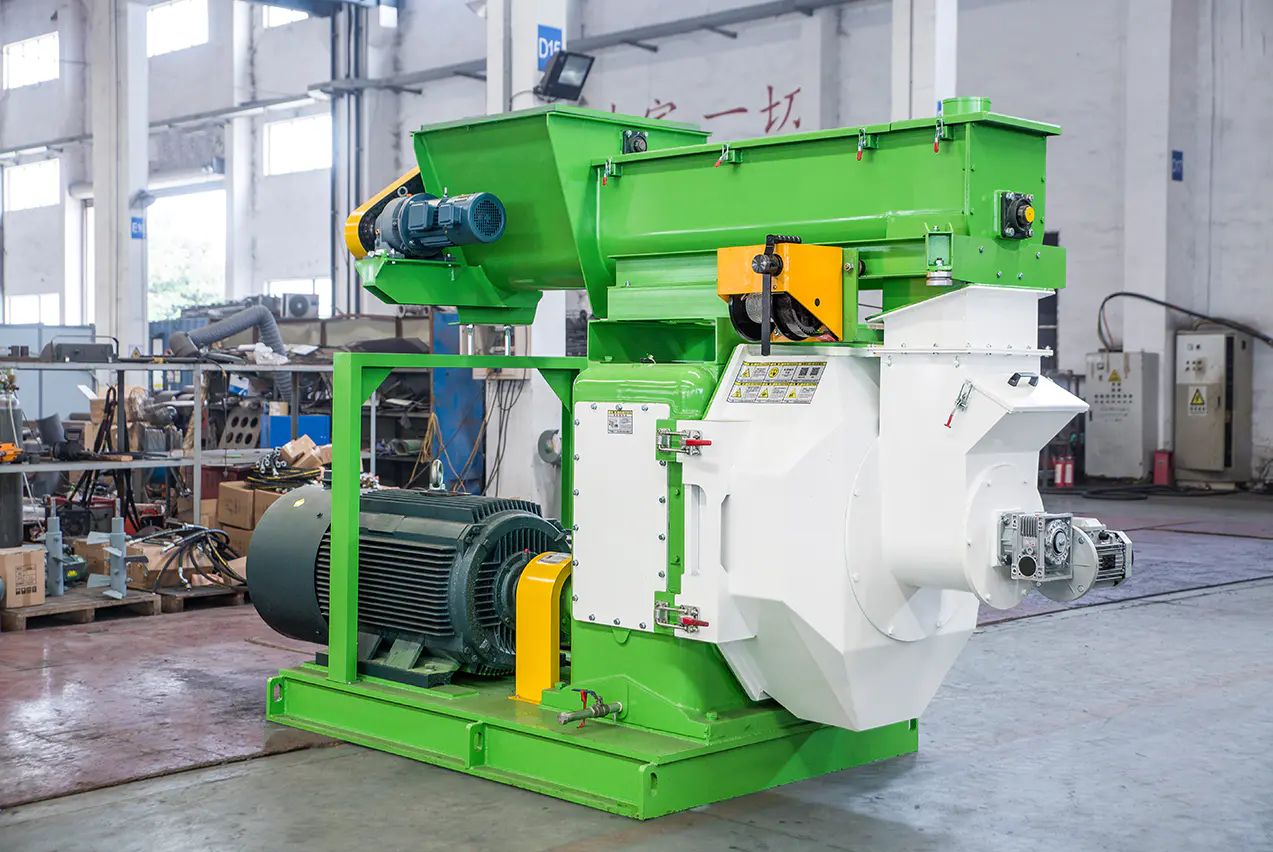
For technical specifications on individual process equipment or complete line design, contact the Kingwood engineering team or review the JWZL-928 pellet mill product page for throughput and configuration details relevant to mid-to-large scale installations.
FAQ
What dust control technologies are used in industrial biomass pellet machines?
Industrial biomass pellet machines integrate cyclone dust collectors and electrostatic precipitators to capture airborne particulates at the source. Closed conveying systems further eliminate fugitive dust during raw material transfer between process stages.
How do biomass pellet production lines handle exhaust gas emissions?
Dedicated exhaust gas treatment systems — including catalytic combustion units and activated carbon adsorption devices — strip harmful compounds from process gases before discharge, keeping emissions below GB13271-2001 limits for boiler air pollutants.
What is the role of raw material pretreatment in reducing pollution?
Screening, crushing, and drying during pretreatment raise raw material purity and consistency, reducing off-spec material that would otherwise generate waste or cause unstable combustion and elevated emissions downstream.
How does controlled combustion technology reduce pollutant output?
Controllable burners regulate air-to-fuel ratio and combustion temperature in real time, ensuring complete burn-out of biomass fuel and minimising CO, NOx, and particulate emissions during energy conversion.
How does Kingwood's Dust-Free production line address environmental compliance?
Kingwood's Dust-Free production line — one of the three pillars of its Three-Standardization Framework — uses fully enclosed processing, integrated dust removal, and sealed material handling to create a low-emission manufacturing environment that meets industrial environmental protection requirements.
What solid waste management is built into biomass pellet systems?
Ash and process residues are routed through onboard waste classification and handling systems. This enables compliant disposal or secondary use of by-products in line with local regulations, minimising landfill burden.
What emissions standards do Kingwood biomass pellets meet?
Kingwood biomass pellets meet China's GB13271-2001 national standard for boiler air pollutant emissions. Fuel specifications include sulfur content below 0.3%, ash content below 18%, and dioxin content below 0.5 ng TEQ — all below the national mandatory thresholds.
- Biomass pellet fuel produced on Kingwood lines achieves dioxin emissions below 0.5 ng TEQ, versus the China GB standard ceiling of 1.0 ng TEQ — a 50% margin below the regulatory limit. (2025, Kingwood product specification data; GB13271-2001, Ministry of Ecology and Environment, China)
- Kingwood biomass pellets deliver a calorific value of 4,800 kcal/kg with sulfur content below 0.3% — well within the Japan import standard of ≤0.5% and the EU moisture standard of <15%. (2025, Kingwood fuel specification sheet; EU Solid Biomass Sustainability Criteria; Japan Biomass Pellet Import Standards)