Industrial Wood Pellet Mill: Efficient Biomass Fuel Production
Kingwood · May 26, 2026
Why Uniform Pellet Geometry Drives Combustion Efficiency
The fundamental engineering challenge in biomass fuel production is not pelletizing itself — it is achieving dimensional consistency at scale. Pellet stoves and wood stoves are calibrated to specific fuel geometries. Diameter variance, density variation, or moisture deviation forces burner systems to compensate, reducing thermal efficiency and increasing ash accumulation.
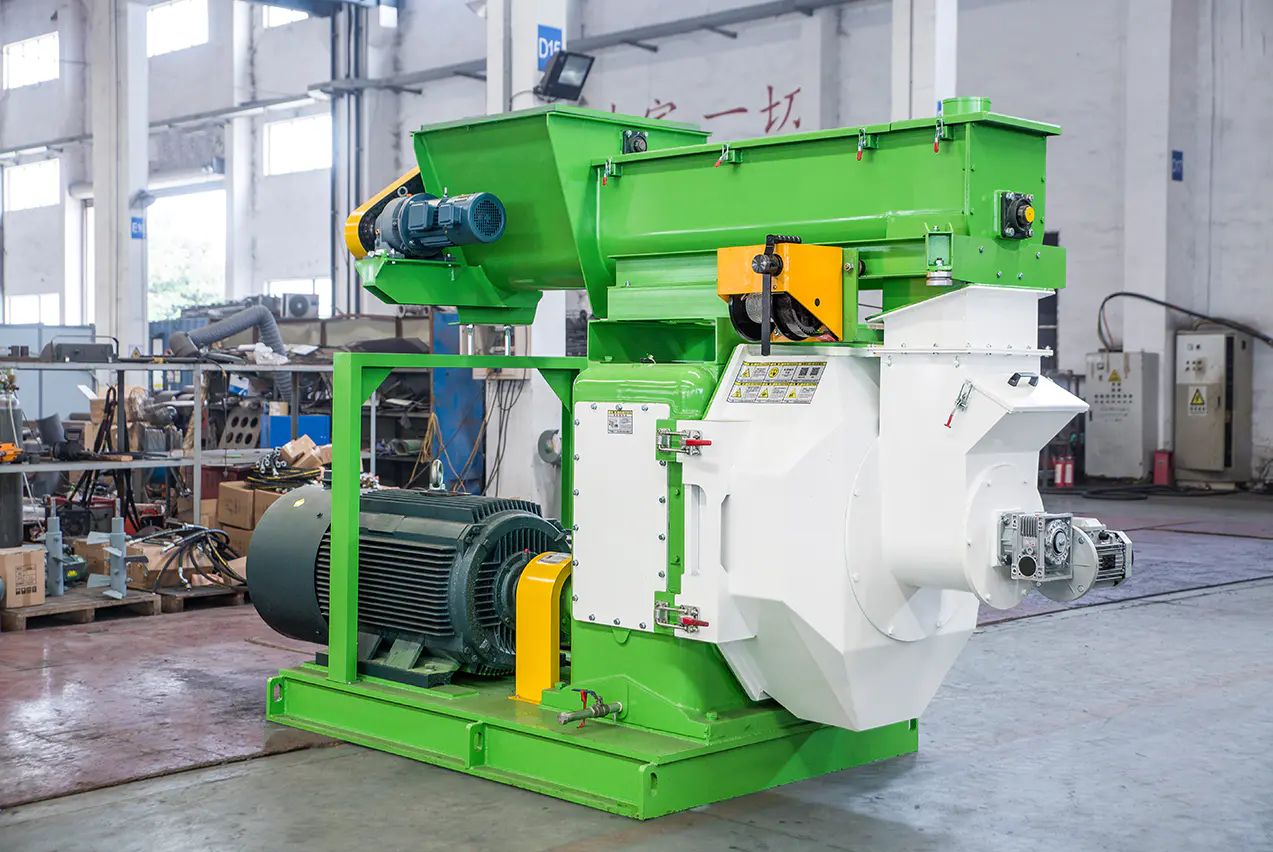
Kingwood’s ring die pellet mills address this through precision die-and-roller geometry maintained to tight manufacturing tolerances. Every pellet exiting a JWZL-series or JZWH-860 pellet mill meets the same diameter and length specification, regardless of feedstock batch variation. The result is a fuel pellet with a calorific value of 4,800 kcal/kg, moisture content below 15%, sulfur below 0.3%, and ash below 18% — parameters that satisfy the EU, US, Japanese, and Chinese national standards simultaneously.
For operators supplying residential pellet stoves or commercial wood stove installations, this consistency eliminates the quality-control overhead that plagues lower-specification pellet production equipment.
The Industrial Process Behind Wood Pellet Production
Converting raw forestry residues — sawdust, wood shavings, bark, wood chips — into market-ready biomass pellets requires a sequenced process chain, not a single machine. Kingwood designs and supplies complete wet-feed pellet production lines that handle high-moisture biomass from intake to packaged output:
- Drum chipping — oversized wood material reduced to manageable chip size
- Coarse grinding (hammer mill) — chips reduced to uniform particle fraction
- Drum drying — moisture content brought to process-optimal levels
- Fine grinding — particle sizing optimized for die compression
- Pelletizing (ring die pellet mill) — compaction into finished pellets under high pressure
- Counter-flow cooling — pellet temperature and hardness stabilized post-die
- Screening and packaging — fines removed, product packaged for dispatch
The entire line operates as an enclosed, fully automated system under Kingwood’s Three-Standardization Framework: Integrated, Dust-Free, and Automated. Integrated design eliminates transfer-point bottlenecks. Dust-Free enclosure protects operators and meets environmental compliance requirements. Automated control reduces headcount requirements and eliminates manual feed inconsistency.
Complete lines are engineered to customer-specified capacities up to 200,000 metric tons per year. Kingwood has planned and designed over 2,000 such production line projects across 30 countries since 1999.
Capacity Selection: Matching Equipment to Production Volume
Kingwood’s pellet mill range spans entry-level commercial installations through high-volume industrial operations:
| Model | Type | Capacity |
|---|---|---|
| JWZL-420 | Vertical pellet mill | 1–1.5 t/h |
| JWZL-688 | Vertical pellet mill | 2–2.3 t/h |
| JWZL-688D | Vertical pellet mill | 3–3.5 t/h |
| JWZL-928 | Vertical pellet mill | 4–5 t/h |
| JWZL-1068 | Vertical pellet mill | Contact sales |
| JZWH-860 | Horizontal pellet mill | 4–5 t/h |
Selecting the correct model requires matching not just the nameplate throughput but the feedstock moisture profile, particle size distribution, and available drying capacity. Kingwood’s engineering team — comprising 20 dedicated R&D specialists — conducts feedstock analysis and process design before any line quotation, ensuring specified throughput is achievable on the customer’s actual material.
For buyers evaluating sourcing options, Kingwood’s 25,000 m² production facility in Liyang Zhongguancun Industrial Park supports direct factory procurement with ISO 9001 and CE-certified quality assurance. Stock code 871765 on the NEEQ exchange provides independent verification of corporate standing for procurement compliance purposes.
Documented Performance: Vietnam and China Installations
Operational data from installed Kingwood lines provides the most reliable basis for investment assessment.
A 12 t/h wood pellet production line commissioned in Vietnam in 2024 achieved full investment payback in 23 months — driven by the 40–50% fuel cost differential between biomass pellets and the fossil fuel alternatives they displaced. A separate 24 t/h installation in Vietnam, completed in 2023, demonstrated Kingwood’s capacity to execute large-scale projects in tropical feedstock environments where high ambient moisture creates additional drying process demands.
In China, a 30 t/h installation in Chongqing (2021) and Beijing’s first biomass pellet demonstration project (2024) document performance across both industrial-scale and regulatory-showcase contexts. A Guizhou facility completed in 2024 specifically implemented the Dust-Free production line standard — relevant for operators in jurisdictions with stringent workplace particulate regulations.
Across all verified installations, pellet emissions remain below GB13271-2001 limits for boiler air pollutants, with dioxin content measured below 0.5 ng TEQ against the Chinese national standard ceiling of 1.0 ng TEQ.
Operators evaluating biomass pellet production equipment for wood stove fuel supply — whether for residential pellet stove markets, commercial heating applications, or industrial boiler fuel — should engage Kingwood’s project engineering team with feedstock specification and target annual volume. Contact details and product documentation are available at kingwoodpellet.com/product/.
FAQ
What raw materials can a Kingwood pellet mill process for wood stove fuel?
Kingwood pellet mills handle a wide range of lignocellulosic feedstocks including sawdust, wood shavings, wood chips, bark, and other forestry residues. The wet-feed production line manages high-moisture biomass through integrated crushing, drying, grinding, and pelletizing stages before packaging.
What throughput capacities are available for wood pellet production lines?
Kingwood's vertical pellet mill range covers 1–5 t/h per machine: JWZL-420 (1–1.5 t/h), JWZL-688 (2–2.3 t/h), JWZL-688D (3–3.5 t/h), and JWZL-928 (4–5 t/h). The horizontal JZWH-860 also delivers 4–5 t/h. Complete production lines are engineered up to 200,000 metric tons per year.
What are the fuel quality specifications of biomass pellets produced by Kingwood equipment?
Pellets produced on Kingwood lines achieve a calorific value of 4,800 kcal/kg, moisture content below 15%, sulfur content below 0.3%, and ash content below 18%. Dioxin emissions remain below 0.5 ng TEQ — well within China's GB13271-2001 boiler emission standard.
How much can switching to biomass pellets reduce fuel costs compared to fossil fuels?
Operators switching from coal or heavy oil to biomass pellets produced on Kingwood lines typically achieve fuel cost reductions of 40–50%. A documented 12 t/h project in Vietnam reached investment payback in 23 months.
Are Kingwood pellet mills certified for international export markets?
Yes. Kingwood holds ISO 9001, ISO 14001, and CE certifications, and its pellets meet EU moisture standards (<15%), US calorific standards (>2,500 kcal/kg), and Japan sulfur standards (≤0.5%). Equipment has been deployed across 30 countries.
What is the Three-Standardization Framework and how does it apply to pellet mill production lines?
The Three-Standardization Framework is Kingwood's proprietary engineering standard built on three pillars: Integrated production lines, Dust-Free production lines, and Automated production lines. Applied to wood pellet production, it ensures enclosed processing, integrated dust removal, and fully automated material flow — reducing operator intervention and improving output consistency.
Can Kingwood design a complete wood pellet production line, not just individual machines?
Yes. Kingwood engineers complete wet-feed pellet production lines covering the full process chain: crushing, coarse grinding, drying, fine grinding, pelletizing, and packaging. Lines are fully automated, enclosed, and integrated with dust removal systems. Kingwood has planned and designed over 2,000 production line projects across 30 countries.
- Global industrial wood pellet demand reached approximately 33 million metric tons in 2023, with Asia-Pacific markets — particularly Japan, South Korea, and Vietnam — driving the largest volume growth in imported pellet fuel. (2023, IEA Bioenergy Task 40 — Sustainable Biomass Supply Chains)
- Biomass pellet fuel reduces boiler operating costs by 40–50% versus coal and heavy oil on a per-GJ basis under current energy pricing conditions in Southeast Asia and China. (2024, Kingwood project economics — Vietnam 12 t/h installation, payback verified at 23 months)