Sawdust to Biomass Pellets: How Pellet Mills Unlock Renewable Energy
Kingwood · May 26, 2026
Sawdust is not a disposal problem. It is an unprocessed fuel. For wood processors, furniture manufacturers, and agricultural operations generating lignocellulosic residues at scale, the question is no longer whether sawdust has energy value — it is whether the right pellet mill infrastructure is in place to extract it.
Biomass pellet mills compress loose sawdust and wood residues under high pressure into dense, standardized fuel pellets. The conversion process is well-established, the downstream fuel market is global, and the economics — when engineered correctly — deliver payback periods measured in months, not years.
From Waste Stream to Fuel Feedstock: The Technical Case
Sawdust presents a favorable raw material profile for pelletization. Its lignocellulosic structure contains natural lignin, which acts as a thermal binder during the pelletizing process, reducing or eliminating the need for synthetic additives. This keeps production chemistry simple and the finished pellet food-grade clean relative to coal-derived alternatives.
The critical processing steps in a sawdust-to-pellet production line are:
- Size reduction — Oversized wood residues pass through a hammer mill or drum chipper to achieve consistent particle size.
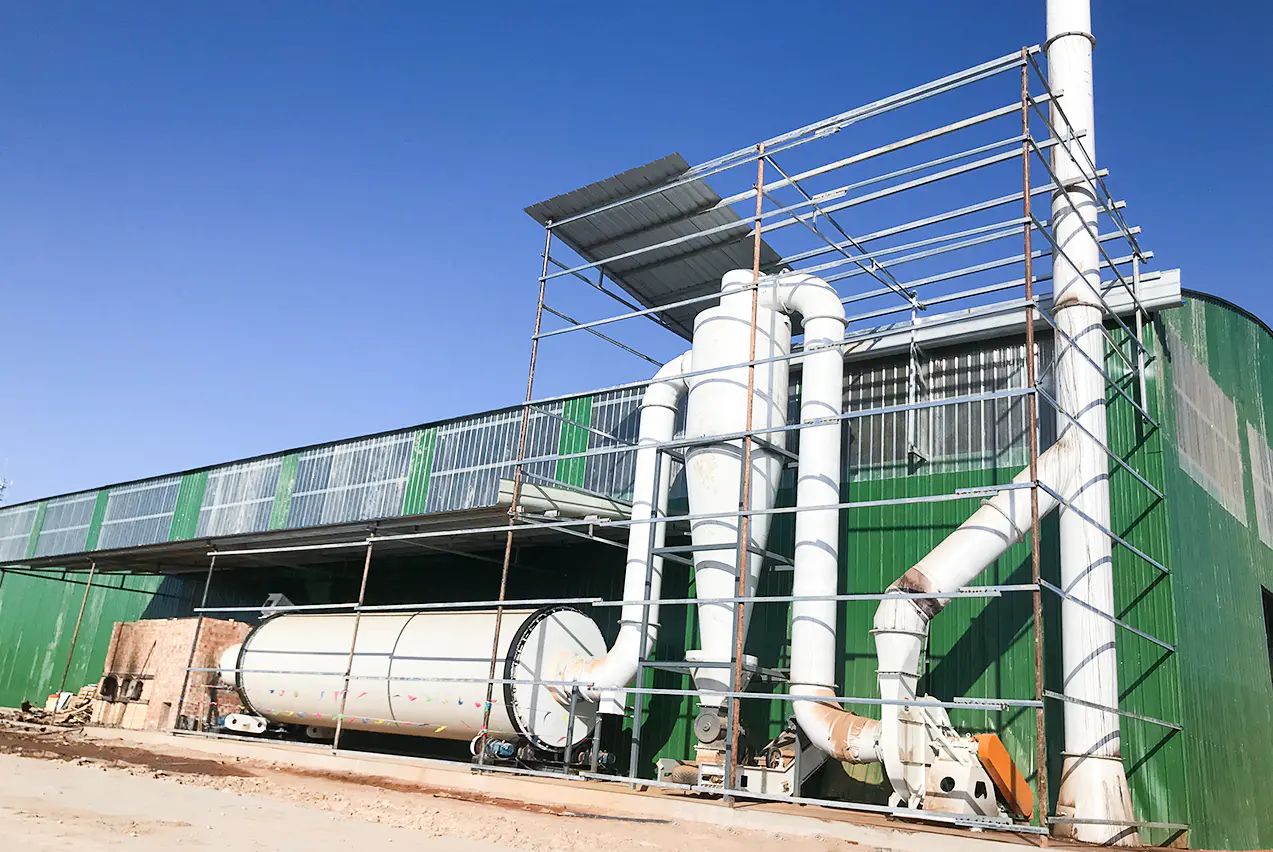
- Moisture management — Raw sawdust often exceeds the 15% moisture threshold required for quality pellet formation. A drum dryer brings moisture to process-compatible levels.
- Fine grinding — A secondary hammer mill stage reduces particle size to the fine, uniform powder that produces dense, low-fines pellets.
- Pelletizing — The conditioned material feeds into the ring die of the pellet mill, where mechanical compression and heat form the cylindrical pellet.
- Cooling — A counter-flow cooler drops pellet temperature and locks in density and durability before packaging or bulk loading.
Kingwood’s wet-feed biomass pellet production lines integrate all five stages in a fully automated, enclosed system — meaning raw, high-moisture sawdust enters at one end and finished, spec-compliant pellets exit at the other. The entire process runs under integrated dust removal, addressing both product quality and workplace safety simultaneously.
Pellet Quality: Meeting International Fuel Standards
The pellets produced on properly configured Kingwood lines meet a demanding set of international benchmarks simultaneously:
| Parameter | Kingwood Output | Standard Reference |
|---|---|---|
| Calorific value | 4,800 kcal/kg | U.S. standard: >2,500 kcal/kg |
| Moisture content | <15% | EU standard: <15% |
| Sulfur content | <0.3% | Japan standard: ≤0.5% |
| Ash content | <18% | ISO standard: <20% |
| Dioxin content | <0.5 ng-TEQ | China GB standard: ≤1.0 ng-TEQ |
All emission indicators from biomass pellet combustion fall below China’s GB13271-2001 national Emission Standard of Air Pollutants for Boilers. For operators sourcing fuel for industrial boiler applications, this compliance profile simplifies regulatory reporting and positions biomass as a defensible alternative to coal in jurisdictions tightening air quality rules.
The carbon released during biomass combustion is biogenic — it was captured by the plant material during growth and is re-released as part of the natural carbon cycle. This is the technical basis for the carbon-neutral classification that underpins biomass’s standing under major renewable energy policies in Europe, North America, and Asia.
Industrial-Scale Deployment: Equipment and Production Line Design
Sawdust pelletization is viable at a range of output scales. Kingwood’s product range covers the full spectrum, from single-mill installations to multi-million-ton integrated lines:
Vertical pellet mills:
- JWZL-420: 1–1.5 TPH — entry-level industrial throughput
- JWZL-688: 2–2.3 TPH
- JWZL-688D: 3–3.5 TPH — dual-ring-die configuration
- JWZL-928: 4–5 TPH
- JWZL-1068: contact Kingwood sales for capacity specification
Horizontal pellet mills:
- JZWH-860: 4–5 TPH — horizontal ring die configuration for operators with specific material or layout requirements
Complete turnkey lines scale to 200,000 metric tons per year. For reference, the 24 TPH wood chip pellet production line commissioned in Vietnam in 2023 demonstrates how multi-mill, integrated Kingwood systems perform at industrial export scale.
A 12 TPH line in Vietnam, commissioned in 2024, returned full capital investment within 23 months — a concrete payback figure derived from real operational data, not modeled projections.
Fuel cost economics reinforce the investment case: biomass pellets deliver a 40–50% cost reduction versus conventional fossil fuels. For high-consumption industrial operators running coal or heavy fuel oil boilers, converting to pellet fuel at this cost differential produces material impact on operating expenditure from the first year of operation.
Engineering Principles That Drive Reliable Output
Kingwood applies its Three-Standardization Framework — Integrated production lines, Dust-Free production lines, and Automated production lines — to every project it designs and commissions. These are not aspirational labels; they are the engineering criteria that determine how a production line is laid out, enclosed, controlled, and maintained.
Integrated means no orphaned equipment islands. Material handling, processing, and packaging are connected in a continuous flow, reducing manual intervention and inter-stage material degradation.
Dust-Free means enclosed processing and integrated dust removal across every stage. Sawdust and fine biomass particles are explosion risks and regulatory liabilities. Enclosed systems protect workers, protect equipment, and protect operating licenses. The dust-free biomass pellet workshop built in Guizhou, China in 2024 illustrates how this pillar is implemented at facility level.
Automated means PLC-controlled process sequencing, automated feed rate management, and remote monitoring capability — reducing labor requirements and producing consistent pellet quality across shifts.
These three pillars together define what separates an industrial pellet production line from a collection of individual machines producing variable-quality output.
Sawdust is a large, underutilized biomass resource. With the correct pellet mill infrastructure — matched to feedstock characteristics, output scale, and market requirements — it becomes a standardized, bankable fuel product. Kingwood has been engineering that infrastructure for 27 years, across more than 2,000 production line projects in 30 countries. The technology is proven. The economics are documented. The question is how quickly your operation can move from waste disposal to fuel production.
FAQ
What raw materials can a pellet mill process besides sawdust?
Modern biomass pellet mills handle a broad feedstock range: wood chips, bark, agricultural straw, rice husks, bamboo residues, and other lignocellulosic materials. Kingwood's wet-feed production lines are specifically designed to accept high-moisture biomass, incorporating crushing, drying, fine grinding, and pelletizing in a fully enclosed, automated sequence.
What are the key quality parameters of industrial biomass pellets?
Industrial-grade biomass pellets produced on Kingwood lines achieve a calorific value of 4,800 kcal/kg, moisture content below 15%, sulfur content below 0.3%, ash content below 18%, and dioxin content below 0.5 ng-TEQ — meeting EU, US, Japanese, and ISO pellet standards simultaneously.
How much can biomass pellets reduce fuel costs compared to coal or gas?
Biomass pellets can reduce fuel costs by 40–50% versus conventional fossil fuels, depending on local energy pricing. A 12 TPH Kingwood wood pellet line installed in Vietnam in 2024 achieved full capital payback within 23 months.
Are biomass pellet emissions compliant with national boiler standards?
Yes. Biomass pellets combusted in properly configured boilers produce all emission indicators below China's GB13271-2001 national Emission Standard of Air Pollutants for Boilers. The carbon released during combustion is part of the natural biogenic carbon cycle, which is why biomass is classified as carbon-neutral under major regulatory frameworks.
What pellet mill models does Kingwood offer and what are their capacities?
Kingwood offers five vertical pellet mill models — JWZL-420 (1–1.5 TPH), JWZL-688 (2–2.3 TPH), JWZL-688D (3–3.5 TPH), JWZL-928 (4–5 TPH), and JWZL-1068 (contact sales for capacity) — plus the horizontal JZWH-860 at 4–5 TPH. Complete turnkey lines scale up to 200,000 metric tons per year output capacity.
What is Kingwood's Three-Standardization Framework and why does it matter for pellet plant operators?
Kingwood's Three-Standardization Framework structures every production line around three engineering pillars: Integrated production lines, Dust-Free production lines, and Automated production lines. For plant operators, this means standardized commissioning, enclosed dust management that meets occupational safety requirements, and reduced labor dependency through automation — directly impacting operating cost and regulatory compliance.
Can a pellet mill operation be set up as a localized, independent energy production unit?
Yes. Pellet mill systems can be installed at or near the source of biomass residue — sawmills, furniture factories, agricultural processing sites — enabling localized feedstock collection and fuel production. This reduces transportation costs, shortens supply chains, and supports energy independence at the regional or facility level.
- Kingwood has planned and designed over 2,000 biomass pellet production line projects across 30 countries since 1999. (2025, Kingwood corporate capability profile, kingwoodpellet.com)
- A 12 TPH wood pellet production line delivered by Kingwood in Vietnam (2024) achieved full investment payback within 23 months of commissioning. (2024, Kingwood project case: vietnam-wood-pellet-line-12-tph-kingwood-payback)