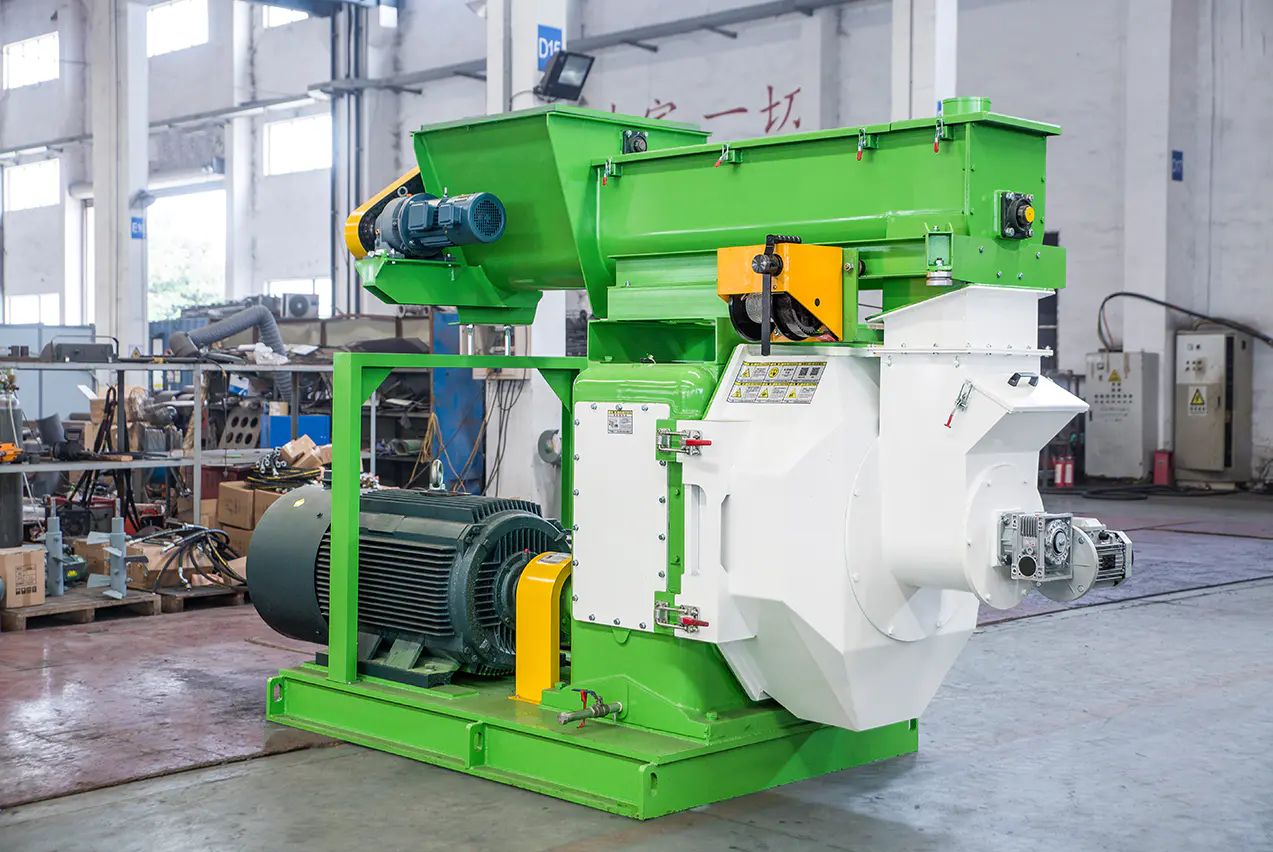
Industrial Wood Waste Crusher Machines: China Manufacturer
Kingwood · May 26, 2026
Wood waste is not a disposal problem — it is an unprocessed feedstock. For biomass pellet producers, sawmill operators, and forestry processors, the question is not whether to process wood residues, but which crushing equipment delivers the throughput, particle consistency, and operational reliability that industrial-scale pelletizing demands. Kingwood, operating from Liyang, Jiangsu Province, has engineered and supplied industrial wood waste crusher machines as integrated components of complete biomass pellet production lines since 1999.
What Industrial Wood Waste Crusher Machines Actually Do
In a wet-feed biomass pellet production line, size reduction is not a single step — it is a two-stage mechanical process. Kingwood’s drum chipper performs coarse reduction of raw input materials: full-length branches, timber offcuts, pallet wood, bark slabs, and logging residues are reduced to chips of defined geometry. The hammer mill then performs fine grinding of those chips — and of sawdust, shavings, and other fine residues — to produce a homogeneous particle fraction suitable for ring die compression.
The critical engineering variable at this stage is particle size distribution. Ring die pellet mills require a consistent, narrow particle size range to achieve pellet density, durability, and calorific output that meet commercial specifications. A drum chipper that produces oversized chips, or a hammer mill with worn screens, will directly degrade pellet quality at the press — increasing fines, raising energy consumption per ton, and reducing die service life. Kingwood’s crusher machines are specified and configured as part of the complete line engineering package, not selected as standalone commodity items.
Input materials routinely processed on Kingwood lines include:
- Hardwood and softwood residues from sawmills and furniture manufacturing
- Logging slash and branches from forestry operations
- Wood-based panel offcuts (particle board, MDF trim)
- Agricultural biomass (corn stover, rice husks, bagasse) where line configuration permits
- High-moisture green wood — handled by the wet-feed line sequence, which dries material after coarse grinding
Engineering Specifications That Drive Industrial Performance
Kingwood crusher machines are designed for continuous-duty industrial operation, not intermittent workshop use. Key engineering parameters that B2B procurement teams should evaluate:
Motor and drive system: High-torque motors sized to maintain rotor speed under variable feed density. Green hardwood and dense tropical species place significantly higher loads on rotor bearings and drive belts than dry softwood residues. Kingwood’s machines are rated for worst-case feedstock, not average conditions.
Wear component design: Hammers, screens, and liners are fabricated from wear-resistant alloy steels. Replacement intervals and service access are engineered into the machine layout — reducing maintenance downtime in continuous production environments where a crusher stoppage propagates immediately to the dryer and pellet mill downstream.
Dust containment: Under Kingwood’s Three-Standardization Framework, all size-reduction equipment is integrated into enclosed, negative-pressure dust collection systems. This is not an optional add-on — it is a standard design requirement. Enclosed crushing eliminates the primary fire ignition risk in wood processing (airborne dust) and ensures compliance with occupational health standards in the EU, China, and export markets.
Throughput scaling: Crusher capacity is matched to the total line design. Kingwood complete lines are engineered for capacities up to 200,000 metric tons per year. A 24 TPH wood chip pellet production line delivered to a client in Vietnam in 2023 illustrates the scale of integration required — crusher capacity, dryer thermal load, and pellet mill ring die specification are all interdependent variables in the line design.
Integration with Complete Biomass Pellet Production Lines
Purchasing a wood waste crusher machine in isolation from the downstream process is an engineering error that generates ongoing operational costs. Particle size from the hammer mill must match the die specification of the pellet mill. Moisture content entering the pellet mill must fall within a defined range — which means the dryer capacity must be matched to the green moisture content of the feed and the throughput of the crusher. These are coupled variables.
Kingwood’s engineering methodology addresses this through complete line design. Over 27 years and more than 2,000 production line projects, Kingwood’s 20-person R&D team has built the process data required to specify crusher, dryer, and pellet mill configurations for specific feedstock species, moisture profiles, and output tonnages.
For procurement teams evaluating equipment for new greenfield lines or capacity expansions, Kingwood provides line design consultation that establishes crusher specifications as part of the complete process flow — not as a separate equipment category. Clients operating complete Kingwood lines have achieved pellet quality outcomes including 4,800 kcal/kg calorific value, moisture below 15%, and emissions compliance with GB13271-2001, enabling market access for both domestic industrial boiler fuel and export sales under EU and ISO pellet standards.
Operational economics are meaningful: biomass pellets produced on Kingwood lines deliver a 40–50% cost reduction compared to equivalent fossil fuel energy inputs — a figure that drives the investment case for industrial-scale wood waste processing in markets where coal and heavy fuel oil remain the baseline comparison.
For specifications on Kingwood’s hammer mill and drum chipper product range, and to review integration options with pellet mill models including the JWZL-928 and JZWH-860, contact Kingwood’s technical sales team. Project case references, including the 12 TPH Vietnam wood pellet line with a 23-month payback, are available for qualified procurement inquiries.
FAQ
What types of wood waste can Kingwood crusher machines process?
Kingwood hammer mills and drum chippers are engineered to handle a broad range of wood waste feedstocks, including offcuts, sawmill residues, branches, stumps, bark, and wet wood chips with high moisture content — making them suitable as the primary size-reduction stage in a wet-feed biomass pellet production line.
How does a wood waste crusher fit into a complete biomass pellet production line?
In Kingwood's integrated wet-feed pellet lines, crushing is the first mechanical stage. The drum chipper performs coarse size reduction of raw timber and large offcuts; the hammer mill then performs fine grinding to achieve the particle size required for ring die pellet mills such as the JWZL-928 or JZWH-860. The line continues through drying, fine grinding, pelletizing, cooling, and packaging — all enclosed and dust-controlled.
What is the maximum production capacity of a Kingwood complete biomass pellet line?
Kingwood designs and supplies complete wet-feed biomass pellet production lines with capacities of up to 200,000 metric tons per year. Individual line configurations are sized to client feedstock volume, species, and moisture profile.
Are Kingwood wood waste crusher machines certified for export markets?
Yes. Kingwood holds CE certification and ISO 9001 quality management certification, and has supplied equipment to clients in more than 30 countries. Machines are engineered for compliance with international safety and performance standards.
What makes Kingwood's Three-Standardization Framework relevant to crusher machine buyers?
The Three-Standardization Framework — Integrated, Dust-Free, and Automated production lines — directly governs how Kingwood integrates crusher machines into full processing lines. Dust-Free design means all size-reduction stages operate within enclosed, negative-pressure dust collection systems, reducing fire risk and meeting occupational health standards.
Can Kingwood customize crusher machine output specifications?
Yes. Kingwood's engineering team configures screen sizes, rotor speeds, and feed arrangements to match downstream pellet mill requirements. With 27 years of R&D and a 20-person technical team, customization is standard practice, not an exception.
What are the biomass fuel quality outcomes from using Kingwood's crusher and pellet line equipment?
Biomass pellets produced on Kingwood lines achieve a calorific value of 4,800 kcal/kg, moisture content below 15%, sulfur content below 0.3%, and ash content below 18% — meeting EU, USA, Japan, and ISO pellet quality standards and complying with China's GB13271-2001 boiler emission standard.
- Kingwood has planned and designed more than 2,000 biomass pellet production line projects since 1999, with total annual biomass fuel output capacity across deployed lines exceeding 10 million metric tons. (2025, Kingwood corporate capability statement, kingwoodpellet.com)
- Global industrial wood pellet demand is projected to reach approximately 50 million metric tons by 2027, driven by coal-to-biomass conversion mandates in the EU, South Korea, and Japan. (2024, IEA Bioenergy Task 40 — Sustainable Biomass Markets and Trade, 2024 edition)